
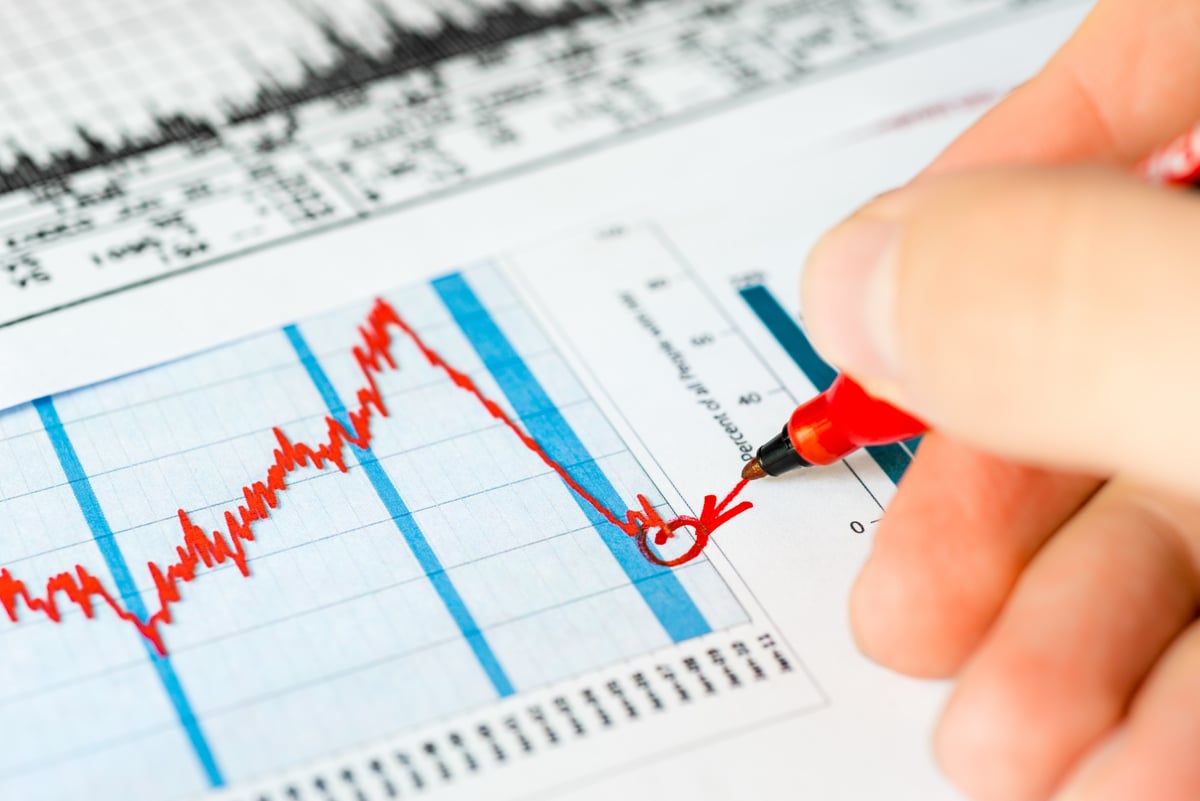
Oil Shock Triggers Bear Market Warning as Gas Hits 4-Year High
Rising geopolitical tensions between the United States and Iran have sent shockwaves through energy markets, pushing gasoline prices to their highest level in four years. With unleaded fuel now averaging $4.11 per gallon, investors are dusting off historical playbooks to assess whether the stock market faces a significant correction. The timing couldn't be more consequential, as major investment banks including Goldman Sachs are raising alarm bells about potential downside risks to equities if energy prices remain elevated.
The current energy crisis has reignited a critical question for portfolio managers: what happens to the S&P 500 when oil prices spike? Historical analysis reveals a sobering pattern that helps explain why markets are now pricing in significant uncertainty.
Historical Precedent and Goldman Sachs' Stark Warning
When gasoline prices have exceeded the $4 per gallon threshold in the past, equity markets have experienced severe strain. According to historical data analyzed by market observers, the S&P 500 has suffered an average decline of 41% during periods when gas prices breach this critical level. This historical precedent has prompted major financial institutions to reassess their outlooks for 2024 and beyond.
Goldman Sachs has been particularly vocal in its warnings, projecting that the S&P 500 could decline to 5,400—representing a 22% decline from current levels. Such a move would officially place the broad market index into bear market territory, defined as a decline of 20% or more from recent highs. The bank's analysis suggests that if oil prices remain elevated and gasoline stays above $4 per gallon, the probability of a significant market downturn increases materially.
Key economic risks cited by analysts include:
- Consumer spending contraction: Higher fuel costs directly reduce discretionary spending power across households
- Manufacturing cost inflation: Transportation and production expenses rise, squeezing profit margins
- Recession triggers: Persistent energy inflation historically precedes economic downturns
- Wage-price spiral potential: Workers demand higher compensation to offset fuel costs, creating inflationary pressure
Market Context: Energy's Outsized Impact on Equity Valuations
The connection between oil prices and stock market performance extends far beyond simple correlation. Energy represents a fundamental input cost across virtually every sector of the economy, from transportation to manufacturing to consumer goods. When oil prices surge unexpectedly due to geopolitical shocks—as opposed to gradual supply-demand adjustments—the market impact tends to be more severe and disruptive.
The current U.S.-Iran tensions represent precisely the type of black swan event that markets struggle to price efficiently. Unlike anticipated increases in oil supply or demand, geopolitical conflicts create uncertainty that extends beyond energy markets into currency valuations, inflation expectations, and central bank policy responses.
Historically, oil shocks have preceded major economic downturns:
- 1973 OPEC embargo: Led to recession and 48% S&P 500 decline
- 1979-1981 Iran Revolution: Triggered stagflation and 27% market decline
- 2008 Financial Crisis: Oil peaked at $147 amid credit collapse
- 2020 Pandemic: Oil turned negative briefly amid demand destruction
The current environment differs in some respects from these historical episodes. The U.S. energy sector has transformed dramatically with the shale revolution, reducing American dependence on foreign oil. However, global supply chains remain vulnerable to disruption, and refineries have consolidated significantly, potentially amplifying price movements.
From a competitive standpoint, energy-intensive sectors face particular pressure. Airlines, trucking companies, and chemical manufacturers all face margin compression when fuel costs spike. Consumer staples companies, which typically weather downturns well, may struggle if elevated energy costs translate into higher input costs that cannot be passed to consumers without damaging volumes.
Investor Implications: Portfolio Risk Management Becomes Critical
For equity investors, the Goldman Sachs projection of a potential 22% S&P 500 decline carries significant portfolio implications. Such a correction would test investor conviction and potentially trigger forced selling from risk-parity strategies and systematic funds with pre-set volatility bands.
The recession risk embedded in current oil prices cannot be dismissed lightly. When gasoline costs exceed $4 per gallon, consumer confidence typically declines, auto purchases drop, and discretionary spending collapses. These dynamics feed directly into corporate earnings, which currently appear to assume continued economic expansion. A recession would likely force significant earnings estimate reductions across sectors.
Fixed income investors face their own dilemma. While a market correction typically benefits bonds as risk appetite deteriorates, recession-driven oil prices also create inflationary pressures that could force the Federal Reserve to maintain higher rates longer than currently anticipated. This dynamic could cap bond gains even as equities decline, reducing portfolio diversification benefits.
Key considerations for portfolio managers:
- Sector rotation: Energy and defensive stocks may outperform during geopolitical stress
- Valuation reset: Elevated price-to-earnings multiples become vulnerable in recession scenarios
- Dividend sustainability: Companies with weak balance sheets may cut dividends if earnings decline 20-30%
- Volatility regime shift: VIX could spike to 40+ levels, requiring hedging reassessment
- Interest rate trajectory: Fed policy divergence from energy-driven inflation could create policy mistakes
Looking Ahead: Energy Markets and Economic Resilience
The critical question facing investors is whether elevated oil prices represent a temporary shock or the beginning of a sustained energy crisis. Current market pricing suggests significant but not catastrophic downside—the S&P 500's recent resilience despite $4+ gasoline suggests some skepticism about the Goldman Sachs bear case.
However, history suggests caution is warranted. The 41% average decline observed when gasoline exceeds $4 per gallon cannot be dismissed as statistical noise. Whether that full historical precedent applies to today's economy remains uncertain, but the directional implications are clear: energy shocks matter enormously for equity returns.
Investors should closely monitor both oil prices and consumer spending data over the coming weeks. If gasoline prices remain above $4 per gallon AND consumer spending begins to deteriorate visibly in real-time data, the probability of the Goldman Sachs scenario increases substantially. Conversely, if diplomatic efforts ease U.S.-Iran tensions or supply responses stabilize prices below $4, the bear case weakens considerably.
The next few months will likely prove pivotal for equity markets. The S&P 500 sits at a critical juncture where energy prices, economic resilience, and monetary policy intersect. Investors would be wise to stress-test portfolios against the 22% downside scenario while remaining alert to the possibility that improved geopolitical conditions could quickly shift sentiment in the opposite direction.