
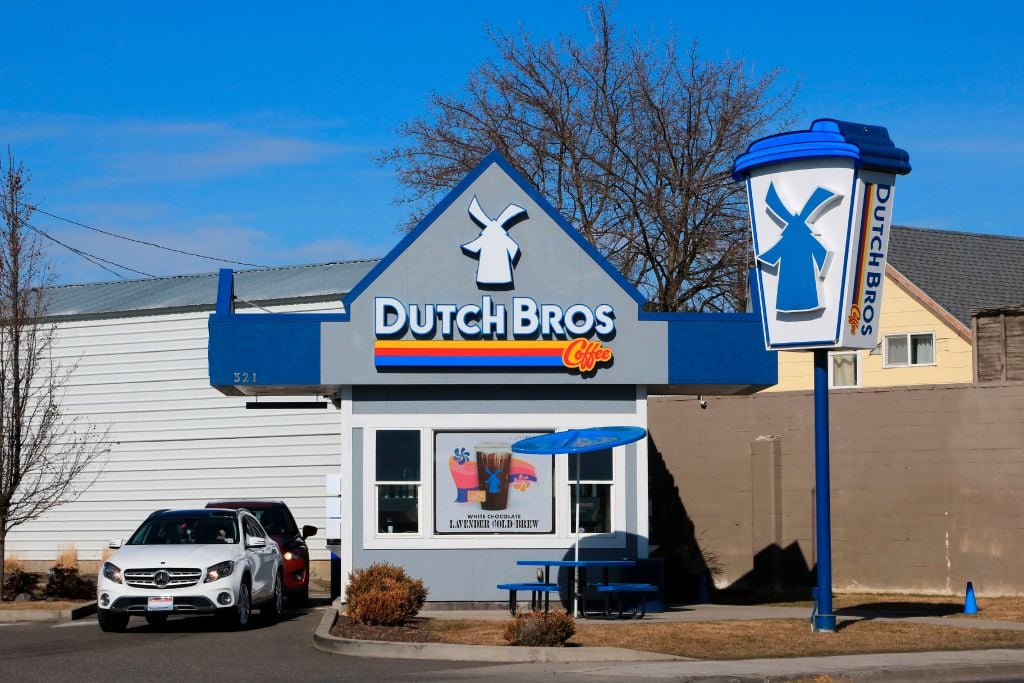
Dutch Bros Stock Down 24% Despite Strong Fundamentals—A Buying Opportunity?
Dutch Bros ($BROS) has experienced a significant pullback over the past three months, with shares falling 24% as macroeconomic headwinds and consumer spending caution weigh on investor sentiment. Yet beneath the surface of this stock price decline lies a company delivering impressive operational performance that stands in stark contrast to broader market concerns about discretionary spending and coffee shop traffic.
The sharp selloff appears disconnected from the company's actual business momentum, raising questions about whether the recent weakness represents a genuine investment opportunity or a warning sign that deserves respect. For investors evaluating whether to accumulate shares at lower prices, understanding the gap between Dutch Bros' market valuation and operational reality becomes crucial.
Strong Financial Performance Amid Market Weakness
Dutch Bros reported 29% revenue growth in recent results, a figure that underscores the company's ability to expand its top line despite a broader consumer environment marked by caution and reduced discretionary spending. More impressively, the company achieved record unit-level economics, with average unit volume (AUV) reaching $2.1 million—a metric that speaks directly to the productivity and profitability of individual store locations.
These unit economics represent a significant competitive advantage in the coffee retail sector. To contextualize this achievement:
- Average unit volume of $2.1 million outperforms both Starbucks and Dunkin, the two largest coffee chains in North America
- Strong unit economics suggest superior brand appeal and customer frequency in Dutch Bros' markets
- Growing AUV indicates pricing power and operational efficiency are both improving simultaneously
- The company's ability to generate higher revenue per location supports margin expansion and justifies future capital allocation decisions
The disconnect between stock price performance and operational metrics suggests that investors may be pricing in more pessimistic scenarios than fundamentals currently warrant. Dutch Bros management has indicated plans for measured expansion rather than aggressive growth, a strategic posture that prioritizes unit quality and profitability over rapid store count increases.
Market Context: Consumer Spending Caution and Valuation Reset
The 24% three-month decline in Dutch Bros shares reflects broader market anxiety about consumer discretionary spending. Early 2026 has seen persistent concerns about credit card debt levels, mortgage rates, and overall consumer purchasing power, creating a headwind for restaurant and beverage stocks across the board. The coffee sector, while relatively resilient during downturns compared to casual dining, is not immune to shifts in consumer behavior and sentiment.
Starbucks ($SBUX) and Dunkin' ($DNKH) have faced similar pressure, though both companies benefit from broader brand recognition and geographic diversification that Dutch Bros is still building. The smaller chain's higher growth rate and expansion into new markets creates both opportunity and risk—investors may be discounting the potential for negative surprises if consumer spending deteriorates further.
Valuation metrics paint an interesting picture amid this selloff. Dutch Bros trades at a PEG ratio of 0.87, a figure that typically indicates a stock is undervalued relative to its growth prospects. A PEG ratio below 1.0 suggests the market may be overly pessimistic about growth durability or underestimating the company's competitive positioning.
Key market context factors include:
- Discretionary spending concerns are creating sector-wide headwinds for beverage and restaurant stocks
- Rising interest rates have increased the cost of capital for expansion and raised discount rates applied to future earnings
- Regional economics in Dutch Bros' footprint may differ from national averages, creating opportunity if markets prove more resilient
- Brand strength among younger consumers provides some buffer against macro weakness, though this demographic is also sensitive to employment and credit conditions
Investor Implications: Risk-Reward at Current Levels
For shareholders and prospective investors, the current valuation presents a classic risk-reward scenario that depends heavily on macro assumptions and faith in management's ability to navigate a potentially weaker consumer environment.
The bull case rests on several pillars:
- Record unit economics demonstrate competitive advantage and operational excellence
- 29% revenue growth in a cautious consumer environment suggests strong brand momentum
- The PEG ratio of 0.87 implies significant upside if the company sustains growth and profitability improves
- Measured expansion plans suggest management is being disciplined about capital allocation, reducing risk of overexpansion
- The company's smaller size relative to Starbucks and Dunkin' provides runway for share gains and geographic expansion
The bear case emphasizes legitimate concerns:
- Further deterioration in consumer spending could pressure store traffic and same-store sales growth
- The company's relative immaturity compared to established competitors creates execution risk
- Expansion into new markets requires operational expertise and capital; failures would be costly
- Valuation recovery depends on sustained growth; any deceleration could trigger further selloffs
For long-term investors with higher risk tolerance, the current valuation combined with strong unit economics and revenue growth creates an asymmetric opportunity—the downside may be limited if consumer spending stabilizes, while upside could be substantial as growth re-accelerates and the market reprices the stock higher.
Shorter-term traders should consider that macro uncertainty could persist, potentially creating additional drawdown risk before a recovery takes hold. Dutch Bros' stock is more volatile than established coffee retailers, reflecting smaller market cap and higher growth expectations.
Looking Forward: Execution and Macro Sensitivity
The coming months will be critical for Dutch Bros' stock trajectory. Management must demonstrate that unit economics remain strong and that new store openings maintain high quality standards. Any stumble on unit volume growth or expansion execution could reinforce bearish sentiment and drive further losses. Conversely, evidence that the company is gaining market share and strengthening its brand position could trigger rapid multiple expansion as macro concerns ease.
Investors considering Dutch Bros at current prices should view this as a longer-term positioning decision rather than a short-term trading opportunity. The company's fundamentals remain compelling, but the macro environment remains genuinely uncertain. A 24% decline over three months has created valuation reset conditions that may reward patient capital willing to tolerate near-term volatility in exchange for exposure to a high-quality, fast-growing beverage company with unit economics that rival the industry's largest players.