
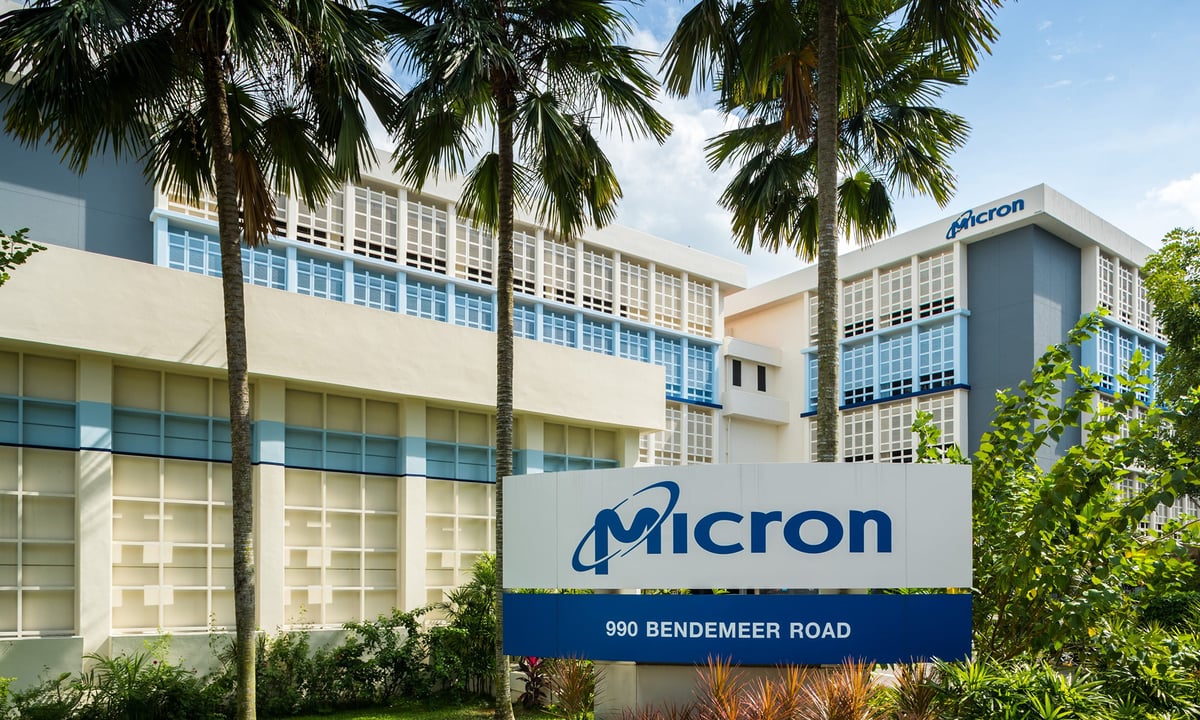
The Micron Sell-Off: Separating Hype from Hardware Reality
Micron Technology ($MU) shares experienced a significant sell-off following Google's introduction of TurboQuant, a memory compression algorithm designed to reduce memory requirements for artificial intelligence models. Investors rushed to the exits on concerns that software optimizations could diminish demand for high-bandwidth memory (HBM)—a critical component that powers Nvidia's ($NVDA) flagship AI accelerators. However, this market panic appears premature and overlooks a fundamental technical reality: memory compression at the software level does not eliminate the underlying hardware requirements that make modern AI systems function. The algorithm represents optimization, not obsolescence, and may ultimately prove bullish for memory manufacturers rather than bearish.
The core anxiety driving the sell-off centers on a straightforward narrative: if Google can compress AI models to require less memory, then fewer memory chips will be needed for AI workloads. This logic, while superficially compelling, misunderstands the architectural requirements of contemporary artificial intelligence systems. Nvidia's GPU infrastructure depends on sustained high-bandwidth memory throughput to move data between processors and memory hierarchies at rates measured in terabytes per second. TurboQuant is fundamentally a compression algorithm—a software optimization layer—that doesn't fundamentally alter the physics of data movement or the bandwidth requirements that define GPU performance bottlenecks.
Why HBM Demand Remains Non-Negotiable
The relationship between memory compression and actual chip demand merits closer examination. TurboQuant achieves efficiency gains by quantizing neural network models—essentially reducing the precision of numerical representations within AI models—which can decrease the total data footprint. However, this optimization operates at the model architecture level, not the memory bandwidth level where Nvidia's HBM components prove indispensable.
Consider the practical deployment scenario: even if Google successfully reduces model size by 30%, 40%, or even 50%, the remaining model still requires the same memory bandwidth characteristics to process inference or training workloads. The GPU must still move tensor data between compute cores and memory at maximum speed to achieve acceptable latency and throughput. Memory bandwidth constraints represent a fundamental physics limitation—the number of bits per second that can flow through a memory interface—that no software algorithm can magically circumvent.
Moreover, TurboQuant represents a single optimization technique from one organization. The broader AI ecosystem remains focused on:
- Scaling model parameters: Larger models generally outperform smaller, compressed versions in capability and accuracy
- Batch processing: Production AI deployments typically process multiple requests simultaneously, multiplying memory requirements
- Real-time inference: Latency-sensitive applications demand maximum bandwidth to minimize response times
- Training operations: Training workloads consume vastly more memory bandwidth than inference, and this segment continues expanding
These countervailing forces suggest that efficiency gains from TurboQuant—while valuable—will not meaningfully reduce aggregate HBM demand in the critical near-term period where Micron and competitors like SK Hynix and Samsung depend on revenue growth.
Market Context: The Broader AI Infrastructure Thesis
The market's visceral reaction to Google's announcement reflects broader anxiety about AI infrastructure profitability sustainability. Since Nvidia began dominating GPU markets in 2023, investors have grappled with a persistent question: at what point do efficiency gains render existing hardware commoditized or obsolete? The TurboQuant news triggered this latent fear, causing portfolio managers to reassess memory chip manufacturers' long-term growth trajectories.
This context matters because memory represents the second major revenue stream in AI infrastructure after compute. Investors have built substantial positions in Micron, SK Hynix, and Samsung based on the thesis that the AI revolution would create durable demand for premium HBM products. A credible threat to this demand would necessarily lower terminal value estimates and justify valuation compression.
However, the competitive landscape suggests reason for skepticism about such existential threats. Nvidia's GPU architecture improvements and new accelerator launches typically drive increased memory bandwidth requirements, not decreased ones. Historical precedent shows that each generation of GPU acceleration raises the bar for memory performance. The Blackwell architecture and successor generations will likely demand more memory bandwidth, not less, as training and inference workloads scale.
Additionally, TurboQuant and similar optimizations may actually accelerate AI adoption by lowering total cost of ownership for end users. If Google's algorithm enables more efficient inference at scale, this could drive broader deployment of AI applications across industries—ultimately expanding the total addressable market for memory chips.
Investor Implications: A Buying Opportunity?
For investors holding or considering positions in Micron ($MU), the recent sell-off presents a potential opportunity rather than a warning sign. The market has extrapolated from a single software optimization technique to an entire thesis about hardware obsolescence—a logical leap that examination of technical fundamentals doesn't support.
The key metrics to monitor going forward include:
- HBM production capacity utilization: If Micron maintains pricing power and capacity utilization above 90%, the TurboQuant thesis loses credibility
- Nvidia GPU shipment acceleration: Each new GPU generation drives memory demand; shipment growth directly correlates to Micron revenue growth
- Industry memory bandwidth benchmarks: Actual deployments may show that TurboQuant has minimal impact on aggregate memory requirements
- Competitor commentary: Guidance from SK Hynix and Samsung will clarify whether the sell-off reflects genuine demand destruction or temporary panic
The sell-off likely represents a classic case of market overreaction to partial information. Micron's exposure to AI infrastructure remains fundamentally sound because the underlying technical requirements that drive memory demand haven't changed. Software optimizations can improve efficiency within constraints, but they cannot eliminate the constraints themselves.
For the broader market, the Micron reaction underscores investor anxiety about AI infrastructure durability and profitability. These are legitimate questions, but they require evidence more substantial than a single compression algorithm. Until actual GPU deployments show measurable reductions in memory bandwidth requirements, the thesis that TurboQuant represents a meaningful threat to Micron's business appears overstated.
The company's long-term value proposition rests on its position within the critical infrastructure layer supporting generative AI. Unless the industry fundamentally rethinks memory architecture—a prospect that remains years away at minimum—Micron should benefit from sustained AI infrastructure investment cycles. The current sell-off may well prove a buying opportunity for disciplined investors willing to look past short-term sentiment.