
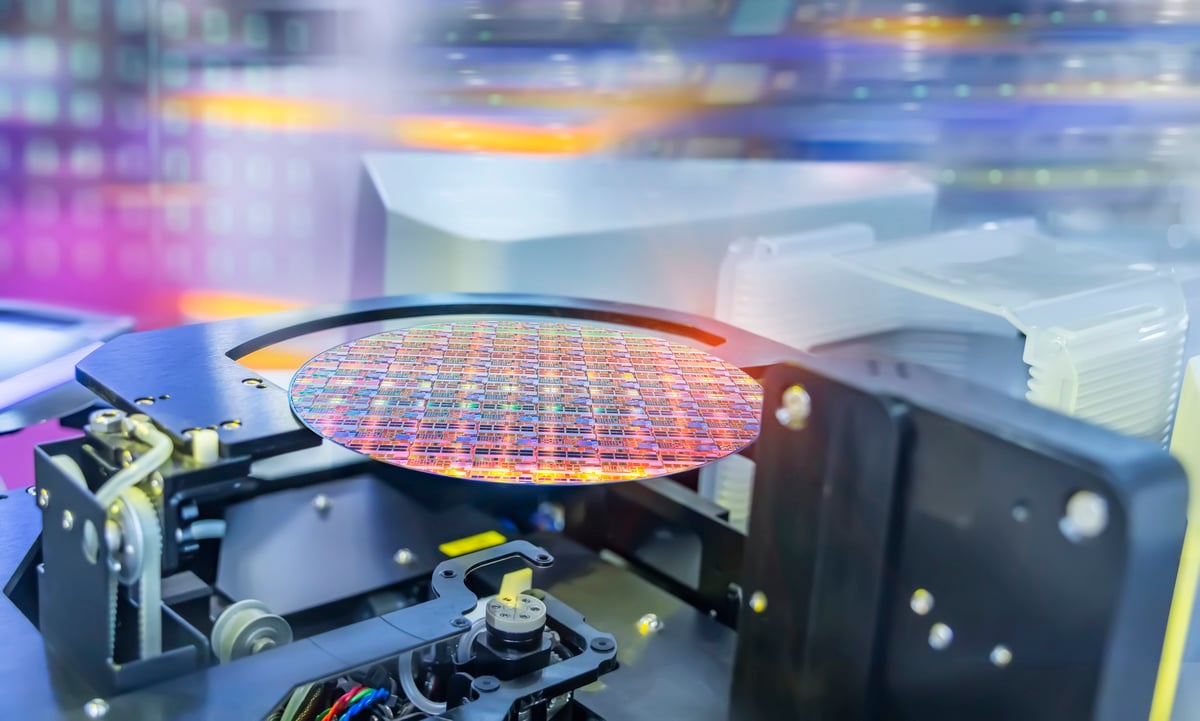
Taiwan Semiconductor's Critical Role in Global AI Infrastructure

The Motley FoolThe Motley Fool
|||1 min read
Key Takeaway

TSMC is critical to global AI infrastructure, manufacturing cutting-edge processors for major tech firms. Its foundry model and advanced capabilities position it to benefit from sustained AI demand.

Taiwan Semiconductor's Critical Role in Global AI Infrastructure

Taiwan Semiconductor Manufacturing Company (TSMC) has established itself as an indispensable component of the artificial intelligence supply chain, despite receiving less public attention than the consumer-facing technology companies it serves. Founded in 1987 by Morris Chang, TSMC pioneered the foundry business model, which separated chip design from manufacturing and allowed specialized companies to focus on their core competencies. This operational framework has become the industry standard, enabling design firms to concentrate on innovation while TSMC manages the complex and capital-intensive manufacturing process.

The company's strategic position has become increasingly valuable as major technology firms—including those developing AI applications and infrastructure—depend on TSMC's advanced manufacturing capabilities. TSMC's dominance in leading-edge semiconductor production positions it to benefit from sustained demand driven by digital transformation initiatives, cloud computing expansion, and the proliferation of artificial intelligence applications across industries.

As enterprise and consumer adoption of AI technologies accelerates, TSMC's role as the primary manufacturer of cutting-edge processors remains central to the broader technology ecosystem's growth trajectory. The company's ability to scale production while maintaining technological advancement makes it a key component of any comprehensive analysis of AI infrastructure and semiconductor industry dynamics.

Source: The Motley Fool

Back to newsPublished Feb 23

Related Coverage

The Motley Fool

Arm's Audacious CPU Gambit: $25B Revenue Target and Market Leadership Bid by 2030

Arm predicts CPU market leadership by 2030, with $15B CPU revenue and $25B total revenue by fiscal 2031, but supply constraints currently limit order fulfillment despite $2B in AGI CPU demand.

AMDMETATSM
GlobeNewswire Inc.

Computer Vision in Healthcare Poised for 7x Growth, Reaching $33.4B by 2036

Global healthcare computer vision market projected to surge from $4.37B in 2026 to $33.4B by 2036, driven by AI diagnostics and radiologist shortages.

NVDAMSFTGOOG
The Motley Fool

TSMC's Hidden Dominance: Why Wall Street Sleeps on Chip Industry's Quiet Monopoly

TSMC dominates chip fabrication with 70% market share and 90% of advanced semiconductors, posting 35% Q1 2026 revenue growth. Despite trading at Apple's valuation multiple, growth potential may be underappreciated.

NVDAAAPLTSM
The Motley Fool

Amazon's $200B 2026 Bet: Is AI Spending Justified or Excessive?

Amazon plans $200B in 2026 capital spending, mostly on AI. Investors question whether the massive outlays will deliver adequate returns amid uncertain AI monetization.

AMZN
Benzinga

Goldman Sachs Sees Nvidia's $1T AI Revenue Target as Conservative

Goldman Sachs raises Nvidia estimates 12%, sees $1T AI revenue target as conservative. Q1 projection hits $80B, above consensus.

NVDATSMSOXX
GlobeNewswire Inc.

KraneShares AI ETF Takes Strategic Stake in Autonomous Driving Leader Nuro

KraneShares' AI ETF invests in autonomous vehicle leader Nuro, which has logged 1.7M autonomous miles with zero accidents and holds NHTSA exemption.

UBERLCIDKOID