
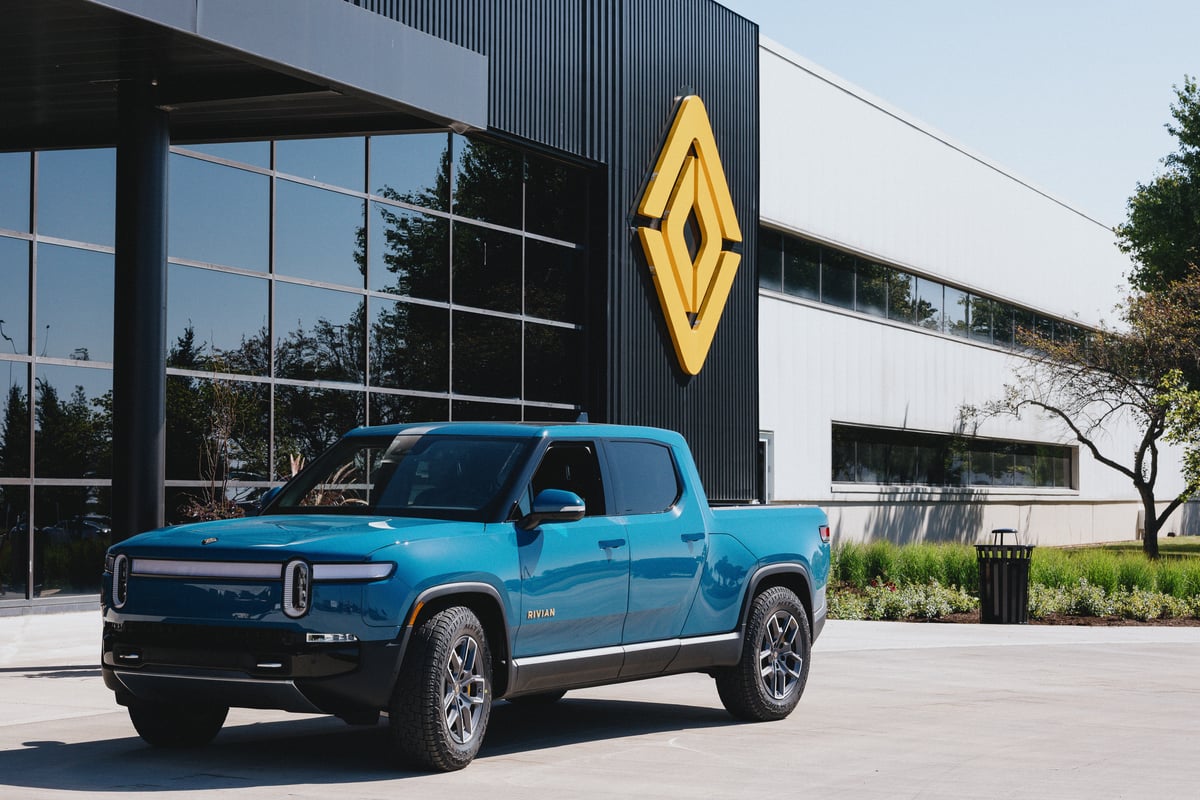
A Rare Valuation Disconnect in EV Market
Rivian Automotive faces a critical inflection point as the electric vehicle startup prepares to report second-quarter earnings on April 30, with analysts suggesting the dramatic stock decline may have created a genuine investment opportunity. The company's shares have collapsed approximately 80% from their initial public offering price, a staggering decline that has left the once-celebrated EV manufacturer trading at a significant discount relative to both historical valuations and industry peers. This dramatic repricing raises a fundamental question for investors: has the market overcorrected, or does the steep decline reflect genuine operational challenges? The timing of the earnings announcement coincides with several potentially transformative catalysts that could reshape investor sentiment and validate the bull case for the Rivian turnaround story.
The valuation disparity between Rivian and Tesla ($TSLA) has become stark. While Tesla commands a valuation of approximately 13x sales, reflecting its market dominance and profitability trajectory, Rivian trades at roughly 3x sales—a discount that appears extreme even accounting for Tesla's superior operational execution and scale advantages. This valuation gap suggests that current market pricing may be excessively pessimistic, particularly if the company successfully executes on its near-term growth initiatives. For contrarian investors, the mathematical argument for mean reversion becomes compelling when paired with concrete operational milestones expected in the coming months.
Multiple Growth Catalysts Converge
The confluence of positive developments surrounding Rivian extends beyond simple valuation metrics. Several strategic initiatives are positioned to capture investor attention and potentially reignite growth narratives:
-
R2 SUV Launch: The introduction of Rivian's lower-priced R2 sport utility vehicle represents a critical expansion into more accessible price points, broadening the addressable market significantly beyond the premium R1T and R1S segments that have dominated the company's current lineup
-
Uber Partnership: Uber Technologies ($UBER) committed $1.25 billion in investment capital while simultaneously establishing a robotaxi partnership, validating Rivian's technology roadmap and providing meaningful capital injection for operations and development
-
Volkswagen Collaboration: The German automotive giant's autonomous vehicle collaboration with Rivian signals substantial technological credibility and provides pathway to mainstream adoption of Rivian's autonomous driving capabilities across global markets
-
Delivery Confirmations: Q2 earnings announcement offers opportunity for management to confirm or raise delivery targets, providing quantifiable evidence of production ramp success
-
Insider Accumulation: Recent insider buying patterns suggest management conviction in the business fundamentals and potential recovery trajectory
Each of these catalysts carries independent weight, but collectively they paint a picture of a company transitioning from speculative startup to validated platform with institutional backing and clear paths to commercialization.
The Competitive and Market Landscape
Rivian's position within the broader EV ecosystem requires careful contextualization. The electric vehicle market has matured considerably since Rivian's 2021 IPO, with established competitors like Tesla, Ford ($F), and General Motors ($GM) all bringing significant manufacturing capacity and brand equity to EV segments. Meanwhile, emerging competitors continue multiplying, from legacy automakers diversifying into electrification to new entrants attempting to replicate Rivian's original value proposition.
However, Rivian's particular positioning—luxury adventure-focused EVs with technology partnerships spanning ride-sharing and autonomous vehicles—occupies a differentiated niche. The company's early delivery success with the R1T and R1S demonstrated consumer appetite for premium electric trucks and SUVs, validating the fundamental market thesis. The question is execution at scale and profitability, not market existence.
The Uber and Volkswagen partnerships are particularly significant because they provide external validation of Rivian's technology and reduce the company's capital burden for future development. Strategic partnerships from tier-one companies carry implicit endorsement of technical viability and commercial potential—endorsements that institutional capital markets take seriously.
What This Means for Investors and Market Dynamics
The investment thesis for Rivian at current valuations rests on several interconnected premises. First, that the 80% stock decline has priced in worst-case scenarios regarding production ramp-up, capital efficiency, and market reception of future products. Second, that Q2 earnings delivery of positive catalysts will trigger algorithmic and institutional rebalancing toward the name. Third, that the discount to Tesla's multiple represents mispricing rather than fundamental inferiority, particularly given the company's partnerships with Uber and Volkswagen that Tesla lacks.
For risk-tolerant investors with conviction in EV market persistence and Rivian's technology differentiation, the risk-reward asymmetry appears favorable. The company trades near multi-year lows with specific, measurable catalysts approaching. If even one or two of the anticipated announcements materialize positively, technical and fundamental support could combine to drive meaningful valuation recovery.
Conversely, investors should recognize the substantive risks. Execution delays, disappointing delivery numbers, or deteriorating cash burn metrics could accelerate the decline further. Rivian remains unprofitable with finite cash reserves, and capital markets remain skeptical of unprofitable manufacturing companies regardless of long-term potential. The announcement of disappointing guidance or reduced delivery targets could trigger another leg down in the stock price.
Forward Outlook and Investor Positioning
As April 30 approaches, Rivian's Q2 earnings announcement will serve as a crucial test of whether the company's strategic partnerships and product roadmap can translate into operational metrics that justify even a modest recovery from current depressed valuations. The convergence of the R2 launch timeline, Uber's confirmed capital commitment, and Volkswagen's collaboration gives management concrete material to work with in repositioning the investment narrative.
For investors contemplating Rivian positioning, the optimal strategy may be to await April 30 earnings for concrete data points rather than speculating on announcements. However, investors with genuine conviction in the company's long-term prospects and sufficient risk tolerance to endure further volatility may find current valuations sufficiently discounted to justify selective accumulation ahead of the earnings report. The mathematical case is compelling: at 3x sales versus 13x for Tesla, Rivian offers either genuine alpha potential or justifies its discount for very specific, identifiable reasons. Q2 earnings will reveal which narrative prevails.