
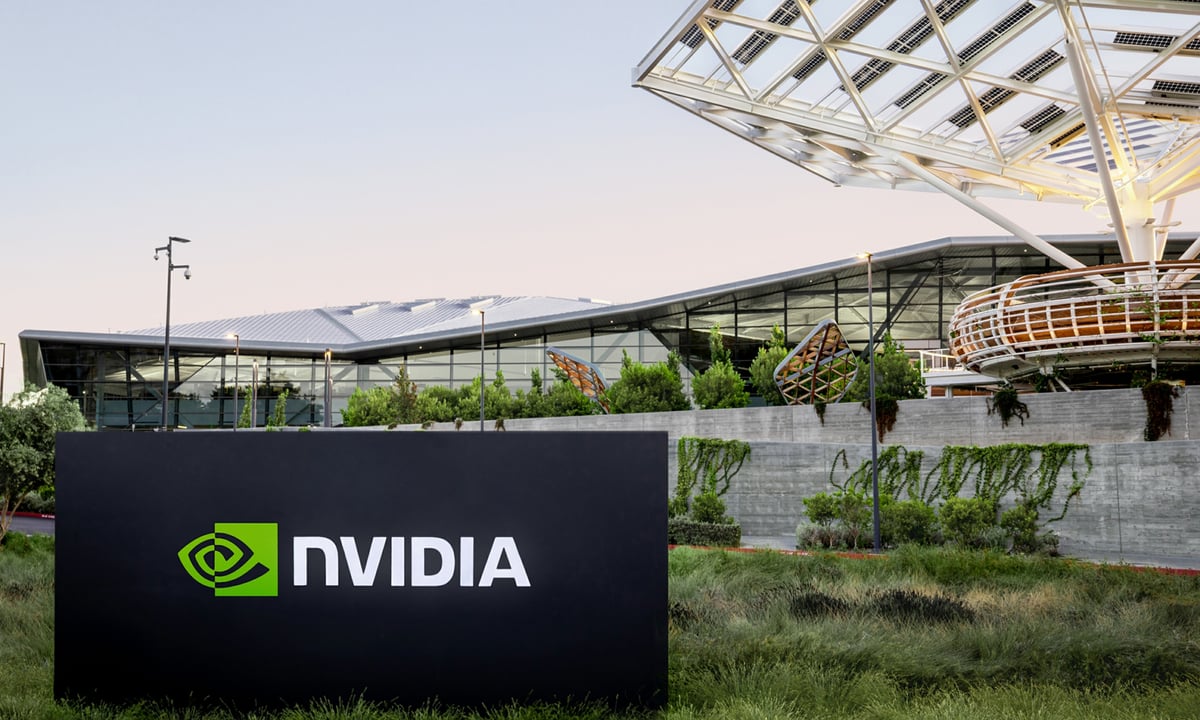
Tech Sector Slump Creates Opportunity: Morningstar Backs $NVDA, $GOOGL Buys
As investors rotate capital away from technology stocks, market analysis firm Morningstar argues that the sector has become fundamentally undervalued, presenting a compelling buying opportunity for growth-focused investors. Two semiconductor and artificial intelligence leaders—Nvidia ($NVDA) and Alphabet ($GOOGL)—are highlighted as particularly attractive entry points given their dominant positioning in the next wave of AI-driven innovation.
The thesis centers on a critical disconnect: while technology stocks have faced selling pressure from rotation-minded investors seeking value elsewhere, the underlying growth catalysts for AI-focused companies remain intact and accelerating. Morningstar's analysis suggests that market pessimism has created a window for contrarian investors to accumulate positions in structurally advantaged firms before a potential rerating occurs.
The Case for $NVDA and $GOOGL in the AI Era
Nvidia is positioned at the epicenter of two major technology inflection points: agentic AI and physical AI adoption. Agentic AI systems—autonomous agents capable of executing complex tasks with minimal human intervention—represent a fundamental shift in how artificial intelligence is deployed across enterprise and consumer applications. Physical AI extends these capabilities into robotics, autonomous vehicles, and IoT devices, creating a multiplicative effect on demand for Nvidia's data center processors and specialized AI chips.
The company's competitive moat in GPU manufacturing remains formidable, with its CUDA software ecosystem creating significant switching costs for customers. As enterprises and hyperscalers scale AI infrastructure deployment, Nvidia's revenue trajectory appears insulated from near-term sector rotation dynamics. The company's ability to capture value across the AI supply chain—from training infrastructure to inference optimization—positions it as a structural beneficiary regardless of which specific AI applications gain traction.
Alphabet, meanwhile, is leveraging artificial intelligence to turbocharge its core advertising business, where it commands roughly 30% global market share. The company's search advertising platform, augmented by AI-powered query understanding and real-time bidding optimization, is generating incremental advertiser demand and improved targeting efficiency. More significantly, Alphabet's broader AI initiatives—including Gemini multimodal models and AI-powered productivity tools—create optionality across Search, YouTube, Cloud, and emerging verticals.
The digital advertising market itself remains in early-stage growth, with digital spending projected to capture an increasing share of total advertising budgets. By embedding AI capabilities deeper into its ad-tech stack, Alphabet can expand margins while capturing incremental share from traditional media and smaller digital competitors lacking comparable AI resources.
Market Context: Sector Rotation and Valuation Dynamics
The current tech sector rotation reflects a broader market dynamic where investors are reassessing growth narratives after an extraordinary two-year rally. Rising interest rates, concerns about AI implementation timelines, and profit-taking from elevated valuations have created headwinds for technology stocks broadly. However, Morningstar's thesis suggests that indiscriminate selling has swept up genuinely undervalued AI-enabled businesses alongside genuinely overvalued unprofitable growth companies.
The technology sector, despite recent weakness, represents roughly 28% of the S&P 500 by market capitalization, making it impossible to avoid entirely in broad market investing. Within tech, clear bifurcation exists: mature software-as-a-service companies with slowing growth trade at reasonable valuations, while AI infrastructure leaders and dominant platforms face valuation pressure despite accelerating fundamentals.
Key context points on the competitive landscape:
- GPU market competition: While AMD and Intel continue developing competitive alternatives, Nvidia's architectural advantages and software ecosystem dominance remain substantial barriers to share loss
- AI advertising evolution: Meta ($META), Amazon ($AMZN), and emerging startups also pursue AI-enhanced advertising, but Alphabet's scale and data advantages provide defensive positioning
- Sector concentration risk: Both $NVDA and $GOOGL carry concentration in semiconductor and advertising respectively, though diversification across segments mitigates single-point-of-failure risk
Regulatory scrutiny of Alphabet's advertising practices and potential restrictions on data usage represent ongoing risks, though the company's scale provides resources to navigate compliance requirements.
Investor Implications: Entry Points and Time Horizon Considerations
For growth-oriented investors, the combination of sector rotation-driven valuations and accelerating AI fundamentals creates a favorable risk-reward dynamic. Morningstar's recommendation to deploy capital into $NVDA and $GOOGL assumes a multi-year time horizon where AI adoption curves inflect upward sharply, justifying current and higher valuations.
Key considerations for investors evaluating this thesis:
- Entry valuation: Both stocks remain well above their 52-week lows but below 2021 peak valuations, creating a middle-ground entry point
- Earnings visibility: Nvidia's forward guidance and data center demand metrics provide near-term visibility; Alphabet's advertising growth is tied to macro conditions and advertiser confidence
- Capital allocation: Both companies generate substantial free cash flow, enabling share buybacks, dividends, and R&D investment—defensive characteristics alongside growth exposure
- Portfolio construction: These names are already significant holdings in growth portfolios; sizing allocation depends on existing concentration and risk tolerance
The rotation out of technology reflects investor sentiment, but sentiment can reverse sharply when growth narratives re-accelerate. Investors who accumulated positions during rotation-driven weakness could capture significant upside if AI-driven earnings growth materializes as expected over the coming 24-36 months.
For institutions and individual investors managing long-term portfolios, the case hinges on whether agentic AI and physical AI adoption will generate the revenue and earnings inflection currently priced into semiconductor and cloud infrastructure stocks. If execution meets expectations, current selling could represent a gift to long-term investors.
Looking Ahead
The technology sector's current vulnerability creates tactical opportunities within a longer-term growth thesis. Morningstar's focus on Nvidia and Alphabet reflects a belief that the winners in artificial intelligence have been incorrectly grouped with the broader tech sector losers during this rotation cycle. As evidence of AI adoption accelerates and translates into measurable revenue and earnings growth, market rerating likely follows. The question for investors is whether they possess conviction—and capital—to deploy during periods of sector-wide pessimism.