
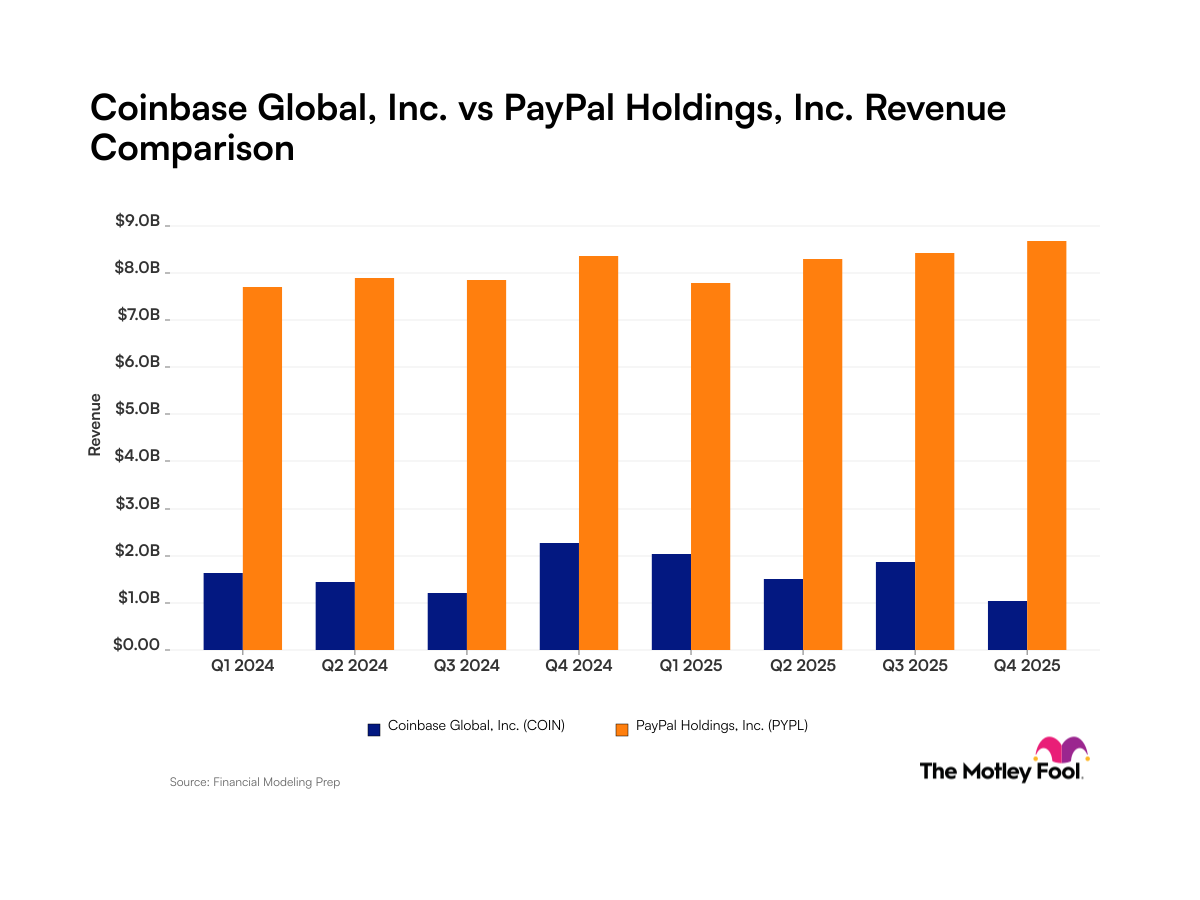
Divergent Paths in Digital Finance: Volatility vs. Stability
Coinbase ($COIN) and PayPal ($PYPL) represent two fundamentally different approaches to the evolving digital payments and cryptocurrency landscape. While PayPal has built a fortress of consistent, profitable revenue generation, Coinbase has embraced the inherent volatility of cryptocurrency markets—a bet that has paradoxically rewarded investors with superior stock performance since 2023, despite the exchange's erratic earnings trajectory. This divergence raises critical questions about the future of digital finance and which business model will ultimately prevail as the industry matures.
The financial profiles of these two companies tell starkly different stories. PayPal operates with a larger, more diversified revenue base that has proven resilient through multiple market cycles, delivering positive profit margins and predictable quarterly results. In contrast, Coinbase posts inconsistent quarterly results with negative profit margins, its financial performance directly tethered to cryptocurrency trading volume and market sentiment. When Bitcoin rallies and crypto markets surge, Coinbase flourishes; when crypto enthusiasm wanes, the exchange struggles. This boom-and-bust dynamic has historically made Coinbase a riskier investment proposition on paper.
Yet the stock market has rewarded Coinbase's volatility handsomely. Since 2023, $COIN has significantly outperformed PayPal, suggesting investors believe the upside potential from cryptocurrency adoption and trading growth outweighs the operational inconsistency. This performance gap reflects a fundamental bet on whether digital assets represent a transformational shift in finance or merely a speculative asset class.
Key Details: The Numbers Behind the Narrative
The operational metrics reveal the stark contrast between these competitors:
- PayPal maintains a substantially larger and more stable revenue base, insulated from crypto market gyrations
- Coinbase exhibits significant revenue volatility directly correlated with cryptocurrency trading activity
- Coinbase has posted negative profit margins across recent quarters, reflecting the cost-intensive nature of trading exchange operations
- PayPal consistently delivers positive profitability, demonstrating the strength of its diversified digital payments ecosystem
- Quarterly results for Coinbase swing dramatically based on crypto market conditions, creating unpredictability for forecasters
- PayPal provides investors with visibility into earnings and cash flow generation
This financial instability at Coinbase stems directly from its core business model: the exchange generates revenue primarily through trading fees, which collapse when crypto markets enter bear phases. When daily active traders decline and trading volumes plummet, Coinbase's top and bottom lines suffer accordingly. PayPal, by contrast, earns through transaction processing fees across a vast merchant network and consumer payment volume, sources far less sensitive to any single asset class's performance.
Market Context: Industry Dynamics and Competitive Landscape
The broader digital payments and cryptocurrency sectors are undergoing profound transformation. PayPal has long dominated mainstream digital payments, but faces intensifying competition from fintech disruptors, traditional banks entering the space, and alternative payment rails. The company's recent leadership transition signals recognition that accelerating growth requires strategic repositioning and potentially bolder bets on emerging technologies.
Coinbase, meanwhile, operates in a sector where regulatory clarity has been chronically absent. The potential passage of the CLARITY Act—legislation designed to establish a regulatory framework for cryptocurrency trading and custody—could fundamentally alter the company's operating environment. Clearer rules might reduce compliance costs and risk, potentially unlocking margin expansion and stabilizing revenue patterns. Conversely, restrictive regulations could constrain growth.
The competitive landscape differs markedly. PayPal faces competition from established payment networks (Visa, Mastercard), digital wallets (Apple Pay, Google Pay), and rising fintech challengers. Coinbase competes primarily with other cryptocurrency exchanges (Kraken, Gemini, international platforms) and increasingly with traditional brokerages offering crypto trading (Fidelity, Charles Schwab) and payment processors integrating crypto services.
Crypto market cycles heavily influence Coinbase's prospects. During the 2021 bull market, the exchange posted record revenues and profitability. The 2022-2023 bear market devastated results. As crypto markets recovered in 2024, Coinbase's financial performance rebounded alongside Bitcoin's price appreciation, demonstrating the inescapable linkage between the company's fortunes and asset price movements.
PayPal's expansion into cryptocurrency and blockchain services—including staking, custody, and crypto payments—represents an attempt to bridge both worlds. However, crypto remains a modest portion of total revenue, allowing the core payments business to shield shareholders from crypto volatility.
Investor Implications: Betting on Growth vs. Stability
For investors, the choice between Coinbase and PayPal encapsulates a fundamental risk-return tradeoff. Coinbase investors are betting that:
- Cryptocurrency adoption will continue accelerating, driving trading volumes higher
- Regulatory clarity will improve operating margins and reduce legal uncertainty
- Expansion into new asset classes and services will diversify revenue beyond trading
- The company's superior stock performance reflects justified optimism about crypto's mainstream adoption
PayPal investors, conversely, accept lower growth expectations in exchange for:
- Predictable cash flows and profitability
- Diversified revenue sources less vulnerable to any single market's volatility
- Established market position and network effects
- Lower execution risk relative to unproven growth strategies
The divergent performance trajectories since 2023 suggest the market has repriced risk and opportunity. Coinbase's stock appreciation despite operational inconsistency implies investors believe the bull thesis: that crypto adoption accelerates, regulation improves, and trading volumes normalize at substantially higher levels than historical averages.
PayPal's future depends critically on whether new leadership can credibly articulate and execute a growth acceleration strategy. The company's stable cash generation provides capital for acquisitions, technology investments, or strategic pivots. However, if PayPal cannot reignite growth momentum, its stability becomes less valuable—investors can obtain stable returns from less cyclical, lower-risk assets.
Coinbase's risk is equally binary: continued bear markets in crypto or restrictive regulatory outcomes could devastate valuations. The company's thin or negative margins mean it cannot easily sustain business during extended crypto downturns. However, if the bull thesis plays out, current valuations may appear cheap in retrospect.
Looking Ahead: The Verdict Depends on Crypto's Future
The Coinbase versus PayPal narrative ultimately hinges on a single macro bet: the future prominence of cryptocurrency and decentralized digital assets. Coinbase has chosen to concentrate its chips on this outcome, accepting volatility as the price of exposure to upside if crypto adoption explodes. PayPal is hedging—maintaining a stable, profitable core while dipping toes into crypto and blockchain—a strategy that limits downside but may cap upside.
The CLARITY Act represents a potential inflection point. Regulatory clarity could validate Coinbase's business model and provide margin expansion—a catalyst for the bull thesis. Conversely, restrictive outcomes could vindicate PayPal's more conservative positioning.
For now, the stock market has rendered its judgment: Coinbase's superior performance since 2023 suggests investors believe the crypto bull case is back in favor and that the company's volatility is temporary rather than structural. Whether that conviction proves justified will determine which company emerges as the better long-term investment.