
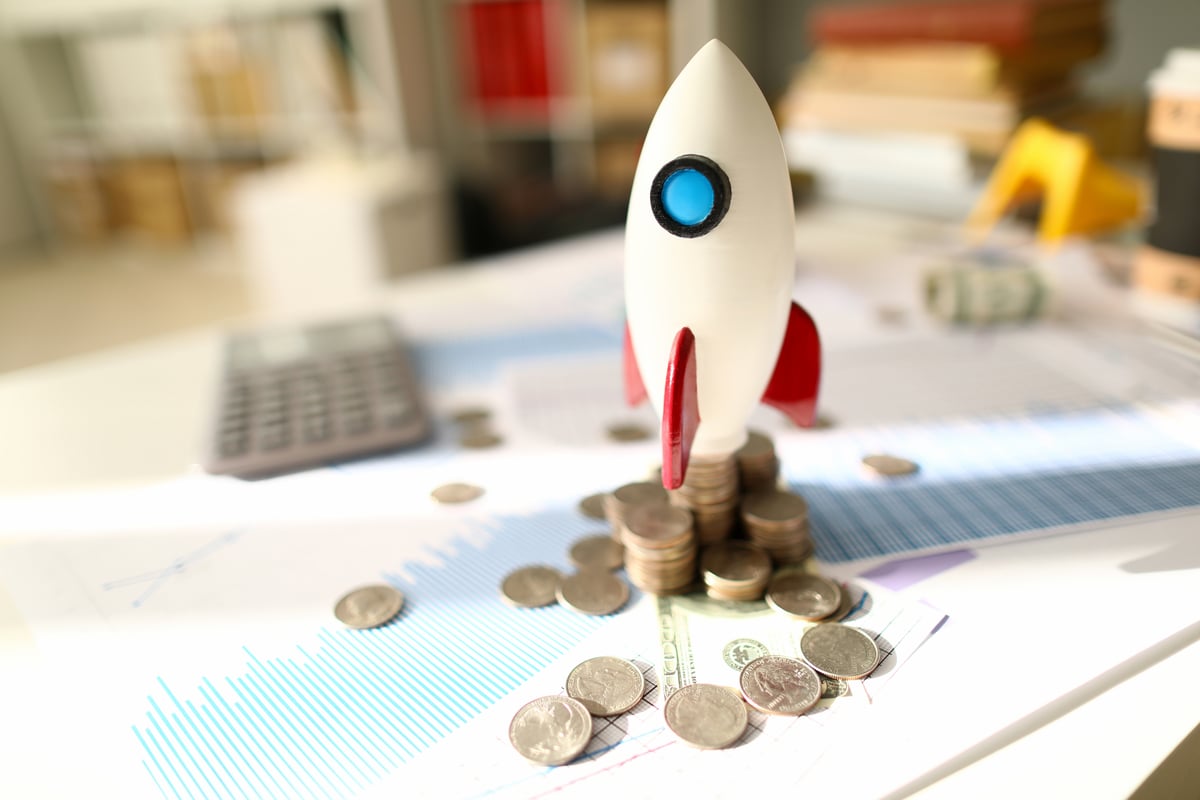
The Mega-IPO Nobody's Discussing
SpaceX is poised to execute what could rank as the largest initial public offering in financial history, with a projected valuation of $1.75 trillion and a planned capital raise of $75 billion. While the aerospace and satellite communications company has captured headlines for its technological achievements and ambitious goals, a critical financial metric is flying under the radar: historical precedent suggests that mega-IPOs of this magnitude routinely lose approximately 10% of their value within six months of going public—a decline that could eviscerate up to $175 billion in market capitalization for SpaceX.
This sobering statistical reality presents a stark contrast to the optimism surrounding the private spaceflight company's trajectory. SpaceX demonstrated profitability in 2025, operates within massive addressable markets spanning satellite internet, launch services, and national security contracts, and boasts a proven business model under founder Elon Musk's leadership. Yet the historical patterns of ultra-large IPOs suggest that even fundamentally strong companies face significant valuation headwinds upon entering public markets.
Key Details: The Numbers and the Pattern
The $1.75 trillion valuation would position SpaceX's IPO among the most consequential capital-raising events in modern financial history. The $75 billion capital raise itself represents an enormous sum, yet the critical concern centers on post-IPO performance rather than the offering itself.
Historical analysis of mega-IPOs reveals a consistent pattern:
- Approximately 10% average decline within six months of IPO among large offerings
- Applied to SpaceX's anticipated market cap: potential $175 billion value destruction
- This would occur despite underlying business fundamentals remaining intact
- The decline reflects typical post-IPO market dynamics rather than operational deterioration
SpaceX's 2025 profitability demonstrates the company has achieved a critical milestone that many pre-IPO enterprises struggle to reach. The company generates revenue across multiple high-margin segments, including commercial launch services, the Starlink satellite internet constellation, and government contracts with the Department of Defense and NASA. These diversified revenue streams provide structural support for the valuation.
However, the sheer size of a $1.75 trillion valuation creates unique dynamics. The company would immediately rank among the largest publicly traded corporations globally, competing for investor attention and capital allocation against established mega-cap technology firms like $AAPL, $MSFT, and $NVDA. This transition from a concentrated private ownership structure to broad public market participation typically triggers volatility.
Market Context: The IPO Environment and Competitive Dynamics
The aerospace and commercial spaceflight sector has undergone dramatic transformation over the past decade. SpaceX has established dominant market position in commercial launch services, capturing approximately 60% of global orbital launch capacity. The Starlink constellation represents the largest active satellite constellation globally, with over 6,000 operational satellites and continued aggressive deployment schedules.
The broader aerospace and defense sector currently trades at valuations ranging from 8-15x EBITDA, depending on growth prospects and margin profiles. SpaceX's implied valuation multiples would likely exceed historical sector benchmarks, creating potential tension between market expectations and trading reality post-IPO.
Key market factors influencing SpaceX's IPO reception include:
- Regulatory environment: FAA licensing, export controls on space technology, and national security considerations affect long-term growth
- Competitive landscape: Blue Origin's New Shepard and New Glenn programs, alongside traditional aerospace contractors, represent emerging competition
- Customer concentration: Heavy reliance on Starlink revenue and government contracts creates dependency concentration
- Technology execution risk: Continued Starship development, full reusability achievement, and rapid iteration capabilities
- Geopolitical factors: International satellite market dynamics, debris mitigation regulations, and spectrum competition
Historical precedent shows that IPO performance correlates weakly with long-term business fundamentals. Companies including Facebook (now $META), Google (now $GOOGL), and Amazon ($AMZN) experienced volatility in their first trading periods despite transformative business models. More recent mega-cap IPOs, including Saudi Aramco, demonstrate that even profitable, cash-generative enterprises face initial valuation adjustments upon public market entry.
Investor Implications: Risk and Opportunity
For prospective SpaceX shareholders, the historical 10% six-month decline warning carries material significance. A $175 billion decrease in valuation would represent a substantial loss in purchasing power, even though underlying business operations might remain intact or improve.
The IPO mechanics that drive this pattern include:
- Lockup expirations: Early investors converting holdings to public shares, increasing float and potential selling pressure
- Index inclusion: Tracking fund requirements necessitating capital deployment independent of valuation considerations
- Valuation normalization: Market reassessment as private valuations transition to public market pricing
- Profit-taking: Early momentum traders closing positions after initial pop
- Macro conditions: Broader market sentiment, interest rate environment, and risk asset appetite
However, the six-month timeframe represents just the immediate post-IPO period. Investors with longer time horizons may view initial volatility as an opportunity rather than a warning. SpaceX's addressable markets remain enormous: global satellite launch demand exceeds $100 billion annually, Starlink's broadband potential touches billions of consumers, and national security spending on space capabilities continues expanding.
The profitability demonstrated in 2025 distinguishes SpaceX from many pre-IPO technology companies that offer growth without earnings. This profitability creates a fundamental distinction from purely speculative IPO offerings. The company generates actual cash flows supporting valuation, reducing the risk of catastrophic value destruction versus cash-burn scenarios.
Institutional investors and sophisticated market participants should incorporate the historical mega-IPO pattern into their analytical frameworks. The pattern suggests positioning for potential six-month volatility rather than assuming linear price appreciation from IPO pricing. Smaller retail investors should carefully evaluate their risk tolerance relative to potential near-term drawdowns, even as long-term business prospects appear compelling.
Forward Outlook: Historical Lessons and Future Valuations
The $175 billion potential value erosion represents a historical reality check for one of the most anticipated IPOs in market history. While SpaceX possesses genuine competitive advantages, proven profitability, and enormous addressable markets, the company cannot escape the gravitational force of mega-IPO historical patterns.
Investors should prepare for volatility without interpreting it as fundamental deterioration. The six-month milestone carries significance not because it predicts permanent value loss, but because it represents a statistical probability derived from decades of IPO performance data. SpaceX's trajectory beyond that initial period will depend on execution against guidance, market conditions, and broader technology sector sentiment.
The real story investors should focus on—beyond the eye-catching $1.75 trillion valuation—centers on whether SpaceX can maintain growth, margins, and capital efficiency while navigating public market expectations. That narrative will ultimately determine whether the initial six-month volatility represents a buying opportunity or a warning sign of overvaluation. History suggests preparation for both scenarios represents prudent investor positioning.