
Lucid's 67% Stock Collapse Exposes EV Startup's Path to Profitability Crisis
Lucid Group ($LCID) has become a cautionary tale for electric vehicle investors, with its stock declining 67% over the past 12 months as the once-celebrated EV startup grapples with a deteriorating financial position and mounting market skepticism. Despite securing fresh capital infusions from ride-sharing giant Uber and Saudi Arabia's sovereign wealth fund, the company continues to hemorrhage value as fundamental questions about its business viability remain unresolved. The dramatic stock decline underscores the brutal realities facing capital-intensive EV manufacturers: without a clear path to profitability or positive gross margins, investor patience—particularly in a rising interest rate environment—evaporates quickly.
The Profitability Problem and Manufacturing Delays
Lucid's stock deterioration reflects a company caught in a profoundly difficult position. The startup has never achieved profitability, nor has it demonstrated positive gross margins—a critical benchmark that separates viable automakers from cash-burning ventures. This performance is particularly damaging because the company has been operating since 2007 (in various iterations) and began commercial production in 2021, making years of losses increasingly difficult for investors to justify.
The timing of these losses has compounded market concerns:
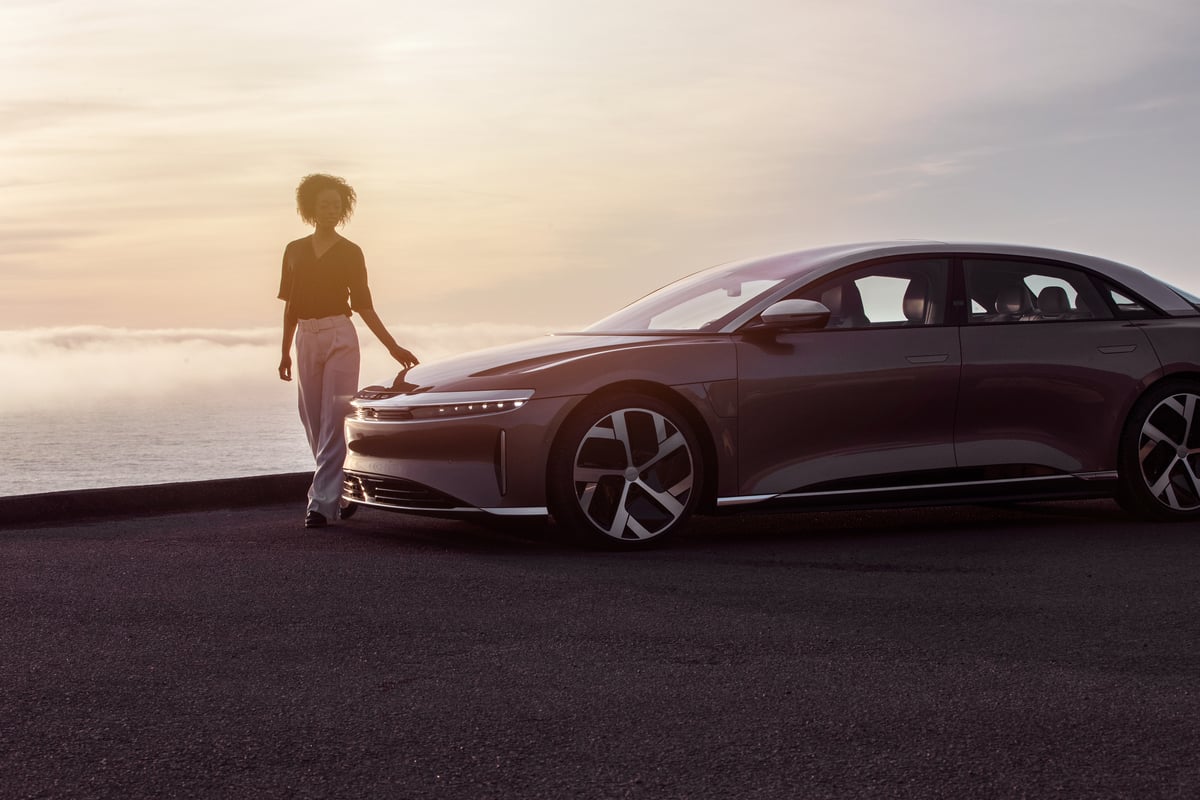
- No path to positive unit economics: Despite producing the luxury Lucid Air sedan, the company struggles with manufacturing costs exceeding revenue per vehicle
- Delayed mass-market models: The affordable model lineup—critical for scaling production and reaching breakeven—continues to slip further into the future
- Persistent cash burn: The company's ability to fund operations depends entirely on external capital rather than business operations
- Production constraints: Limited manufacturing capacity at its Arizona plant restricts revenue growth potential
The absence of an affordable vehicle launch represents perhaps the most significant investor concern. Lucid's luxury-focused strategy, while generating some revenue, cannot sustain the company long-term. Mass-market EV demand remains the true growth story in automotive, and Lucid's delayed entry into this segment suggests execution challenges that go beyond simple manufacturing ramp-up issues.
Capital Raises Fail to Restore Confidence
In an attempt to address mounting cash burn concerns, Lucid has secured additional funding from two high-profile sources: Uber and Saudi Arabia's Public Investment Fund (PIF). However, these capital infusions have failed to reverse the stock's downward trajectory, suggesting investors view fresh funding as merely extending the runway rather than solving structural business problems.
The Uber investment is particularly noteworthy, as the ride-sharing platform has signaled commitment to electrifying its fleet. However, securing an anchor customer for future production does not solve Lucid's immediate profitability crisis or address whether the company can manufacture vehicles at cost-competitive prices.
Saudi Arabia's continued investment through PIF—already the company's largest shareholder—represents strategic capital preservation rather than validation of Lucid's business model. The sovereign wealth fund's willingness to continue supporting Lucid may reflect geopolitical considerations and Saudi Arabia's broader EV ambitions, rather than traditional financial return expectations.
Market Context: The Brutal EV Shakeout
Lucid's struggles must be understood within the broader context of the electric vehicle market's maturation. The sector that once seemed to offer unlimited upside potential has become increasingly competitive and unforgiving:
- Established OEM competition intensifies: Traditional automakers including Tesla ($TSLA), Ford ($F), General Motors ($GM), and international players have launched competitive EV offerings with established supply chains and manufacturing expertise
- Rising interest rates penalize cash-burning startups: Higher financing costs make it increasingly expensive for unprofitable companies to raise capital
- Consumer demand proves selective: EV buyers prioritize value, range, and brand reliability—advantages held by established manufacturers
- Gross margin pressure across the sector: Even profitable EV makers face margin compression as battery costs remain elevated and competition intensifies
Within this landscape, Rivian ($RIVN)—often mentioned as an alternative for EV investors—faces similar challenges but maintains advantages in brand positioning (luxury adventure vehicles) and customer preorders. However, Rivian likewise faces profitability pressures and delayed production ramps, suggesting the EV startup sector broadly remains in precarious financial territory.
Investor Implications and Forward-Looking Outlook
Lucid's 67% stock decline carries important implications for equity investors assessing EV sector opportunities:
For current Lucid shareholders: The stock decline reflects rational market repricing of a company with no clear profitability timeline and a business model dependent on continuous external capital. The absence of positive gross margins indicates the company loses money on every vehicle sold—a mathematically unsustainable situation regardless of capital raised.
For broader EV investors: Lucid's deterioration illustrates why diversification across proven battery manufacturers, EV component suppliers, and established automaker EV divisions may offer better risk-adjusted returns than pure-play EV startups. Companies like Tesla, with demonstrated profitability and positive margins, command market premiums for good reason.
For macro observers: The EV startup sector's struggles highlight the capital intensity and execution difficulty of automotive manufacturing. Simply having technology or ambitious goals proves insufficient; successful automakers require manufacturing excellence, supply chain optimization, and ruthless cost discipline—capabilities Lucid has yet to demonstrate.
The critical question for Lucid's future hinges on whether the company can achieve two critical milestones: (1) launching its affordable model at acceptable production volumes, and (2) demonstrating positive unit economics at scale. Until management achieves these objectives, the stock likely remains vulnerable to further declines.
Conclusion
Lucid Group's 67% stock decline represents more than typical startup volatility; it reflects fundamental questions about the company's business viability. Without profitability, positive gross margins, or a clear mass-market strategy, the company remains a speculative bet dependent entirely on continued access to capital. While fresh funding from Uber and Saudi Arabia's PIF extends Lucid's operational runway, it does not resolve the underlying economics that make the business model problematic. Investors considering exposure to the EV sector would be wise to focus on companies demonstrating positive unit economics and clear paths to sustained profitability—characteristics notably absent from Lucid's current financial position. The next 12-24 months will prove critical in determining whether Lucid can execute its turnaround narrative or become a cautionary tale in the EV market's inevitable shakeout.