
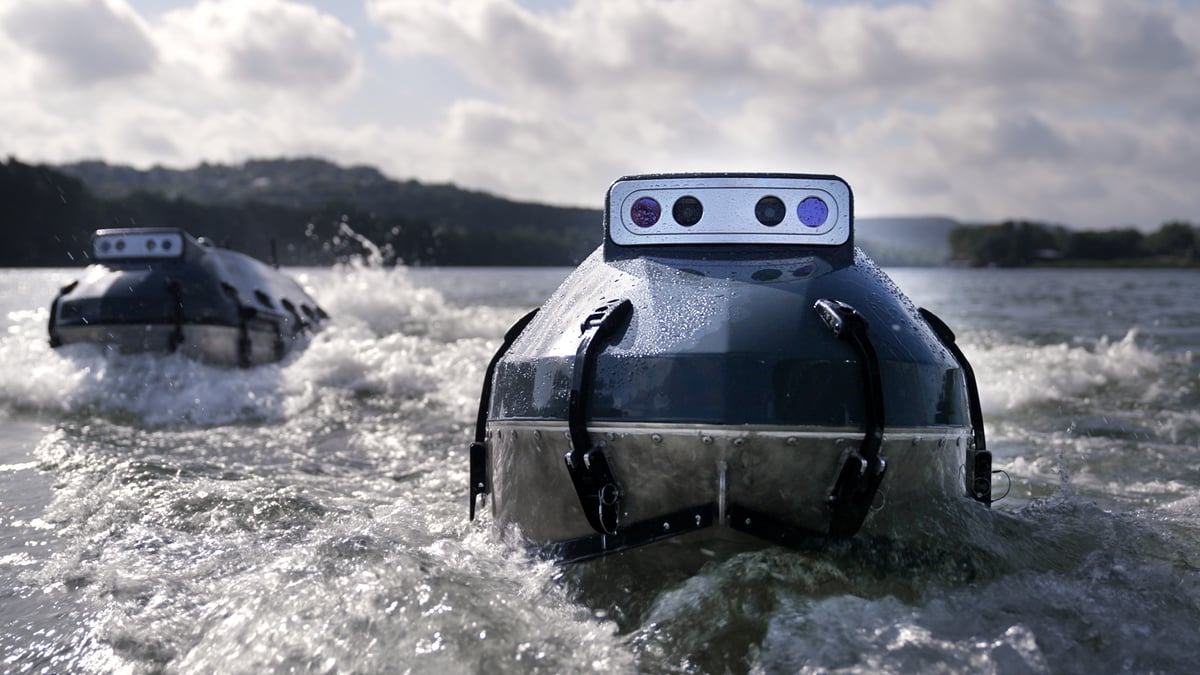
The Rise of Robotic Warfare
Saronic, a privately-held defense technology company specializing in uncrewed autonomous warships, has secured $1.75 billion in funding at a valuation of $9.25 billion, positioning itself as a critical player in the Pentagon's shift toward autonomous naval capabilities. The milestone funding round comes on the heels of a $392 million U.S. Navy contract win, signaling accelerating government investment in autonomous maritime systems as geopolitical tensions and technological advancement reshape naval warfare doctrine.
The funding underscores a dramatic transformation in defense procurement, where artificial intelligence and robotics are reshaping how military planners envision future combat operations. Saronic's success reflects broader industry momentum toward autonomous systems that can operate with minimal human intervention, reducing risk to personnel while expanding operational capabilities. With the new capital, the company plans to aggressively scale production of its flagship platform, the 180-foot Marauder, an autonomous vessel capable of carrying cruise missiles and conducting extended maritime operations independently.
The Marauder and Autonomous Naval Systems
The Marauder represents a significant advancement in unmanned naval technology. Key specifications and capabilities include:
- Length: 180 feet, enabling substantial payload capacity
- Armament: Designed to carry cruise missiles and advanced sensor suites
- Operation: Autonomous capabilities reduce crew requirements and operational costs
- Mission Profile: Extended-range maritime patrol, surveillance, and strike operations
- Production Timeline: Saronic plans substantial scaling of manufacturing capacity
The $392 million Navy contract validates the technological approach and provides the critical proof-of-concept that the Pentagon is willing to commit substantial capital to autonomous vessels. This contract serves as both a financial milestone and a strategic endorsement, likely to accelerate adoption across the U.S. military and allied navies. The contract volume suggests the Navy views autonomous surface vessels not as experimental platforms but as operational necessities for 21st-century naval strategy.
The timing is significant. As the U.S. military pivots toward great power competition with China and Russia, the Navy has emphasized distributed operations and unmanned systems as force multipliers. The Marauder's range and autonomous capabilities align directly with this strategic doctrine, offering commanders the ability to project power across vast ocean areas without risking crewed vessels in contested environments.
Market Context and Competitive Landscape
Saronic's valuation and funding success reflect a broader defense technology boom, particularly in autonomous systems. The global military robotics market is experiencing compound annual growth rates in the double digits, driven by:
- Technological maturation of AI and autonomous navigation systems
- Geopolitical tensions creating urgent demand for advanced capabilities
- Cost economics that favor unmanned systems over crewed alternatives
- Regulatory advancement enabling autonomous operations in military contexts
- Private capital influx into defense technology startups
While Saronic operates in a relatively nascent sector, it faces indirect competition from traditional defense contractors including Lockheed Martin, Huntington Ingalls Industries (HII), and General Dynamics, all of which have invested in autonomous naval programs. However, Saronic's specialized focus and demonstrated Navy contract success position it uniquely among pure-play autonomous warship developers.
The broader defense sector has benefited from increased government spending driven by the Biden administration's emphasis on military modernization and Indo-Pacific security concerns. Defense budgets globally are rising, with particular emphasis on advanced technologies rather than traditional platforms. This creates a tailwind for innovative companies like Saronic that address genuine strategic priorities.
Investor Implications and IPO Prospects
The $1.75 billion funding round at a $9.25 billion valuation creates a compelling investment profile ahead of a potential public offering. Several factors make Saronic an attractive acquisition or IPO candidate:
- Proven customer base: A $392 million Navy contract provides visibility into recurring revenue
- Scalable technology: Autonomous vessels represent a large and growing market segment
- Government backing: Pentagon endorsement reduces market risk and provides strategic support
- Defense sector momentum: Public markets have rewarded defense innovators generously
- Valuation support: The $9.25 billion valuation likely reflects strong investor demand and exit expectations
The original summary indicates an IPO "may be forthcoming as demand for shares grows," suggesting company leadership is evaluating public market timing. Recent precedents in defense technology IPOs, including the spate of SPAC deals in the sector over recent years, demonstrate sustained investor appetite for innovative defense companies with legitimate government contracts and clear paths to profitability.
For potential shareholders, Saronic represents exposure to multiple tailwinds: autonomous technology adoption, increased defense spending, naval modernization, and geopolitical risk premium. However, investors should monitor execution risks around production scaling, potential supply chain challenges, and the company's ability to secure additional contracts beyond the current Navy award.
The $1.75 billion funding round suggests late-stage maturity and probable near-term liquidity events for existing shareholders. Venture capital and growth equity firms backing Saronic typically have 5-7 year exit timelines, making a 2024-2025 IPO window plausible. This would position Saronic within a wave of defense technology companies accessing public markets during a period of elevated geopolitical risk and defense budget expansion.
Looking Forward
Saronic's transformation from defense startup to $9.25 billion company with major Navy contracts exemplifies how specialized technology companies addressing genuine government needs can achieve rapid scale and valuation growth. The $1.75 billion funding round and aggressive production scaling plans suggest the company believes demand for autonomous warships will accelerate meaningfully over the next 3-5 years. As the company executes on production commitments and potentially pursues international customers among U.S. allies, its valuation and market significance will likely continue expanding. Whether through private capital or eventual public markets, Saronic appears positioned to become a significant player in defense technology infrastructure for decades to come.