
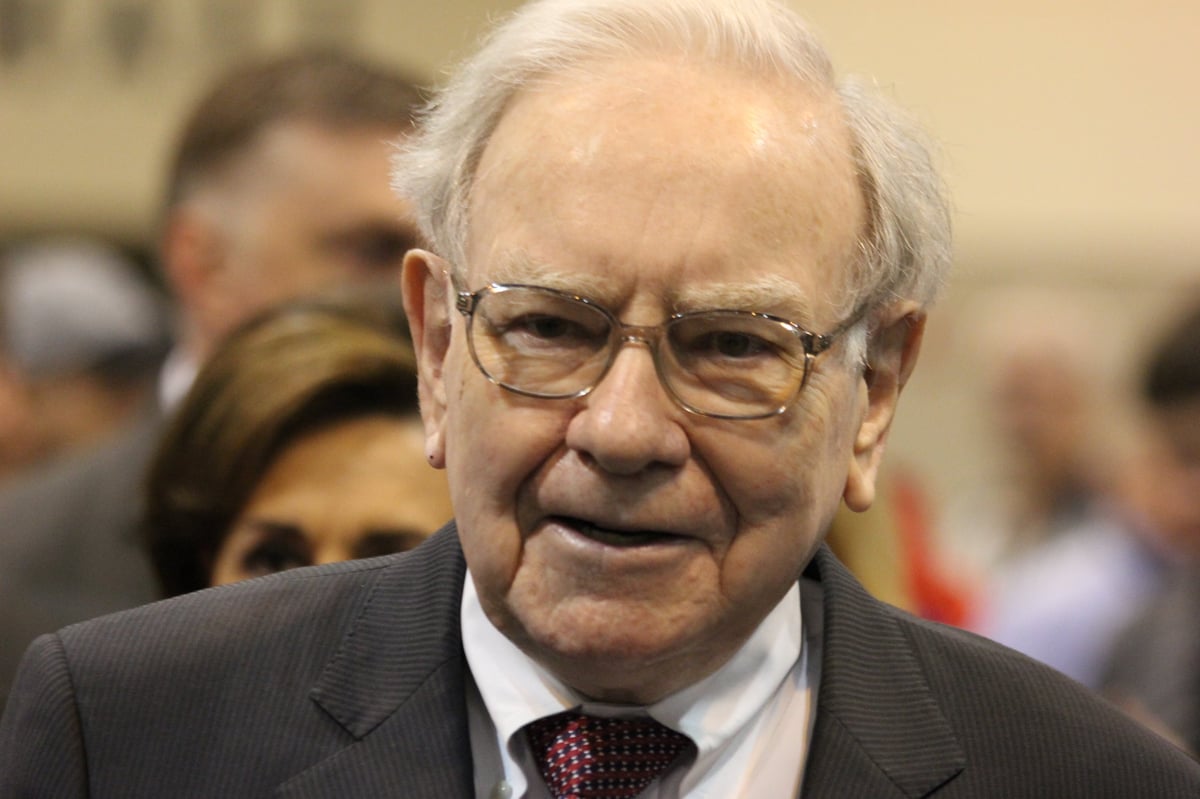
Buffett's $370B War Chest Signals Skepticism as S&P 500 Valuations Remain Elevated
Warren Buffett is not convinced that current market conditions present compelling investment opportunities, even as the S&P 500 experienced a 4.6% decline at the end of the first quarter of 2026. Despite this pullback, Berkshire Hathaway continues to accumulate an unprecedented cash position exceeding $370 billion, signaling the legendary investor's persistent caution about valuations and his reluctance to deploy capital at prevailing price levels. The Oracle of Omaha's measured approach stands in stark contrast to the broader market narrative, raising critical questions about whether recent declines represent genuine correction opportunities or merely modest adjustments in an overvalued market.
Unprecedented Cash Accumulation Amid Selective Selling
The most striking indicator of Buffett's current market sentiment is Berkshire Hathaway's continued net selling position—disposing of more equities than it acquires while simultaneously building the largest cash reserve in the company's history. Several key metrics illuminate this defensive posture:
- Cash position: Over $370 billion in liquid reserves
- Trading activity: Net seller of stocks throughout the period
- Market benchmark: S&P 500 declined 4.6% in Q1 2026
- Valuation multiple: S&P 500 trading at 25x trailing earnings
- Investment stance: No significant new positions identified
This accumulation pattern represents a departure from Buffett's historical "deploying capital when others fear" playbook, suggesting that even by his contrarian standards, current valuations lack the margin of safety he demands. The 25x trailing earnings multiple for the broader market remains substantially elevated compared to historical norms and well above valuations during previous major buying opportunities. For a portfolio manager with Buffett's $370 billion+ in assets under management, the absence of meaningful deployment indicates that suitable investment vehicles meeting his strict valuation criteria remain elusive.
Buffett's reluctance to act aggressively even after a 4.6% decline reflects his philosophical view that this pullback represents a modest adjustment rather than a fundamental repricing. Historical context matters here: corrections of 10-20% are routine market occurrences, while 30-40% declines define bear markets. From Buffett's perspective, the recent selloff has barely moved the needle in terms of generating genuinely attractive risk-reward dynamics.
Market Context: Valuations in Uncharted Territory
The broader investment landscape reveals why cautious voices like Buffett's have gained prominence heading into mid-2026. The equity market's valuation framework has shifted dramatically compared to just a few years ago:
Valuation comparison metrics:
- Current S&P 500 P/E ratio: 25x trailing earnings
- Historical median P/E ratio: Approximately 15-17x
- Implied premium: 40-60% above long-term averages
- Recent correction magnitude: 4.6% (modest by historical standards)
Sector-specific dynamics further complicate the picture. Technology stocks, which have driven much of the bull market's gains, continue trading at premium valuations despite competitive and regulatory pressures. The concentration of wealth in mega-cap growth names has left many market segments with more reasonable valuations, yet Buffett's demonstrated preference for quality businesses with durable competitive advantages means he cannot simply rotate into lower-quality names simply because they appear cheaper.
The macroeconomic backdrop remains complex. While economic growth persists, interest rate environments, inflation dynamics, and geopolitical uncertainties all factor into Buffett's calculus about future returns. A 25x earnings multiple simultaneously assumes both strong growth continuation and moderate discount rates—assumptions that merit scrutiny in an increasingly uncertain environment.
Investor Implications: What Buffett's Caution Signals
For market participants and Berkshire Hathaway shareholders ($BRK.A, $BRK.B), Buffett's defensive positioning carries multiple important implications:
Capital allocation signal: The accumulation of $370 billion in cash represents an implicit forecast that superior opportunities will emerge. Buffett is essentially betting that either valuations will compress or that absolute returns will be insufficient to justify deployment at current levels. For long-term investors, this suggests either patience or selective opportunism in under-followed segments.
Market sentiment indicator: Buffett's actions serve as a data point for institutional investors monitoring smart-money positioning. His skepticism, combined with his access to the best dealflow in the business, suggests that even premium-quality assets lack adequate margin of safety at present valuations.
Dividend and buyback implications: Berkshire's restraint in buybacks (which accelerate when Buffett views shares as undervalued) versus stock sales indicates he sees limited value in repurchasing shares at current levels. This contrasts sharply with his aggressive buyback programs during market stress periods.
Broader market valuation risk: The widening gap between Buffett's opportunity set and available markets suggests that many investors may be taking risks they don't fully appreciate. If one of history's greatest capital allocators cannot find sufficient opportunities at 25x earnings, retail and institutional investors operating with less rigorous valuation discipline should contemplate whether they're positioned appropriately.
The $370 billion cash position also provides Berkshire Hathaway with asymmetric optionality. Any significant market stress or valuation reset would provide Buffett with unprecedented firepower to acquire assets at attractive prices. From a $BRK.A and $BRK.B shareholder perspective, this represents implicit call options on future market dislocations.
Looking Forward: Patience as a Strategic Advantage
Warren Buffett's current market posture reflects a fundamental principle that has governed his investment approach for seven decades: waiting for exceptional opportunities is more profitable than forcing capital into mediocre ones. The 4.6% Q1 2026 decline in the S&P 500 has clearly not shifted his assessment sufficiently to overcome his valuation concerns regarding the broader market's 25x earnings multiple.
The accumulation of $370 billion in cash while maintaining a net selling position represents a clear message to the market: at these valuations, the risk-reward proposition remains unfavorable. Buffett's historical record suggests this patience typically proves rewarded—either through eventual valuations compression or through the emergence of specific opportunities where his rigorous standards can be met.
For investors monitoring market conditions, Buffett's caution serves as a valuable counterweight to complacency. Whether the market ultimately proves him overly conservative or vindicated will depend on factors ranging from earnings growth to multiple compression. What remains certain is that Berkshire Hathaway's formidable financial resources are positioned and ready, should the opportunity set improve substantially.