
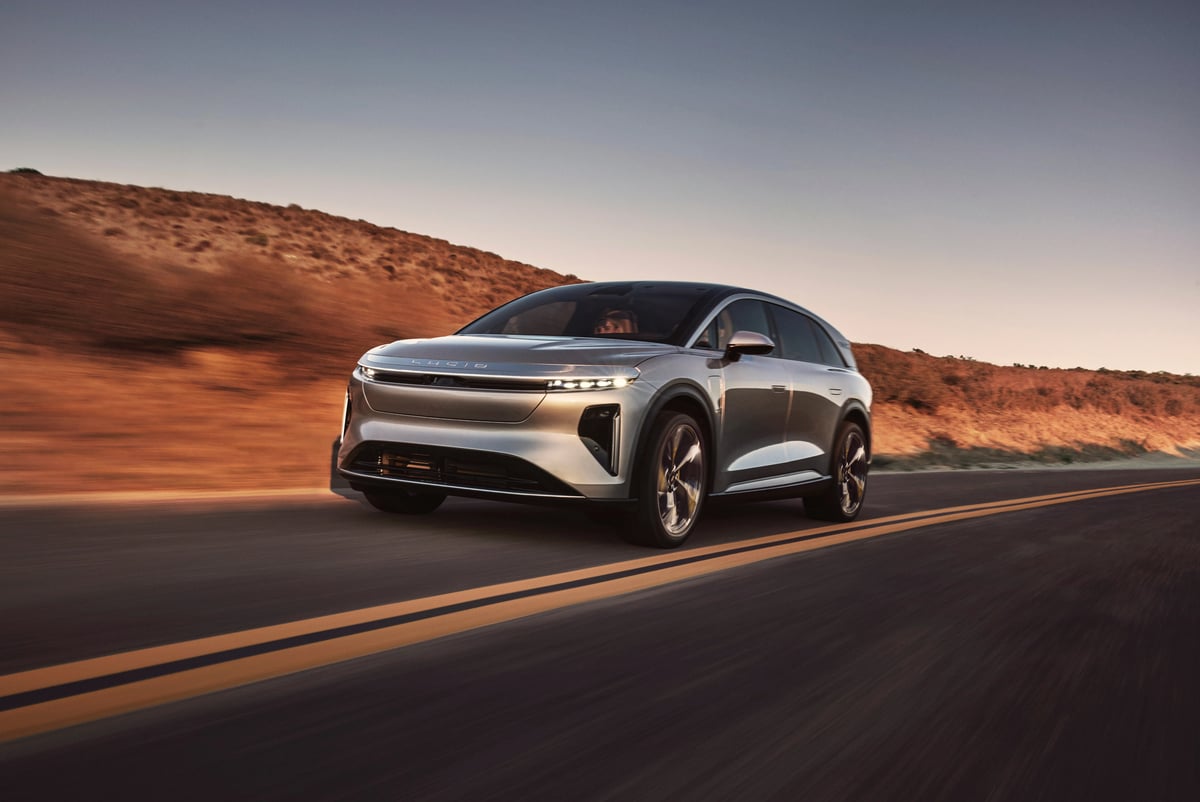
Lucid's High-Profile Shake-Up Fails to Reverse Fundamental Challenges
Lucid Motors announced a significant leadership transition and substantial capital infusion, yet the electric vehicle manufacturer continues to grapple with mounting operational headwinds that have investors deeply concerned about the company's path to profitability. The luxury EV maker appointed Silvio Napoli as its new CEO while simultaneously securing $1.05 billion in fresh capital from Saudi Arabia's Public Investment Fund (PIF) and ride-sharing giant Uber, moves that superficially suggest confidence in the company's long-term vision. However, beneath these headline-grabbing developments lies a troubling financial reality: the company is burning through cash at an accelerating pace, with Q4 2025 cash burn reaching $1.25 billion, a figure that underscores the urgent existential challenges facing the once-hyped EV startup.
The capital raise, while substantial on its surface, arrives at a critical juncture as Lucid's cash runway extends only until 2027—a compressed timeline that leaves minimal room for execution errors or market delays. The new investment represents a lifeline, yet it simultaneously represents another round of shareholder dilution for existing stakeholders. Despite the appointment of Napoli to helm operations and strategic initiatives, the company has yet to demonstrate the operational discipline or market penetration necessary to justify the inflated valuations and promises that defined its early narrative.
Record Deliveries Mask Deteriorating Unit Economics
Lucid achieved eight consecutive quarters of record deliveries, a metric that initially appears bullish on the surface. This streak suggests growing market demand for the company's luxury vehicles and expanding production capacity. However, this apparent success story obscures a far more alarming picture when examined through the lens of profitability metrics and cash consumption rates.
The fundamental problem is stark:
- Cash burn in Q4 2025 reached $1.25 billion, an acceleration from prior periods
- Limited cash runway extends only to 2027, providing roughly 18-24 months of operational flexibility
- Zero gross profitability achieved to date, despite years of operations and expanding production
- Significant shareholder dilution from the latest capital raise, decreasing per-share ownership for existing investors
- Record deliveries fail to translate into positive unit economics, indicating the company loses money on every vehicle sold
The disconnect between delivery volume growth and financial deterioration reveals the core problem: Lucid is scaling unprofitable operations. Each additional vehicle sold accelerates the path to cash depletion rather than improving the company's financial trajectory. This represents a fundamental business model failure that new leadership and fresh capital cannot easily resolve.
Comparing Performance Against Competitor Rivian
When benchmarked against Rivian ($RIVN), another luxury EV manufacturer also fighting for market share and profitability, Lucid's position appears increasingly vulnerable. While Rivian has similarly struggled to reach profitability and has faced its own share of production challenges, the company has demonstrated better capital efficiency and a clearer path toward managing cash burn relative to its scale of operations.
Rivian's recent strategic initiatives and production ramp-ups, while not without challenges, suggest a more measured approach to capital deployment and operational scaling. Lucid, by contrast, has pursued an aggressive expansion strategy that has exponentially increased cash consumption without proportional revenue scaling. The luxury EV market itself remains highly competitive, with Tesla ($TSLA) dominating the sector despite facing pressure from traditional automakers launching premium electric vehicles.
The broader EV sector has cooled considerably from the speculative fervor of 2020-2021, as investors have become increasingly disciplined about demanding clear paths to profitability. This shift in investor sentiment creates particular challenges for cash-intensive startups like Lucid that lack the established cash flows or balance sheets of legacy automakers.
Why This Matters for Investors and Market Implications
The investment community faces a critical decision point with Lucid's stock. While the appointment of a new CEO and fresh capital might suggest stabilization, the underlying metrics tell a different story. Investors holding Lucid shares face several material risks:
Liquidity Risk: With cash running out in 2027, the company faces the prospect of additional dilutive capital raises unless operations dramatically improve. Each subsequent round of fundraising further diminishes the equity value available to current shareholders.
Unit Economics: The company's inability to achieve gross profitability after years of operations suggests structural issues with its production costs, pricing strategy, or both. No amount of operational excellence can overcome fundamental unprofitability at scale.
Market Competition: The luxury EV segment is becoming increasingly crowded, with traditional automakers investing billions in electric platforms. Lucid's first-mover advantage has eroded, and the company lacks the scale advantages or brand loyalty of established competitors.
Dilution Trajectory: Each capital raise reduces per-share ownership and increases total share count. Existing shareholders are financing operations through their ownership stakes, a pattern that historically ends poorly for early investors.
For institutional and retail investors, the risk-reward calculation has shifted decidedly toward the downside. The company's $1.05 billion raise provides a temporary reprieve, but without fundamental improvements in unit economics and operational efficiency, it merely extends the timeline to another crisis point.
The Road Ahead: Leadership Change Insufficient Without Operational Turnaround
Silvio Napoli's appointment as CEO carries both symbolic and practical significance. New leadership can reset operational priorities and potentially implement necessary cost discipline. However, executive changes alone cannot solve Lucid's core challenge: the company is structurally unprofitable and cash-constrained in a market that increasingly demands both operational excellence and financial viability.
The company must demonstrate dramatic improvements in manufacturing efficiency, cost reduction, and pricing power to justify continued investor support. The $1.05 billion capital raise provides runway, but it is fundamentally a delaying tactic rather than a solution. Without clear evidence that Lucid can achieve positive unit economics and reduce cash burn materially, the trajectory points toward further shareholder dilution, potential bankruptcy, or acquisition by a better-capitalized competitor.
The verdict from fundamental analysis is clear: despite the optimistic headlines surrounding new leadership and fresh capital, Lucid's financial trajectory remains deeply concerning. The eight consecutive quarters of record deliveries obscure the far more important metric—that the company is bleeding cash faster than it can raise capital. For investors seeking exposure to the EV sector, established players with clear paths to profitability represent substantially better risk-adjusted opportunities. Lucid, whatever its technological achievements, remains a speculative bet on a company that has not yet demonstrated it can execute the fundamentals necessary for long-term survival in an increasingly competitive industry.