
Satellite Connectivity Providers Show Starkly Different Revenue Trajectories
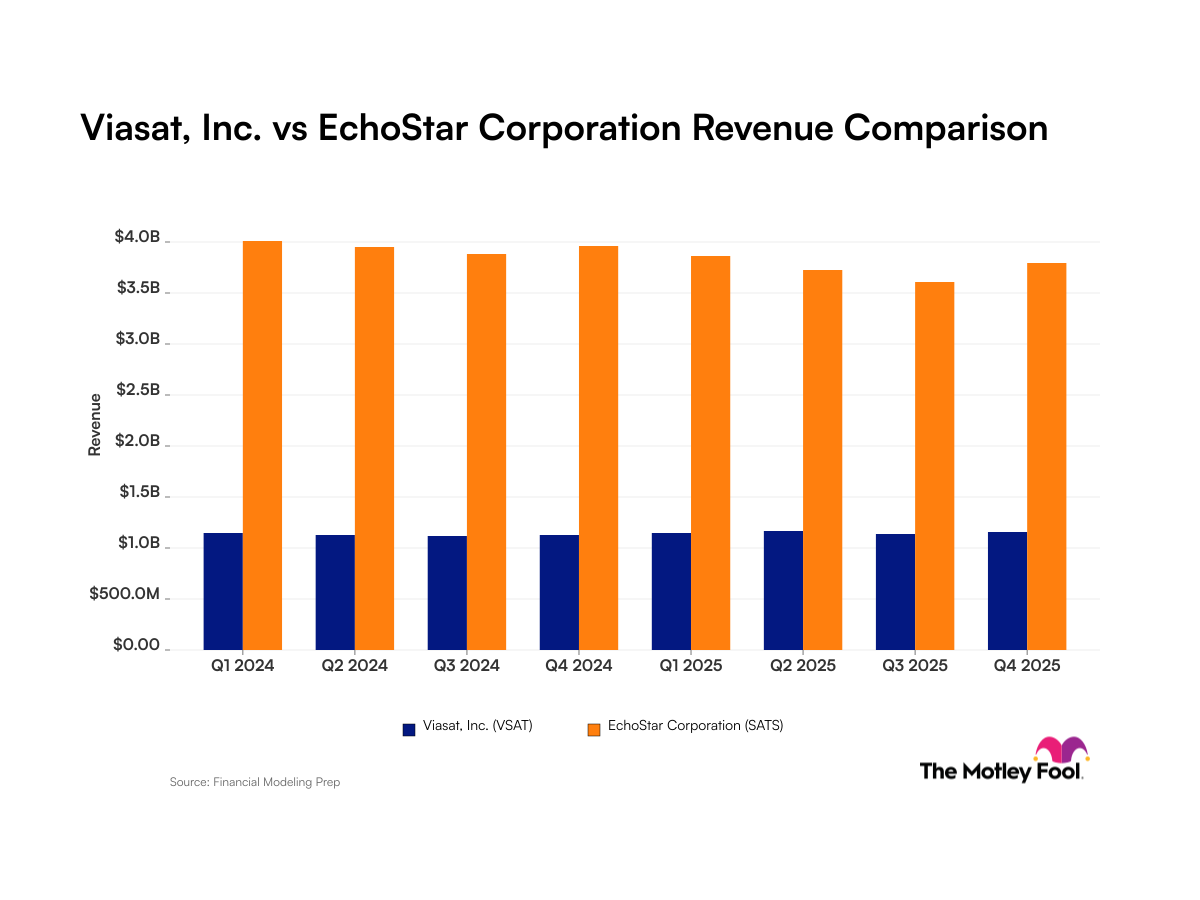
Viasat and EchoStar present a study in contrasts within the increasingly competitive satellite communications sector. While Viasat has demonstrated impressive revenue stability with consistent quarterly figures hovering around $1.1-1.2 billion, EchoStar is navigating a more challenging landscape, with revenues declining from $4.0 billion to $3.8 billion over eight quarters. Despite EchoStar's significantly larger absolute revenue base, both companies are contending with mounting pressure from SpaceX's Starlink expansion and evolving market dynamics that threaten to reshape the satellite connectivity industry.
The divergence in their financial trajectories raises critical questions about strategic positioning, operational efficiency, and competitive resilience in an industry experiencing unprecedented technological disruption. For investors tracking satellite communications and aerospace stocks, understanding these competing narratives is essential to evaluating long-term value propositions in a sector experiencing rapid transformation.
Key Details: Revenue Patterns and Financial Performance
Viasat's Consistent Performance
Viasat has delivered a masterclass in operational consistency, maintaining quarterly revenues within a narrow band of $1.1-1.2 billion across the eight-quarter observation period. This stability suggests:
- Strong customer retention and recurring revenue streams
- Effective cost management and operational discipline
- Resilient demand across its service portfolio
- A business model less vulnerable to cyclical pressures
The company's ability to maintain this steady revenue plateau indicates mature market positioning and potentially defensive characteristics that may appeal to conservative investors seeking stability in a volatile sector.
EchoStar's Declining Trajectory
In contrast, EchoStar presents a more troubling picture with quarterly revenues declining from approximately $4.0 billion to $3.8 billion over the same timeframe. This roughly 5% contraction represents:
- Gradual revenue erosion of approximately 2.5% per quarter (implied)
- Potential customer churn or market share losses
- Operational headwinds in core business segments
- Possible strategic transitions affecting near-term financial results
Despite commanding nearly three times Viasat's quarterly revenue, EchoStar's downward trend signals underlying competitive pressures or strategic challenges requiring investor scrutiny.
Market Context: The Starlink Disruption and Industry Transformation
The Competitive Landscape Shifts
Both satellite connectivity providers operate in an industry experiencing unprecedented disruption. SpaceX's Starlink has emerged as a formidable competitor, leveraging:
- Next-generation satellite technology with significantly lower latency
- Aggressive pricing strategies targeting consumer and enterprise markets
- Massive capital deployment and launch cadence
- Government contracts and strategic partnerships
The traditional satellite communications sector, long dominated by incumbents like EchoStar and Viasat, suddenly faces competition from a company with vastly different cost structures and technological capabilities. This structural shift explains both companies' defensive positioning and the market's cautious outlook on satellite connectivity providers.
Sector Consolidation and Strategic Responses
The broader satellite communications industry has undergone significant consolidation and strategic repositioning:
- Viasat's focus on stability suggests a strategy emphasizing profitable niche markets and service differentiation
- EchoStar's revenue decline may reflect portfolio restructuring or the shedding of lower-margin business lines
- Both companies are competing in broadband, maritime, aviation, and government segments with varying competitive intensities
Regulatory considerations also matter significantly, with the Federal Communications Commission maintaining oversight of spectrum allocation and licensing—factors that could provide protective moats for established players against new entrants.
Investor Implications: Strong Returns Mask Underlying Concerns
A Paradoxical Performance Picture
Perhaps most intriguingly, both $VSAT and $SATS have delivered strong returns over the past three years, with EchoStar significantly outperforming Viasat. This apparent disconnect between declining fundamentals and stock performance warrants careful interpretation:
What This Suggests:
- Market expectations are rising faster than current fundamentals: Investors may be pricing in future growth or strategic transformations not yet reflected in quarterly results
- Recovery narratives appeal to growth investors: Despite current headwinds, both companies may benefit from belief in technological innovation or market expansion
- EchoStar's outperformance may reflect valuation reset: The company's larger revenue base, despite decline, may have offered deeper value opportunities for investors
- Sector rotation dynamics: Broader investor appetite for aerospace and satellite communications may be overriding company-specific concerns
Risk Considerations for Investors
The divergent financial trajectories coupled with strong stock performance suggests potential valuation disconnects:
- Viasat's stability is admirable but may not excite growth-oriented investors
- EchoStar's revenue decline raises sustainability questions despite recent share price strength
- Both companies face existential threats from Starlink and other next-generation competitors
- Capital intensity in satellite communications requires sustained investment, potentially pressuring margins
Investors should scrutinize whether current valuations adequately price in the competitive challenges both companies face, particularly as SpaceX continues expanding Starlink's market penetration and service quality.
Forward-Looking Assessment: Positioning for Tomorrow's Satellite Market
The contrast between Viasat's steadfast revenue consistency and EchoStar's gradual decline illuminates two different paths through an industry inflection point. Viasat appears to be betting on defensive positioning and profitability within defined market segments, while EchoStar's declining revenues may reflect more aggressive portfolio optimization or strategic repositioning.
For investors, the key question is whether either company possesses the technology, capital resources, and strategic vision to compete effectively against Starlink's disruptive innovation. The past three years' strong returns suggest market participants believe at least one—or both—can adapt and thrive. However, the underlying divergence in financial performance suggests caution is warranted, and deeper fundamental analysis is essential before committing capital to either satellite communications provider. The next few years will prove decisive in determining whether these companies represent turnaround opportunities or value traps in an industry undergoing radical transformation.