
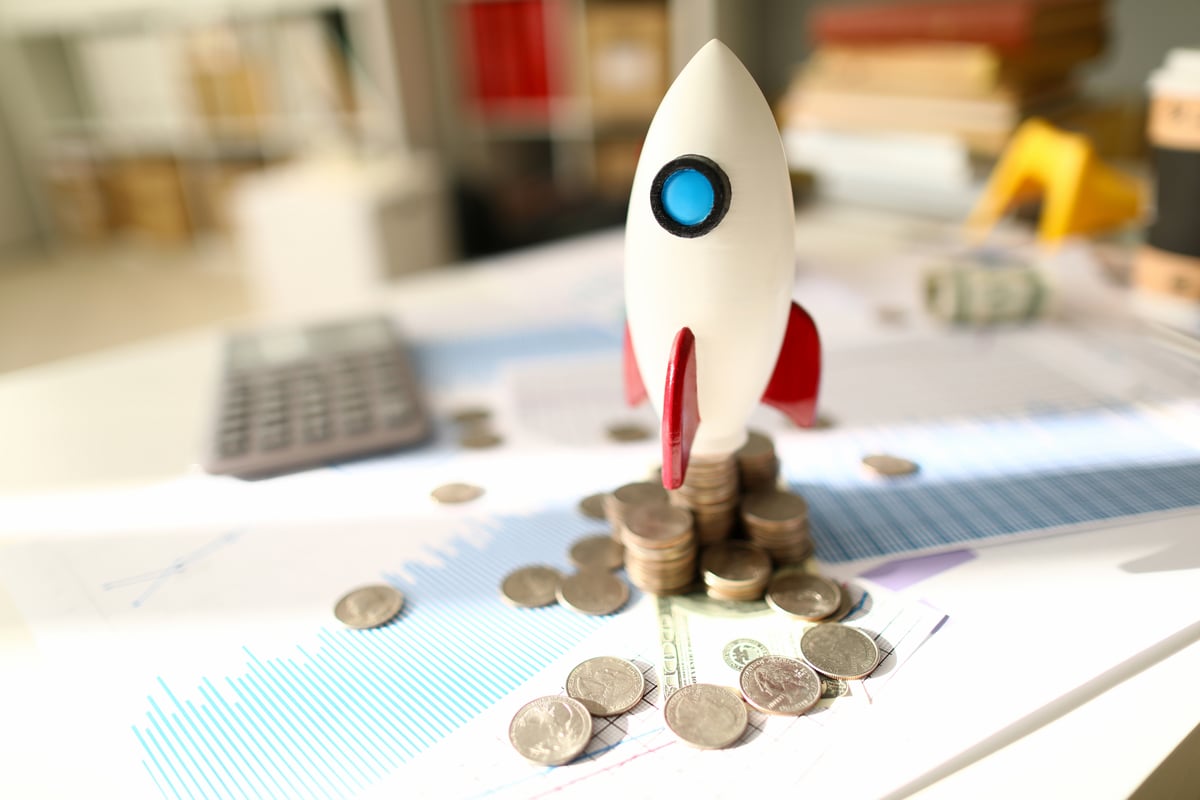
SpaceX's $1.75T IPO Faces Historical Headwinds Despite Record-Breaking Ambitions
SpaceX has filed confidentially for what could become the largest initial public offering in Wall Street history, seeking to raise approximately $75 billion at a staggering valuation between $1.75 trillion and $2 trillion. The filing, submitted on April 1, 2026, represents an unprecedented capital raise that would dwarf the current record-holder and signal explosive investor appetite for the commercial space industry. However, market analysts are sounding the alarm about three historical patterns that have consistently plagued mega-IPOs, warning that even SpaceX's transformative business model may not be immune to the gravitational forces that typically pull newly public technology firms back to earth.
The sheer scale of SpaceX's anticipated debut cannot be overstated. A $75 billion raise would be nearly three times larger than the previous IPO record, reflecting not just the company's demonstrated operational achievements but also the current investment zeitgeist surrounding space exploration, satellite internet infrastructure, and reusable rocket technology. At the midpoint of its valuation range, SpaceX would be valued at approximately $1.875 trillion, placing it among the most valuable companies ever to enter public markets—comparable to the combined market capitalization of Berkshire Hathaway and Tesla at current levels.
The Three Historical Headwinds
Despite the blockbuster projections, equity market historians point to three compounding headwinds that have consistently worked against major IPOs over the past 27 years.
First, post-IPO performance has been historically weak. Data spanning from 1999 through 2026 reveals a troubling pattern: the vast majority of large-cap IPOs have declined in value within six months of their public debuts. This pattern held true through various market cycles—from the 2000-2001 tech crash to the 2008-2009 financial crisis to more recent corrections. Even companies with strong fundamentals and transformative technology have succumbed to this timing phenomenon, as initial pricing typically reflects maximum optimism while early public shareholders discover reality to be more complex than pre-IPO enthusiasm suggested.
Second, SpaceX's valuation metrics appear stretched by historical standards. At the projected range, the company would command price-to-sales ratios in the high double digits to triple digits, depending on how current revenue is measured and projected forward. For context, traditional aerospace and defense contractors like Lockheed Martin ($LMT) and Northrop Grumman ($NOC) typically trade at single-digit price-to-sales multiples, while even high-growth technology firms rarely sustain valuations above 10x sales for extended periods. SpaceX's premium reflects belief in exponential growth, but premium valuations leave little room for execution disappointment or market repricing.
Third, emerging technology sectors have consistently experienced early bubble-bursting events before reaching optimization. The pattern is well-documented: initial euphoria drives valuations to unsustainable levels, disappointing results or slower-than-expected adoption triggers capitulation, valuations collapse 50-80%, and only then do survivors rebuild with more rational pricing. This cycle characterized the internet boom of 1999-2000, the cleantech bubble of 2006-2011, the cryptocurrency craze of 2017-2018, and the artificial intelligence surge beginning in 2023. The commercial space sector, despite its genuine transformative potential, shows early signs of exhibiting similar characteristics.
Market Context: The Space Sector's Evolution
SpaceX enters public markets at an inflection point for the commercial space industry. The company has legitimately revolutionized launch economics through reusable rocket technology, dramatically reducing per-kilogram-to-orbit costs. Its Starshield government contracts, international launch agreements, and emerging Starlink satellite internet constellation represent genuine revenue diversification that competitors like Blue Origin and emerging providers cannot yet match.
However, the sector faces real operational challenges:
- Supply chain constraints limiting production scaling
- Regulatory uncertainty surrounding satellite megaconstellations and space debris management
- Revenue concentration risks with dependence on U.S. government contracts
- Capital intensity of space infrastructure requiring continuous investment
- Competition accelerating from both established aerospace contractors pivoting to commercial markets and well-funded startups pursuing niche opportunities
The current market sentiment toward space stocks reflects what some analysts characterize as "irrational exuberance." Public space-adjacent companies have traded at premium valuations throughout 2025-2026, and SpaceX's IPO filing has further energized investor interest. Yet historical precedent suggests this enthusiasm may prove unsustainable.
Investor Implications: Weighing Opportunity Against Risk
For prospective investors, the SpaceX IPO presents a classic risk-reward dilemma that defies easy categorization.
The bull case rests on several compelling foundations:
- Proven business model with demonstrated revenue generation and profitability trajectories
- Durable competitive advantages in launch economics that competitors struggle to replicate
- Secular tailwinds including government space spending, satellite internet adoption, and Mars colonization ambitions
- Founder-led execution under Elon Musk, whose track record of delivering on technological promises (despite frequent timeline misses) exceeds that of comparable entrepreneurs
- Market access to institutional capital likely to drive massive demand regardless of valuation
The bear case emphasizes historical patterns that transcend company quality:
- Valuation-driven downside risk if growth rates fail to justify triple-digit price-to-sales multiples
- IPO timing dynamics that have historically produced 6-month declines in comparable mega-offerings
- Sector bubble dynamics as investor enthusiasm consistently outpaces fundamental justification
- Liquidity considerations where massive early capitalization can work against early-stage public shareholders as insider selling and secondary offerings commence
- Macro sensitivity to interest rate environments and growth stock sentiment
For long-term oriented investors with genuine conviction in space industry fundamentals, the key question becomes not whether SpaceX will succeed as a business—the evidence increasingly suggests it will—but rather whether current valuations offer attractive entry points. Historical precedent suggests patient capital may find better opportunities 12-24 months post-IPO, after inevitable repricing occurs.
Institutional investors managing massive portfolios face different calculus. The sheer size of the $75 billion raise may necessitate index funds and passive strategies to hold significant stakes simply to maintain portfolio weightings in broadbased market indices. This structural demand may support valuations despite fundamental concerns, at least through the first quarters of public trading.
Looking Forward: The Verdict
SpaceX's confidential IPO filing represents a genuine watershed moment for the commercial space industry, validating decades of private investment and technological development. The company's operational achievements and market position are difficult to overstate. Yet the three historical headwinds documented above—weak post-IPO performance, stretched valuations, and sector bubble dynamics—suggest caution is warranted.
The most likely scenario is neither outright failure nor unbounded success, but rather a pattern of initial euphoria followed by repricing, eventual stabilization at levels still elevated by historical standards, and ultimately a valuable public company that enriches long-term shareholders but punishes those who buy at IPO pricing. For investors seeking exposure to the genuine opportunities presented by commercial space, patience may prove as valuable as enthusiasm. The opportunity will likely remain accessible at more attractive valuations within the next two years, even if those valuations still reflect substantial premiums to traditional aerospace comparables. SpaceX is almost certainly a generational company; the only question is whether April 2026 represents the optimal moment to buy that company's stock.