
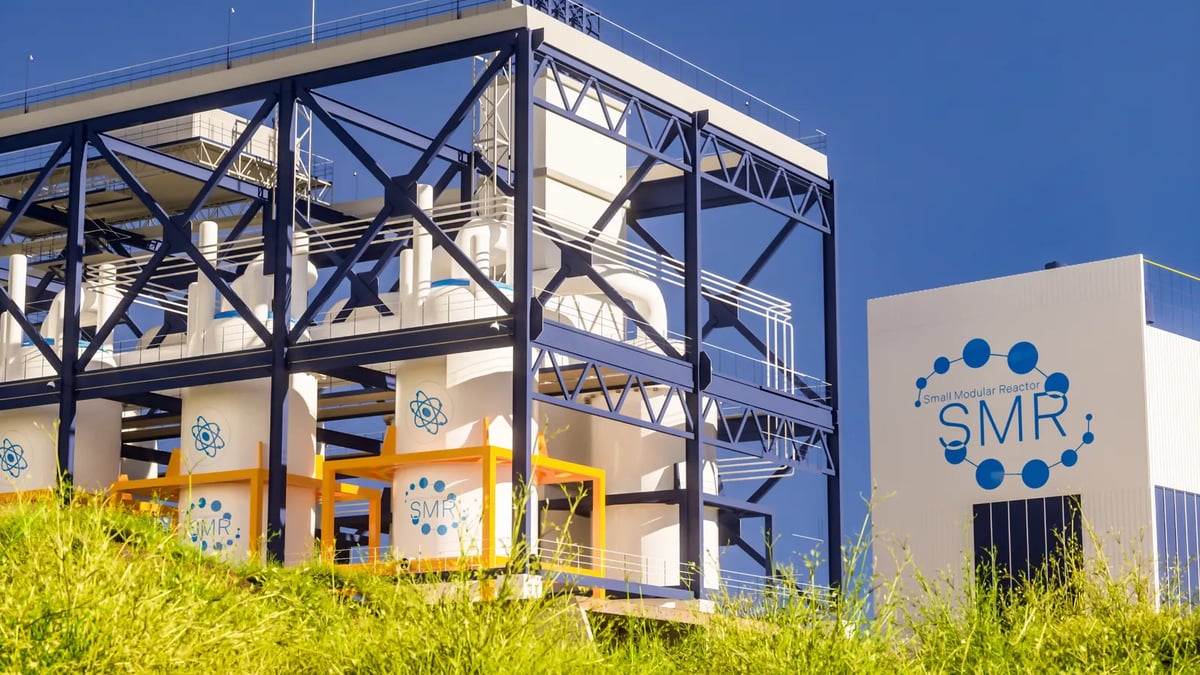
Nuclear Power's Uneven Descent
Two of the most prominent advanced nuclear technology companies are experiencing significant headwinds in 2026, but their divergent regulatory positions are creating a stark bifurcation in investor sentiment. NuScale Power has shed 27% of its value year-to-date, while smaller competitor Oklo is down a more modest 11%—a disparity that masks fundamentally different risk profiles for investors betting on nuclear's resurgence as artificial intelligence demands unprecedented amounts of clean power. The divergence highlights a critical truth in the emerging advanced nuclear sector: regulatory validation increasingly matters more than pure technological potential, especially when both companies remain pre-revenue ventures.
The timing of these declines is particularly striking given the tailwinds supposedly propelling the nuclear sector. Major technology companies, from Microsoft to Google and Amazon, are openly acknowledging they need massive increases in reliable baseload power to fuel their AI data center ambitions. Yet the market is punishing these nuclear pure-plays, suggesting that investors are making careful distinctions between which companies are positioned to actually capture this demand.
Key Details: The Regulatory Divide
NuScale Power's competitive advantage rests on a singular but crucial achievement: its small modular reactor (SMR) design has received approval from the Nuclear Regulatory Commission (NRC). This regulatory milestone represents years of rigorous engineering review and represents a tangible de-risking event that Oklo has not yet matched.
Key metrics distinguishing the two companies:
- NuScale: NRC-approved design, expected near-term revenue potential, though no firm sales yet
- Oklo: Lacks regulatory approval, broader theoretical customer addressable market, higher valuation relative to current assets
- Market cap divergence: Despite the larger percentage decline, NuScale's approval carries significant strategic weight
- Path to commercialization: NuScale closer to actual deployment and revenue generation
Neither company has yet recorded meaningful commercial revenue, making them both high-risk speculative positions. However, NuScale's regulatory approval from the NRC represents a critical gating factor that potential customers—especially risk-conscious Fortune 500 technology companies—increasingly view as essential. A company like Microsoft evaluating long-term power procurement needs must weigh the regulatory certainty of NuScale's design against the theoretical potential of Oklo's approach.
Oklo, by contrast, possesses a broader customer aperture in theory. Its advanced reactor design could theoretically serve a wider range of applications and sites than NuScale's modular approach. However, this theoretical advantage is overshadowed by the absence of NRC validation, which creates an uncertain timeline to actual commercialization and revenue generation. Without regulatory approval, Oklo faces a longer, more expensive path to market—one that could easily extend another five to ten years.
Market Context: The AI Power Shortage Is Real
The broader context underpinning both companies' existence remains compelling, even as stock prices retreat. The artificial intelligence industry's insatiable appetite for electrical power is not a speculative phenomenon; it is already driving measurable changes in energy markets.
The structural demand drivers include:
- Data center power requirements growing at double-digit annual rates due to AI model training and inference
- Grid capacity constraints in regions hosting major technology company facilities
- Decarbonization mandates making nuclear the only viable large-scale baseload alternative to fossil fuels
- Tech company sustainability commitments creating contractual obligations for clean power procurement
The irony of 2026's market pullback is that the fundamental case for advanced nuclear remains intact—perhaps more intact than ever. Yet the market is making a critical distinction: between companies positioned to capitalize on the trend versus those merely positioned to benefit from it theoretically.
NuScale's position as the "safer" speculative play reflects investor psychology shifting toward a preference for regulatory de-risking. The NRC approval essentially outsources some of the technical due diligence to a credible government agency. For an institutional investor managing billions in assets, this matters. Oklo's lack of regulatory approval means that institutional capital must perform decades of complex nuclear engineering evaluation independently—a task most investors lack the expertise or risk tolerance to undertake without additional validation.
The competitive landscape includes several other advanced nuclear ventures—including companies like TerraPower (backed by Berkshire Hathaway) and international competitors—but NuScale and Oklo represent the most liquid, publicly traded exposure to this sector. This liquidity advantage, combined with NuScale's regulatory achievement, creates a widening competitive moat that may prove difficult for Oklo to overcome absent its own regulatory approval.
Investor Implications: Risk Stratification in an Emerging Sector
The 2026 market action reveals important lessons about how capital allocates in pre-revenue, high-uncertainty sectors. Both stocks are down significantly, but for different reasons and with different implications for future performance.
For risk-tolerant investors, the distinction matters significantly:
- NuScale offers downside protection through regulatory validation, though it remains years from meaningful revenue
- Oklo offers theoretical upside through a broader market addressable but uncertain regulatory and commercialization timeline
- Neither company offers dividend income or near-term profitability
- Both require conviction in multi-year, high-volatility investment horizons
The market's preference for NuScale despite its steeper 2026 decline suggests that investors are repricing risk premiums. A 27% decline for a company with NRC approval may feel like a capitulation-driven opportunity, whereas Oklo's 11% decline for a pre-approval venture is increasingly viewed as pricing in years of additional uncertainty.
What makes this sector particularly treacherous is the extended timeline between investment and cash flow generation. Unlike traditional utility stocks or even renewable energy plays, advanced nuclear ventures typically require 7-10+ years from significant capital deployment to first megawatt of revenue. This compresses valuation multiples as the cost of capital and opportunity cost of waiting compound.
For sophisticated venture capital and private equity investors, this dynamic creates interesting opportunities in non-public rounds where valuations are more forgiving. For public market investors, both NuScale and Oklo represent leveraged bets on sustained AI power growth and maintained policy support for nuclear energy—two assumptions that appear robust but are nonetheless assumptions.
Looking Forward: Regulatory Approval as the Critical Variable
The divergence between these two companies will likely widen in coming years unless Oklo achieves meaningful regulatory milestones. The NRC approval process is both a moat and a bottleneck—it protects NuScale from new competition while simultaneously being the single variable that could most dramatically reset market expectations for Oklo.
Investors monitoring these companies should track:
- NuScale's first commercial deployment and revenue generation timeline
- Oklo's regulatory approval progress and NRC review status
- Major technology company commitments to purchasing advanced nuclear power
- Changes in national and international nuclear policy
- Interest rate environment and cost of capital for long-duration projects
The painful 2026 declines for both companies may ultimately prove to be capitulation-driven opportunities—or they may reflect a market adjusting its timeline for nuclear's meaningful contribution to the AI power supply. The answer likely depends on how quickly regulatory approval converts to actual deployed capacity and revenue. For now, NuScale's regulatory achievement has earned it the market's designation as the less risky speculative position, even as both companies remain firmly in the high-risk category.