
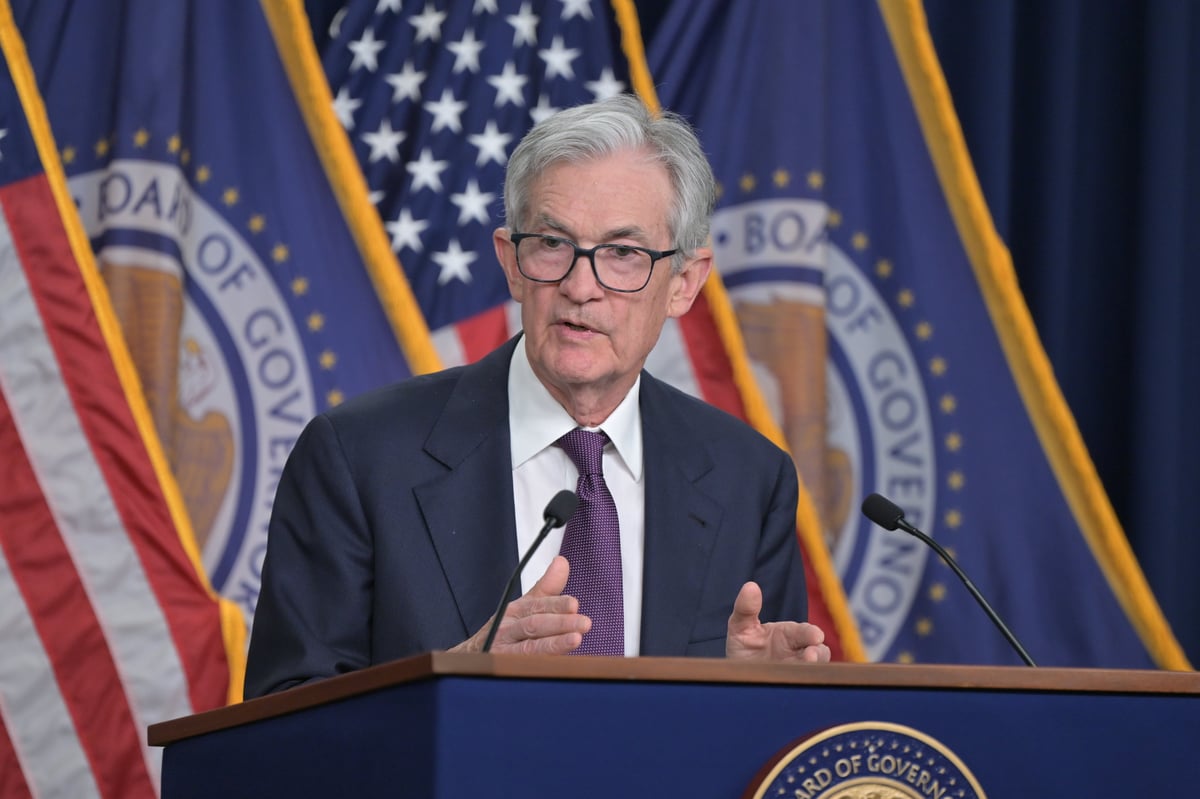
Powell's Inflation Warning Threatens to Derail Rate-Cut Cycle, Roiling Markets
Federal Reserve Chair Jerome Powell has delivered a sobering message to investors expecting imminent interest rate cuts, warning that economic uncertainty and geopolitical tensions pose persistent threats to the inflation outlook. The stark cautionary note, which signals a potential prolongation of the Fed's restrictive monetary policy stance, has sent shockwaves through equity markets where valuations have been increasingly priced on the assumption of an accelerating rate-cut cycle in 2025. Rather than the path of steady rate reductions many on Wall Street have been modeling, Powell's comments suggest the central bank may maintain its current restrictive posture far longer than previously anticipated.
The implications for asset allocation are significant. The S&P 500 is currently trading at a premium valuation of 20.9x forward earnings—a level that historically assumes economic growth acceleration and margin expansion driven by lower borrowing costs. If those rate cuts fail to materialize as expected, the fundamental backdrop supporting these elevated multiples evaporates, potentially forcing a repricing lower across equities.
The Fed's New Rate Outlook: Stagnation Instead of Cuts
JPMorgan Chase economists have revised their interest rate forecast materially, now predicting the Federal Reserve will hold rates steady throughout 2026 before pivoting to rate hikes beginning in the third quarter of 2027. This represents a dramatic departure from the consensus expectations that dominated financial markets in late 2024, when investors were broadly anticipating the Fed would begin cutting rates in the first half of 2025.
Powell's warning centered on two primary headwinds to the inflation trajectory:
- Economic uncertainty surrounding domestic growth prospects and labor market dynamics
- The Iran conflict, which poses risks to oil prices and global supply chains
These geopolitical risks compound the existing inflation pressures that have proven more persistent than the Fed initially expected. The central bank has maintained the federal funds rate in the 4.25%-4.50% range since December 2023, and Powell's remarks suggest this restrictive stance will remain in place through at least 2026.
The Fed chairman's caution stands in stark contrast to the dovish narrative that has dominated much of the financial media and investor positioning over the past several months. Markets had begun pricing in approximately three to four quarter-point rate cuts for 2025, representing a significant easing cycle that would have provided substantial tailwinds for rate-sensitive equities and growth stocks. Powell's warning effectively eliminates that scenario from serious consideration.
Market Context: Valuations at Risk in a Higher-For-Longer Rate Environment
The equity market's current valuation structure is fundamentally dependent on the assumption that Federal Reserve policy will eventually turn accommodative. The 20.9x forward price-to-earnings multiple on the S&P 500 is notably elevated relative to long-term historical averages and reflects investor expectations for strong earnings growth and multiple expansion.
That optimistic scenario requires several conditions to materialize:
- Aggressive Fed rate cuts reducing corporate borrowing costs and stimulating demand
- Margin expansion as lower financing costs boost profitability
- Acceleration of economic growth offsetting the drag from higher rates
- Stable inflation that validates the Fed's achievement of its 2% target
Powell's warning suggests each of these assumptions faces material downside risk. If the Fed maintains rates at current levels through 2026 and subsequently raises rates in 2027, the operating environment for corporations deteriorates significantly. Higher financing costs, compressed margins, and potentially slower economic growth would make current valuations untenable.
The broader sector implications are equally concerning. Technology stocks, which have dominated market gains and command the highest multiples, would face particular pressure in a scenario where rate cuts don't materialize. The sector's structural dependence on attractive discount rates for valuing future cash flows creates outsized sensitivity to Fed policy expectations. Conversely, financial stocks like JPMorgan Chase ($JPM) would benefit from a prolonged higher-rate environment, though this benefit must be weighed against broader economic growth headwinds.
Historically, periods when the Fed maintains rates at restrictive levels for extended periods eventually force investors to reassess equity valuations downward. The "higher-for-longer" narrative that has circulated in recent months now appears to be crystallizing into Fed policy reality, rather than remaining an abstract downside scenario.
Investor Implications: Repricing and Asset Allocation Shifts
For equity investors, Powell's warning represents a critical inflection point. The rally in U.S. equities since October 2023 has been substantially predicated on the expectation of an imminent easing cycle. If that cycle is delayed until 2026 or postponed entirely, the fundamental support for current stock prices weakens materially.
The likely investor responses include:
- Flight to fixed income: With the Fed potentially maintaining higher rates for an extended period, bond yields offer more attractive risk-adjusted returns, potentially drawing capital away from equities
- Portfolio rebalancing: Investors may shift capital from growth-oriented and rate-sensitive sectors toward value stocks and defensive positions
- International diversification: Developed and emerging market equities with lower valuations may attract capital flows, particularly if U.S. rate differentials narrow
- Alternative asset seeking: Some investors may increase allocations to commodities and real assets as hedges against inflation persistence
The geopolitical dimension of Powell's warning—particularly the reference to Iran conflict risks—adds another layer of uncertainty. Energy markets historically exhibit significant volatility in response to Middle East tensions, and elevated oil prices would create additional headwinds for the Fed's inflation-fighting efforts, further justifying the maintenance of restrictive policy.
For investors currently holding concentrated positions in high-multiple technology stocks, Powell's comments may trigger urgent portfolio reviews. The risk/reward calculation has shifted meaningfully. Where the potential 20-30% upside from rate cuts previously dominated risk calculations, the downside risk from absent cuts now looms larger.
Corporate treasurers and borrowers should also reassess financing strategies. The extended rate plateau suggested by JPMorgan Chase's forecast argues for locking in longer-term fixed-rate debt now, before potential 2027 rate increases elevate borrowing costs further.
Looking Forward: A Market in Transition
Powell's inflation warning and JPMorgan Chase's revised rate forecast represent a significant recalibration of Fed policy expectations that the financial markets are only beginning to fully price in. The comfortable consensus of an easing cycle in 2025 has been shattered, replaced by the prospect of rates remaining elevated through 2026 and potentially rising thereafter.
This represents a stark reversal from the narrative that has dominated markets since mid-2023. The path forward depends critically on whether inflation indeed remains sticky as Powell suggests, or whether economic growth slows enough to compel an earlier Fed pivot. The geopolitical risks Powell highlighted add genuine uncertainty to this calculus, preventing confident forecasting of Fed actions more than 12 months forward.
Equity investors should brace for heightened volatility as market participants reprrice the entire capital structure around this new rate reality. The premium valuations currently commanded by growth-oriented equities appear increasingly unjustifiable absent a near-term easing cycle, suggesting downside risk remains substantial. The days of "buy the dip" confidence may be giving way to a more cautious, valuation-conscious market environment.