
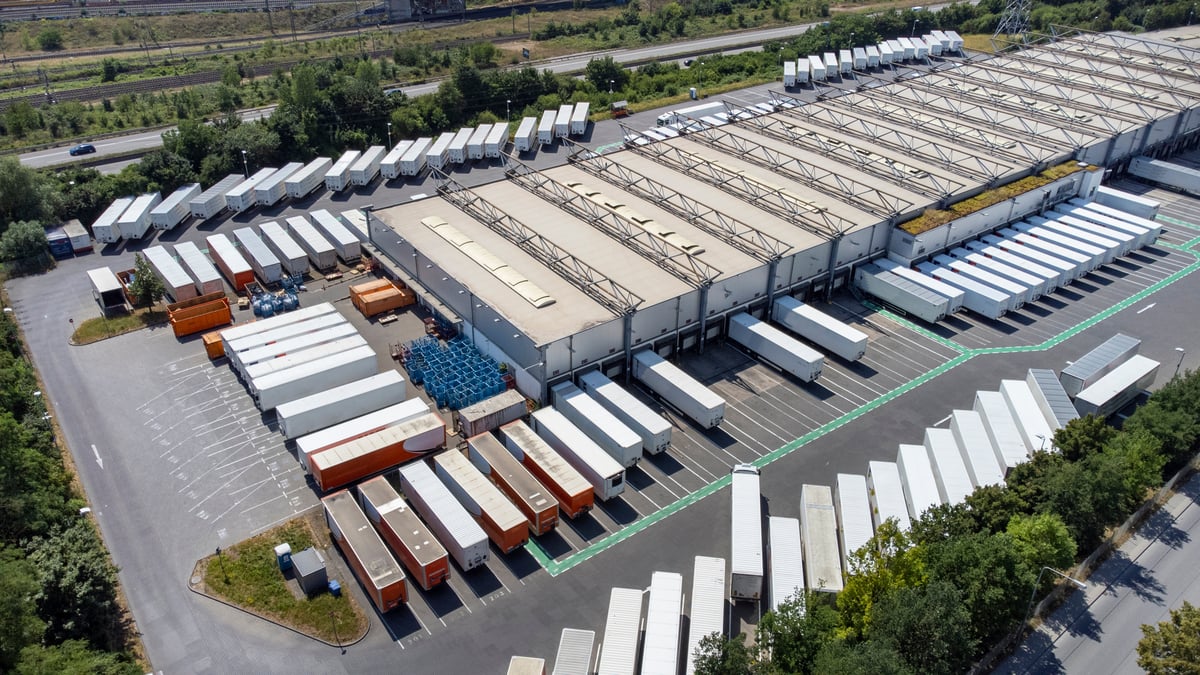
Amazon's aggressive expansion into enterprise logistics services sent shockwaves through the third-party logistics sector on Wednesday, with $GXO shares tumbling nearly 13% following the company's announcement of Amazon Supply Chain Services (ASCS). The e-commerce giant's move into freight, distribution, fulfillment, and parcel shipping directly targets the enterprise market that GXO Logistics has long dominated, raising serious questions about competitive pressures in the contract logistics industry.
The market reaction was swift and severe, reflecting investor concerns about Amazon's ability to leverage its massive operational infrastructure and customer relationships to disrupt traditional logistics providers. GXO, spun off from XPO Logistics in 2021, has built its reputation on providing sophisticated supply chain solutions to large enterprise customers. However, Amazon's entry into this segment with what appears to be a comprehensive service suite threatens to reshape competitive dynamics in ways that extend far beyond typical e-commerce logistics.
The Amazon Threat and Market Impact
Amazon's launch of ASCS represents a significant strategic pivot for the company, one that capitalizes on the operational expertise it has developed over decades of managing its own sprawling supply chain network. The service offering encompasses several critical logistics functions that form the core of GXO's business model:
- Freight management and transportation optimization
- Distribution center operations and warehousing solutions
- Fulfillment services for order processing and shipping
- Parcel shipping capabilities across domestic networks
What makes this announcement particularly threatening is the comprehensiveness of Amazon's offering. Rather than entering a single niche of the logistics market, Amazon is positioning ASCS as a full-service alternative to traditional 3PL (third-party logistics) providers. This directly competes with the bread-and-butter services that GXO has relied upon for revenue growth.
Investors have good reason to be concerned. Amazon possesses several structural advantages in this market—existing relationships with enterprise customers through AWS and its retail operations, unmatched scale that enables aggressive pricing, proprietary technology for supply chain optimization, and the financial resources to subsidize services to gain market share. For a company like GXO that depends on enterprise contracts for predictable, long-term revenue, Amazon's entry represents an existential competitive threat.
Navigating Complexity: Where GXO May Find Protection
However, the picture is not entirely bleak for GXO shareholders. Industry analysts note that GXO's more complex contract logistics offerings—particularly those involving highly specialized supply chain design, regulatory compliance, and customized operational solutions—may prove more resilient to Amazon's competitive assault.
The distinction is crucial. While Amazon excels at operating standardized, high-volume logistics operations, GXO has built significant expertise in:
- Specialized contract manufacturing logistics requiring technical expertise
- Regulatory-heavy sectors including automotive, pharmaceuticals, and technology
- Bespoke supply chain design tailored to individual customer requirements
- Complex multi-modal transportation networks spanning global operations
These higher-touch, more sophisticated services command premium pricing and deeper customer relationships than the commodity-like services Amazon is offering. A logistics provider that manages the intricate supply chain for a pharmaceutical company delivering temperature-controlled products to hospitals, or handles just-in-time manufacturing components for automotive plants, occupies a different competitive position than one offering standard warehouse and fulfillment services.
Additionally, GXO's focused business model—pure-play contract logistics without competing retail operations—means the company can dedicate its entire organizational focus to logistics excellence without the conflicts of interest that might arise for Amazon, which competes with many of its potential ASCS customers through its retail business.
Broader Market Implications and Industry Dynamics
The announcement of ASCS has implications that extend well beyond GXO's stock price. It signals that Amazon views the enterprise logistics market as sufficiently attractive to warrant major investment, validating a thesis that many in the industry have long held: logistics services represent a massive, fragmented market ripe for consolidation and optimization.
Paradoxically, industry observers suggest that Amazon's market entry could raise broader awareness about the benefits of logistics outsourcing among enterprise customers. Many companies that might typically handle logistics in-house could be prompted to reevaluate whether outsourcing makes strategic sense, particularly if Amazon is highlighting logistics expertise as a core competency.
The competitive landscape in contract logistics has been consolidating for years. Major players include:
- J.B. Hunt Transport Services ($JBHT)
- Knight-Swift Transportation ($KNX)
- XPO Logistics ($XPO), GXO's parent company until the 2021 spinoff
- Saia Inc. ($SAIA)
- Old Dominion Freight Line ($ODFL)
Each of these competitors will likely face similar pressures from Amazon's expansion, though the impact will vary based on their service mix and customer base. Companies more focused on long-haul trucking and transportation may feel less pressure than those heavily invested in distribution and fulfillment operations.
Investor Implications and Forward-Looking Outlook
For GXO shareholders, the immediate news is negative. The 13% stock decline reflects justified concern about near-term competitive pressures and potential contract losses to Amazon. Investors are rightfully questioning whether GXO's growth trajectory—which has depended on winning enterprise customers away from competitors and expanding relationships with existing clients—can continue unabated in a world where Amazon is actively competing for the same business.
However, longer-term investors might consider several mitigating factors:
-
Customer relationships matter: Large enterprises with complex logistics needs develop deep, multi-year relationships with their logistics providers. Switching costs are real, both financially and operationally.
-
Margin dynamics differ: Amazon's willingness to operate at lower margins to gain market share could actually benefit specialized logistics providers by repositioning them as premium alternatives for customers unwilling to compromise on customization and service quality.
-
Scale and specificity: While Amazon can compete on commodity logistics, GXO can potentially gain market share among customers seeking vendors without competitive conflicts and willing to pay for specialization.
-
Regulatory environment: Proposed antitrust scrutiny of Amazon's business practices could ultimately constrain the company's ability to leverage competitive advantages in its core retail business to dominate the logistics market.
The stock decline, while significant, may have overshot the fundamental damage to GXO's business. A company with strong operational capabilities, deep customer relationships, and differentiated service offerings in complex logistics segments can still thrive even with Amazon as a competitor. However, investors should monitor upcoming earnings calls and contract wins closely to assess whether Amazon's competitive threat is materializing into actual customer losses.
Ultimately, GXO's future depends on executing a clear strategy: doubling down on complex, high-margin logistics services that Amazon is unlikely to ever offer, while defending market share in commodity services through operational excellence and customer intimacy. The company's management team will need to demonstrate that this strategy is viable in earnings announcements and investor communications in coming quarters. For now, the market has priced in significant concern—which may eventually prove prescient, or may represent a buying opportunity for investors confident in GXO's ability to compete in a world where Amazon is a serious logistics competitor.