
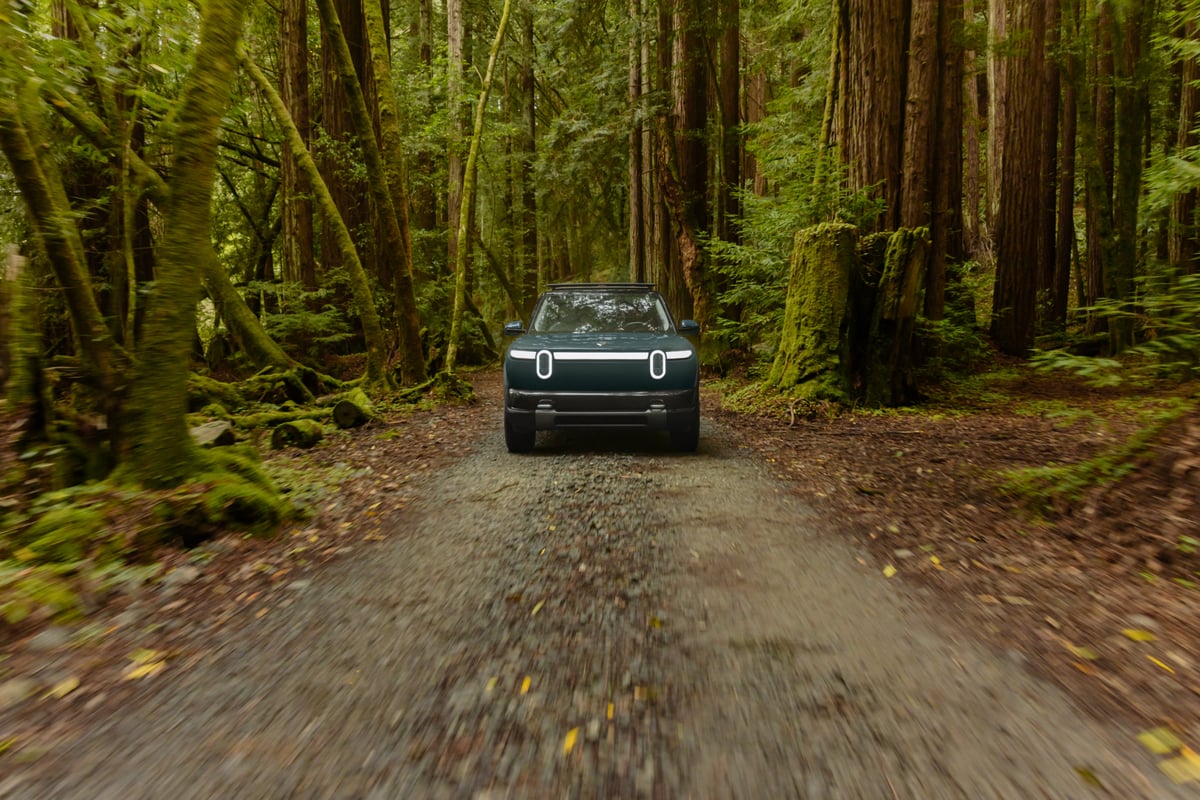
Uber's $1B Rivian Robotaxi Deal Signals Major Bet on Autonomous Delivery
Uber Technologies has placed a substantial order for 10,000 Rivian R2 autonomous vehicles slated for delivery in 2028, with plans to purchase an additional 40,000 units by 2030. The landmark partnership injects over $1 billion in capital into $RIVN and represents a critical vote of confidence in Rivian's self-driving technology and artificial intelligence capabilities. This strategic alliance positions Rivian alongside industry heavyweights Tesla and Waymo in the rapidly consolidating autonomous vehicle market, signaling that the race for robotaxi dominance is intensifying beyond Silicon Valley's traditional leaders.
The order underscores Uber's aggressive pivot toward autonomous delivery and mobility services as it seeks to reduce labor costs and scale operations globally. For Rivian, the deal provides much-needed capital injection and validation of its technology platform at a critical juncture when the company is racing to achieve profitability and establish market leadership in the autonomous vehicle space.
The Financial Impact and Technology Validation
The financial mechanics of this partnership carry substantial significance for $RIVN shareholders:
- Immediate capital infusion: Over $1 billion flows to Rivian to support manufacturing scale-up and technology development
- Multi-year revenue visibility: Committed orders through 2030 provide predictable revenue streams and production guidance
- Volume-based validation: A 50,000-unit order represents meaningful commercial validation of Rivian's R2 platform and autonomous capabilities
- Technology demonstration: The partnership highlights Rivian's advancement in self-driving algorithms and custom AI processors developed specifically for autonomous operations
Beyond the headline numbers, this deal demonstrates that Rivian has successfully positioned its R2 vehicle as suitable for commercial autonomous deployment—a critical inflection point that many skeptics questioned. The R2, originally conceived as an affordable consumer electric vehicle, has evolved into a platform capable of supporting Level 4 autonomous capabilities with Uber's technology stack integration.
Rivian's proprietary AI processors and sensor fusion technology have apparently satisfied Uber's stringent technical requirements, suggesting the company's engineering roadmap is gaining credibility with one of the world's largest mobility platforms. The 2028 delivery timeline also provides a realistic window for finalizing autonomous driving validation, regulatory approval, and manufacturing ramp-up—addressing previous concerns about Rivian's execution timeline.
Market Context: The Robotaxi Landscape Transforms
This partnership emerges within a rapidly evolving autonomous vehicle ecosystem where several competing visions are crystallizing:
Tesla's Approach: $TSLA has committed to fully autonomous Teslas and the Cybercab robotaxi platform, leveraging its existing fleet data and vertical integration. However, Tesla faces skepticism about timelines and the feasibility of its camera-only autonomous system without LiDAR sensors.
Waymo's Strategy: Alphabet's Waymo subsidiary operates commercial robotaxi services in Phoenix, San Francisco, and Los Angeles, focusing on controlled geographic expansion with its custom-built vehicles. Waymo's measured deployment approach prioritizes operational reliability over rapid scaling.
Uber's Model: Rather than developing autonomous technology from the ground up, Uber is integrating partner technologies—first with Aurora for long-haul trucking, now with Rivian for urban delivery. This platform-agnostic approach allows Uber to accelerate rollout without bearing full R&D costs.
Rivian's entry into this landscape through Uber establishes a significant third pillar in robotaxi competition. The R2's platform design—purpose-built for autonomous operations rather than retrofitted—may provide operational advantages over retrofitted consumer vehicles. The commercial partnership also provides Rivian with real-world deployment experience and continuous improvement feedback that typical automotive manufacturers lack.
From a sector perspective, this deal validates growing investor confidence that autonomous vehicle technology has matured sufficiently for commercial deployment. Traditional automotive incumbents and ride-sharing platforms are making irreversible capital commitments, suggesting the robotaxi transition is no longer a speculative thesis but an emerging reality.
Investor Implications: Risk Factors and Upside Scenarios
For $RIVN shareholders, this partnership presents both significant opportunities and execution risks requiring careful monitoring:
Positive Catalysts:
- Profitability pathway: Large-volume, pre-committed orders improve unit economics and manufacturing utilization rates
- Technology validation: Third-party endorsement from Uber reduces technology risk perception
- Capital structure: Billion-dollar inflow strengthens balance sheet and reduces near-term financing risk
- Market positioning: Establishes Rivian as essential infrastructure in Uber's autonomous future
- Revenue acceleration: Potential for additional orders if initial deployments succeed
Execution Risks:
- Manufacturing scale: Rivian must demonstrate ability to produce 50,000 units across two production windows while maintaining quality standards
- Autonomous integration: Successfully integrating Uber's autonomous software stack with Rivian's hardware platform requires flawless technical coordination
- Regulatory uncertainty: Full autonomous commercial deployment depends on favorable regulatory environments across multiple jurisdictions
- Timeline slippage: 2028 delivery timelines are aggressive; any manufacturing or approval delays would damage credibility
- Competitive acceleration: Tesla and Waymo may accelerate their own programs in response, compressing Rivian's window of advantage
The stock market's reaction to this news will largely depend on whether investors view it as transformative validation or incremental progress for a company still proving its execution capability. Rivian's previous production challenges and timeline delays have created credibility deficits that must be overcome through consistent operational delivery.
This partnership also signals that the autonomous vehicle future may not be winner-take-all. Rather than a single dominant platform, the market appears to be consolidating around multiple viable approaches—Tesla's vertically integrated Cybercab, Waymo's deliberate geographic expansion, and Rivian's partnership-enabled deployment through Uber. This ecosystem approach may ultimately prove more resilient than competing visions.
Looking Ahead: The Critical Deployment Phase
The true measure of this partnership's value will emerge between 2028 and 2030 as vehicles roll out and Uber begins commercial autonomous delivery operations. Investors should monitor several key metrics: production ramp success, autonomous system performance and safety records, regulatory approval progress across Uber's operational markets, and customer adoption rates for autonomous delivery services.
Rivian's success in this domain could unlock significantly higher valuations and justify much larger order volumes. Conversely, deployment challenges or competitive breakthroughs could rapidly diminish the partnership's perceived value. For equity investors in $RIVN, this deal represents the company's most significant inflection point since going public, making the next 18-24 months of operational progress absolutely critical to long-term shareholder value creation.