
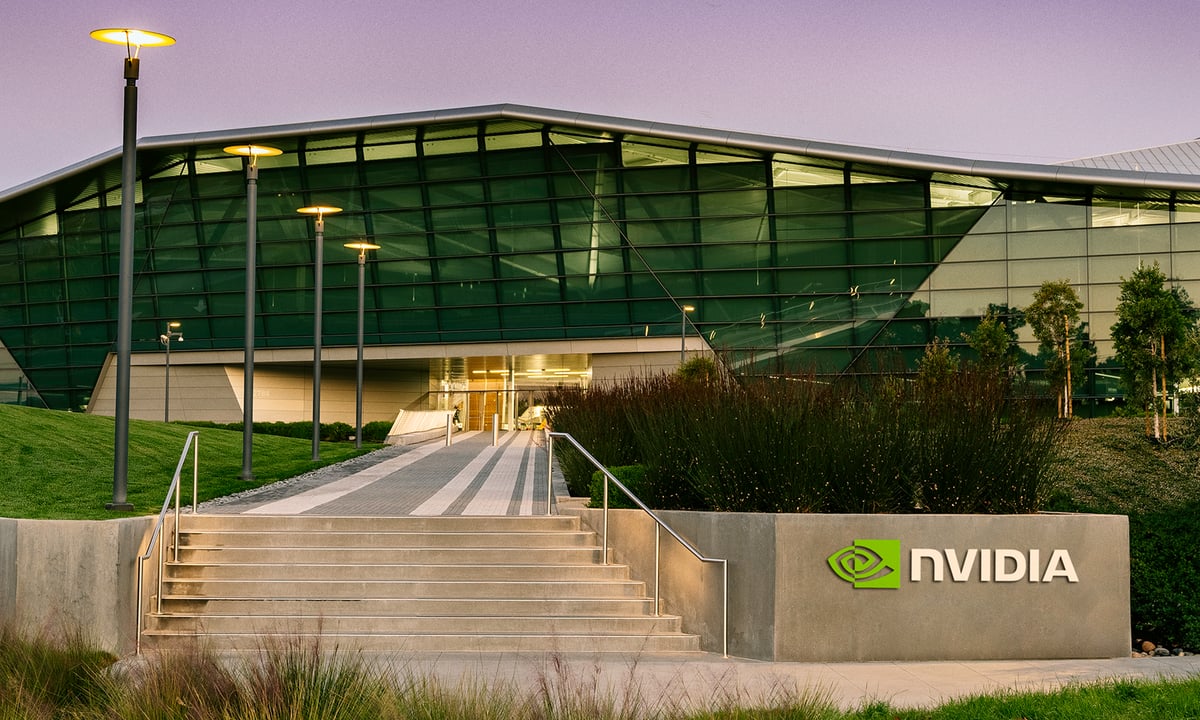
Will Nvidia Stock Survive an AI Slowdown? Analyst Says Downside Risk is Contained
As artificial intelligence infrastructure spending reaches fever pitch, investors are increasingly asking the inevitable question: what happens when growth moderates? A closer examination of $NVDA fundamentals suggests that even in a scenario where AI demand decelerates, Nvidia's downside exposure may be significantly more limited than historical semiconductor cycles would suggest—a development that could provide crucial reassurance to shareholders navigating a market that has priced in years of accelerating growth.
The Case for Contained Downside Risk
While an eventual slowdown in AI investment is all but certain given the cyclical nature of the semiconductor industry, the magnitude of potential stock price depreciation appears remarkably modest relative to typical sector corrections. Analysis suggests that Nvidia stock could experience anywhere from negligible price movement to a mild 20% pullback in a sustained AI slowdown scenario—a range that stands in stark contrast to the devastating 50-70% declines that have historically characterized semiconductor downturns.
The primary cushion protecting Nvidia from a more severe correction stems from the company's current valuation profile:
- Market capitalization: $4.8 trillion, placing the company among the world's most valuable corporations
- Forward price-to-earnings multiple: 24x, representing a meaningful compression from the 40x+ multiples that characterized peak pandemic enthusiasm
- Valuation trajectory: Declining multiples even as earnings growth remains robust, creating a widening margin of safety
The company's valuation architecture has fundamentally shifted from the "growth at any price" paradigm that defined earlier bull markets. This revaluation, while gradual, has been substantial enough to reduce the stock's sensitivity to near-term growth disappointments. Nvidia's trading at approximately 24x forward earnings suggests the market has already incorporated some moderation expectations into current pricing—a reality that dramatically alters the risk-reward calculus for existing shareholders.
Market Context: The AI Cycle's Unique Characteristics
Understanding Nvidia's downside resilience requires examining what makes the current AI infrastructure cycle materially different from previous semiconductor booms. Unlike past cycles driven by consumer electronics upgrades or cyclical data center refreshes, the AI buildout involves fundamental computational architecture shifts backed by generational technology advancement.
The semiconductor industry historically experiences severe cyclicality, with demand shocks cascading through supply chains and triggering inventory corrections that amplify downturns. However, Nvidia's current market position presents several structural distinctions:
Demand dynamics: AI chip demand stems from multiple end-markets simultaneously—cloud infrastructure providers, enterprise data centers, consumer computing, and automotive—rather than concentrated exposure to a single cyclical industry segment.
Competitive positioning: While competitors are advancing rapidly, Nvidia's architectural advantages and software ecosystem (CUDA) continue to create switching costs that support pricing power and market share resilience.
Capital intensity: The massive capital expenditure requirements for AI infrastructure buildout may extend the investment cycle longer than traditional semiconductor upswings, potentially moderating the severity of any eventual correction.
Furthermore, the semiconductor sector's forward-looking nature means much of the growth assumption is already embedded in current stock prices. This differs markedly from growth stories where valuations remain untethered to fundamentals—a condition that characterized technology stocks in 2021. Nvidia's rationalization from 40x+ earnings multiples to 24x represents meaningful acknowledgment that growth will inevitably decelerate.
Investor Implications: A Bifurcated Strategy
For different investor cohorts, the outlook carries distinctly different implications. Current Nvidia shareholders benefit from a combination of fundamental business strength and valuation support that appears sufficient to weather a meaningful growth moderation. The analysis suggests holding positions rather than attempting to exit ahead of a potential slowdown—particularly given the binary nature of such decisions and the historical tendency for technology cycles to surprise to the upside.
The recommendation framework distinguishes between two investor populations:
Existing shareholders: Hold positions. The combination of a $4.8 trillion market cap, declining valuation multiples, and diversified end-market exposure creates a risk-reward profile that favors maintaining exposure. A 20% downside scenario, while meaningful in absolute terms, represents a relatively modest correction for a mega-cap technology stock with Nvidia's growth profile.
New investors: Exercise patience for better entry points. While the long-term semiconductor and AI demand trends remain compelling, prospective investors may face more attractive risk-adjusted opportunities if the stock experiences any moderation from current levels. A slowdown scenario that drives a 20% pullback would meaningfully improve entry valuations for capital deployed over multi-year horizons.
This bifurcated approach acknowledges the reality that Nvidia's current valuation, while reasonable relative to growth expectations, leaves limited room for upside surprise entry points. Prospective investors weighing dollar-cost averaging strategies or large capital deployment decisions may rationally elect to wait for pullback opportunities before initiating or significantly expanding positions.
The Long-Term Investment Case Remains Intact
Perhaps most importantly, even moderate slowdown scenarios don't undermine Nvidia's long-term structural advantages. The shift toward artificial intelligence represents a multi-decade infrastructure reorientation that transcends traditional semiconductor cycle dynamics. Computing workloads are fundamentally restructuring around AI and machine learning, creating durable demand for the specialized processors that Nvidia manufactures.
The valuation multiple compression from 40x+ to 24x earnings already incorporates significant reality-checking regarding growth expectations. This recalibration means the stock price likely reflects a more mature, moderated growth profile than the euphoria-driven valuations of prior years. Investors are no longer paying 2020-2021 multiples for 2020-2021 growth rates.
Conclusion: Managed Downside with Durable Upside
Nvidia stock appears positioned to weather an AI slowdown scenario with considerably more grace than historical semiconductor cycles would suggest. The combination of a massive market capitalization, already-declining valuation multiples, and diversified end-market exposure creates a defensive quality that may surprise investors accustomed to technology sector volatility. A 20% pullback represents a non-catastrophic correction that existing shareholders should be prepared to tolerate in exchange for sustained long-term exposure to secular AI infrastructure trends.
For current shareholders, the message is clear: hold and prepare for volatility. For prospective investors, patience may provide superior risk-adjusted entry opportunities. Either way, the AI infrastructure cycle's unique characteristics suggest that Nvidia stock downside risks remain substantially more contained than traditional semiconductor cycle patterns would indicate—a reality that could prove significantly more important than near-term growth moderation debates.