
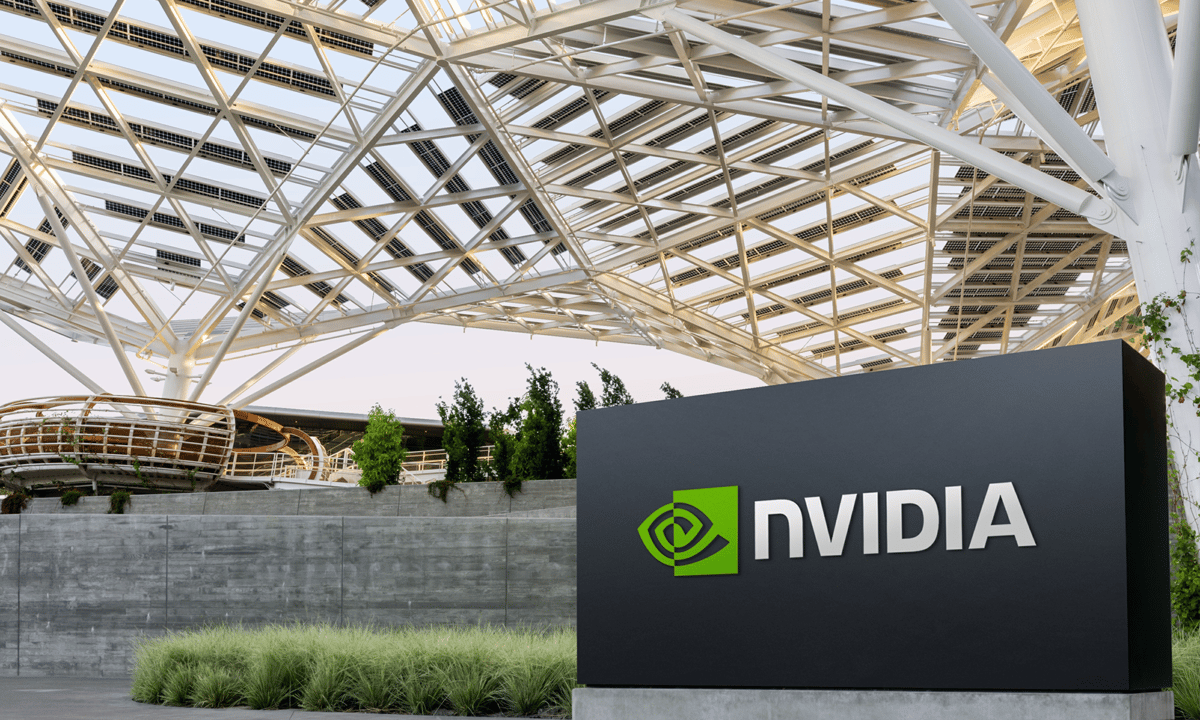
Nvidia's Trillion-Dollar Valuation Hides Opportunity for Long-Term Believers
With a staggering $5.17 trillion market capitalization, Nvidia ($NVDA) has cemented its position as the world's most valuable company—a remarkable achievement for a chipmaker that has become synonymous with artificial intelligence infrastructure. Yet despite this extraordinary valuation and the stock's substantial gains, a compelling investment case remains for long-term shareholders willing to look beyond the headline figures and examine the company's fundamentals. The real question for investors isn't whether Nvidia has already had its moment, but whether the company's extraordinary growth trajectory can continue justifying its market position in an increasingly competitive and capital-intensive AI landscape.
Fundamentals Tell a Remarkable Growth Story
The numbers underlying Nvidia's valuation reveal why the market has rewarded the company so handsomely. Over a three-year period, the company has delivered:
- Revenue growth of 250%, reflecting explosive demand for its AI chips and data center solutions
- Net income growth of 300%, demonstrating operating leverage and margin expansion
- Free cash flow growth of 200%, providing the financial firepower for research, development, and potential shareholder returns
These aren't incremental improvements—they represent the kind of growth typically associated with emerging technology sectors rather than mature semiconductor companies. Nvidia has essentially transformed from a graphics processor manufacturer into the foundational infrastructure provider for the AI revolution, a positioning that has unlocked entirely new markets and customer bases.
Trade valuations present an equally compelling narrative. Despite the stock's run-up to become the world's most valuable company, Nvidia trades at historically depressed valuation multiples relative to its growth rate. This disconnect between the company's valuation metrics and its growth profile suggests that the market may be pricing in significant risks or that investors have become desensitized to the company's exceptional performance metrics. For contrarian investors, this represents potential opportunity rather than excess.
Looking ahead to Q1 earnings, analyst expectations remain robust, with strong results anticipated across the company's core data center business and emerging applications in cloud computing, autonomous vehicles, and enterprise AI deployments. The earnings report could provide another inflection point for the stock, particularly if management offers positive forward guidance amid the ongoing AI infrastructure buildout.
The Competitive and Industry Landscape Shifting
The semiconductor and AI chip markets are becoming increasingly competitive, a reality that Nvidia investors cannot ignore. Advanced Micro Devices ($AMD) and Intel ($INTL) continue investing heavily in competitive chip designs, while cloud providers like Amazon ($AMZN), Google ($GOOGL), and Microsoft ($MSFT) are developing proprietary AI accelerators to reduce dependence on Nvidia's products.
However, Nvidia's first-mover advantage, software ecosystem dominance through CUDA, and relationships with the world's largest technology companies provide significant moats. The company's CUDA platform has become deeply embedded in AI development workflows, making switching costs substantial for developers and enterprises. This software advantage, combined with continuous innovation in hardware design, suggests that competitive pressures, while real, may not immediately erode Nvidia's market position.
Regulatory scrutiny presents another consideration. Export controls on advanced AI chips, particularly those destined for China, constrain Nvidia's addressable market and create geopolitical risk. The company has already experienced revenue impacts from these restrictions, and further tightening could weigh on growth rates. Conversely, efforts to develop domestic semiconductor capacity in the United States, Europe, and allied nations could create new opportunities and subsidies that benefit Nvidia's growth.
Why This Matters for Investors
The investment thesis for Nvidia at current valuations rests on several key assumptions:
Secular AI Growth: The artificial intelligence market remains in its infancy relative to long-term potential. If enterprises and cloud providers continue deploying AI infrastructure at accelerating rates, demand for Nvidia's chips could remain robust for years. The company is positioned to capture disproportionate value from this transition.
Multiple Expansion Optionality: Current valuation multiples leave limited room for error, but they also suggest limited upside from multiple expansion if execution remains strong. However, if Nvidia can demonstrate that AI chip demand is truly secular rather than cyclical, multiple expansion could resume.
Capital Intensity Benefits: The massive capital expenditures by cloud providers building AI infrastructure benefit Nvidia disproportionately. As the foundational layer, Nvidia chips are essential to every major AI infrastructure project, creating a powerful structural tailwind.
For long-term investors with a 5-10 year horizon, the case for Nvidia ownership remains defensible despite current valuations. The company's competitive advantages, exceptional financial growth, and position at the heart of the AI revolution provide multiple paths to shareholder value creation. The risk isn't that the stock will underperform due to deteriorating fundamentals—it's that unrealistic expectations are already priced in and that geopolitical, competitive, or macroeconomic shocks could derail the narrative.
The Path Forward
The relevant question for prospective Nvidia investors isn't whether the stock is "cheap" in absolute terms—by most traditional metrics, it isn't. Rather, the question is whether the company's growth trajectory justifies patience and belief in the AI revolution's continuing expansion. History suggests that investors who recognized structural trends in computing (cloud, mobile, internet) and owned the primary beneficiaries were rewarded over multi-year periods, even when valuations looked stretched in the moment.
Nvidia investors should approach the position with clear-eyed realism about execution risks, competitive threats, and valuation dependency on continued exceptional growth. But for those comfortable with volatility and convinced by the secular AI thesis, the company's position as the world's most valuable firm may not be the endpoint of its journey—merely an important milestone.