
Nvidia's $3.2B Corning Investment Powers AI Boom—But Stock Valuation Raises Caution
Corning Incorporated ($GLW) has secured a landmark partnership with Nvidia that underscores the relentless infrastructure buildout required to power the artificial intelligence revolution. Under the multi-year agreement, Nvidia will invest up to $3.2 billion to expand U.S.-based optical component manufacturing capacity at Corning, positioning the materials science company as a critical supplier in the race for AI data center connectivity. The deal represents a significant vote of confidence from one of the world's most valuable semiconductor companies, yet raises a crucial question for investors: has the market already priced in this growth opportunity?
The partnership marks a watershed moment for Corning's optical communications division, which has become increasingly vital as data centers grapple with exponential bandwidth demands from AI model training and inference workloads. The strategic alliance includes the construction of three new manufacturing facilities dedicated to optical interconnect products, along with a 10-fold increase in optical connectivity capacity to meet Nvidia's specifications and broader industry demand. This manufacturing expansion represents a tangible, capital-backed commitment that extends well beyond typical vendor relationships.
A Business Transformation Built on AI Momentum
Corning's fundamentals paint a compelling narrative for growth-oriented investors, with the company's optical communications segment delivering 36% sales growth in recent periods. The division has already secured multibillion-dollar customer agreements that provide revenue visibility and reduce execution risk. These aren't speculative ventures—they reflect concrete contractual commitments from hyperscale cloud providers and infrastructure operators frantically upgrading their data centers to support AI applications.
The optical communications market itself has become a bottleneck in the AI infrastructure supply chain. While Nvidia dominates GPU production and semiconductor fabs race to increase chip output, the "last mile" problem persists: getting data efficiently between processors, storage systems, and across data centers requires specialized fiber optic and photonic components. Corning's expertise in glass manufacturing and optical materials positions the company uniquely to capitalize on this infrastructure imperative. The company's ability to scale production—a historically challenging task for specialized manufacturing—now has Nvidia's financial backing and technical collaboration, reducing timeline risk.
Market Context: Competition and Valuation Concerns
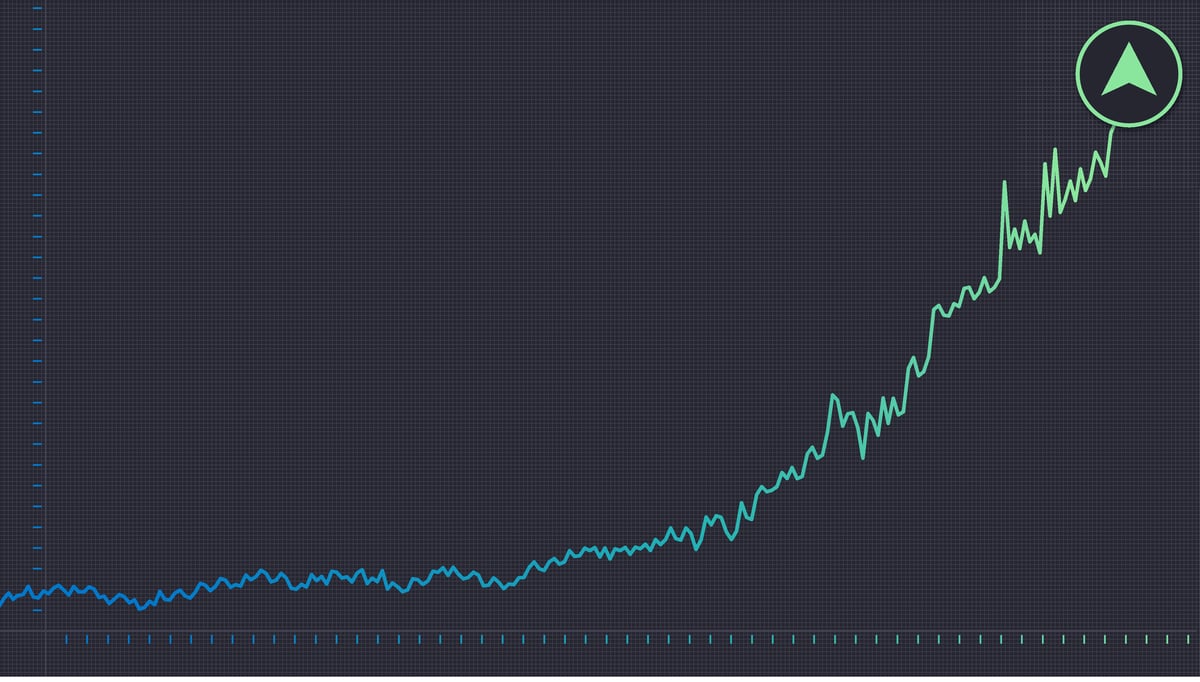
Yet the financial markets have already substantially rewarded Corning ($GLW) for this opportunity. The stock has surged 315% over the past 12 months, a performance that reflects growing investor enthusiasm for data center infrastructure beneficiaries. More concerning, $GLW trades at approximately 60x forward earnings, a valuation multiple that typically signals market expectations have run well ahead of near-term fundamentals.
This valuation context matters significantly when assessing the Nvidia partnership announcement:
- Valuation compression risk: The 315% gain leaves limited room for positive surprises; most of the growth narrative appears already embedded in the stock price
- Execution uncertainty: Scaling manufacturing capacity to 10x current levels involves supply chain, regulatory, and operational complexities that could experience delays
- Competitive dynamics: Other optical component manufacturers, including companies like II-VI Incorporated and international players, may also expand capacity or improve technology, pressuring margins
- Customer concentration: Heavy reliance on Nvidia and a few hyperscale customers introduces revenue concentration risk despite the multibillion-dollar agreements
The optical communications sector remains highly competitive, with established players and new entrants eyeing the same AI infrastructure opportunity. While Corning's partnership with Nvidia provides competitive advantage, the market has likely capitalized this advantage substantially given current valuation levels.
Investor Implications: Growth Potential vs. Valuation Reality
For equity investors, this announcement presents a classic scenario where exceptional business fundamentals collide with stretched valuations. Corning's 36% growth rate in optical communications is genuinely impressive, and the Nvidia partnership validates the company's strategic positioning. The $3.2 billion investment commitment demonstrates confidence that extends beyond rhetoric into concrete capital allocation.
However, the 60x forward earnings multiple represents a significant execution requirement. The stock price essentially assumes:
- Flawless execution on manufacturing capacity expansion
- Sustained 30%+ growth rates in optical communications for multiple years
- No significant margin pressure from competitive intensity
- Continued hyperscale data center investment at present pace
For long-term investors with a multi-year horizon, the partnership fundamentals remain sound. The AI infrastructure build-out will likely persist for years, and optical connectivity represents a genuine constraint. Corning's partnership with Nvidia provides tangible advantages in securing customer relationships and capital for expansion.
Conversely, traders and investors seeking entry points might prefer to wait for valuation normalization. A correction toward 40-50x forward earnings would still reflect substantial growth expectations while providing more attractive risk-reward positioning. The announcement itself doesn't necessarily justify current valuation levels; it validates business trends already reflected in the stock's 315% appreciation.
The broader market context also matters. As the Fed maintains higher-for-longer interest rates and investors reassess technology sector valuations, profitable but expensive growth stocks face headwinds. Corning's partnership with Nvidia is genuinely significant, but it shouldn't override fundamental valuation discipline.
The Nvidia-Corning partnership represents exactly the type of transformative business opportunity that justifies premium valuations—but only when valuation remains proportionate to achievable growth. At current prices, $GLW has captured substantial appreciation from AI infrastructure trends. Investors should monitor execution over the coming quarters before adding to positions at these levels, while recognizing that long-term demand fundamentals for optical connectivity in AI data centers remain genuinely strong.