
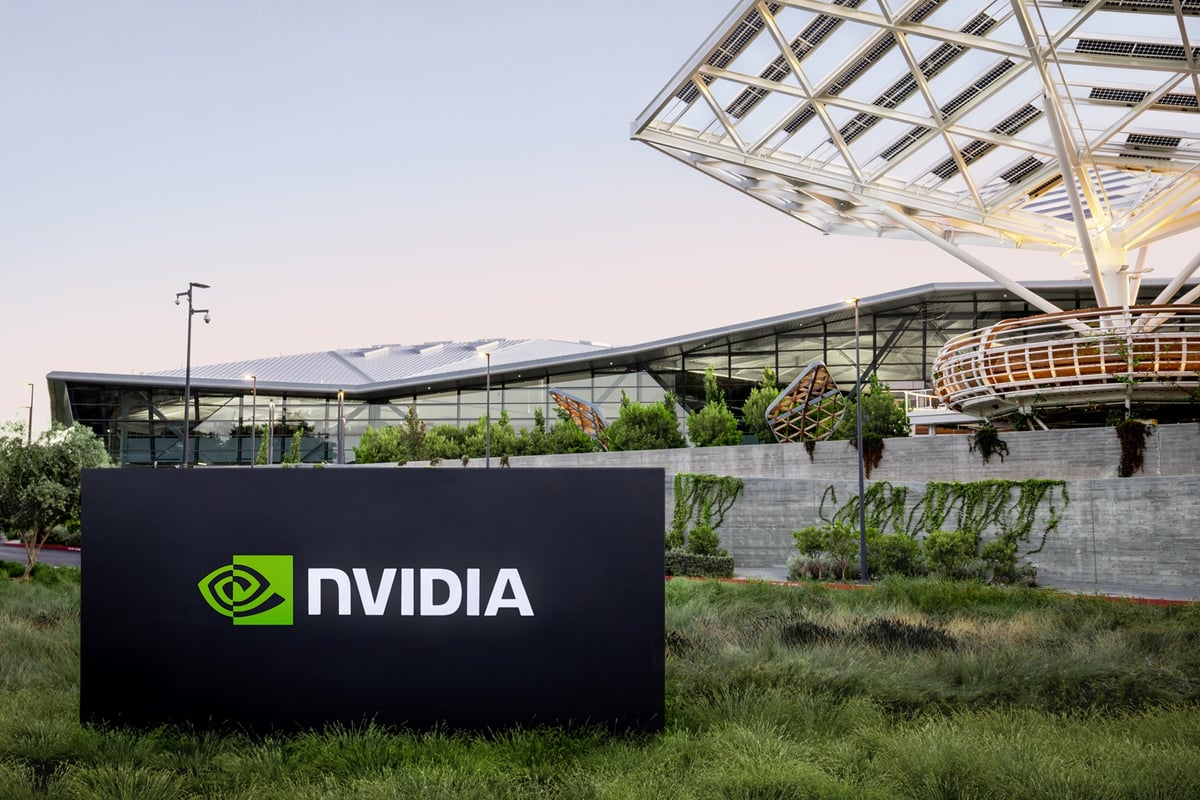
Nvidia is poised to report its fiscal 2027 first-quarter earnings on May 20, with Wall Street anticipating a dominant performance that would further cement the chipmaker's stranglehold on artificial intelligence infrastructure. Analysts expect the company to deliver $1.77 in earnings per share alongside a remarkable 78% year-over-year revenue surge, extending a remarkable earnings-beat streak that has defined the company's rise to become the world's most valuable corporation. Most notably, CEO Jensen Huang has projected that Blackwell and Vera Rubin processors will generate approximately $1 trillion in aggregate sales across 2026 and 2027, a forecast that underscores management's confidence in sustained AI chip demand from hyperscalers building out their generative AI infrastructure.
The Numbers Behind the Momentum
The anticipated 78% year-over-year revenue growth represents a deceleration from the extraordinary triple-digit growth rates Nvidia achieved during fiscal 2026, yet still towers above typical semiconductor industry expansion. The $1.77 EPS expectation reflects analysts' confidence that the company's legendary operational leverage—where incremental revenue translates disproportionately to earnings—continues to function at near-perfect efficiency.
The $1 trillion sales projection for Blackwell and Vera Rubin across 24 months deserves particular scrutiny:
- Blackwell architecture represents Nvidia's next-generation flagship GPU designed specifically for large language model training and inference
- Vera Rubin processors target specialized applications within the AI and scientific computing domains
- The $1 trillion figure implies annual run-rates approaching $500 billion for these product lines alone—comparable to the entire current revenue base of most Fortune 500 technology companies
- This forecast would position Nvidia as a multi-trillion-dollar annual revenue company by 2027 if realized
Investors should note that Nvidia has built a consistent track record of surpassing analyst expectations. The company's earnings beats have become so routine that Wall Street often adjusts guidance upward in anticipation of management's forward commentary, creating a self-reinforcing cycle of positive surprises.
Market Context: The AI Infrastructure Oligopoly
The backdrop for Nvidia's fiscal Q1 results reflects a transformative moment in computing architecture. The explosive demand for AI chips stems from a concentrated customer base—primarily Microsoft, Amazon Web Services, Alphabet's Google Cloud, and Meta—that collectively spent an estimated $60+ billion on AI infrastructure in 2024 and continues to accelerate capital expenditures into 2025 and beyond.
Nvidia's competitive moat has widened considerably since the generative AI inflection point in late 2022. While competitors including Intel ($INTC), Advanced Micro Devices ($AMD), and emerging players like Cerebras and Graphcore offer alternative solutions, Nvidia's combination of hardware performance, software ecosystem (CUDA), and supply chain relationships creates what analysts describe as a "three-to-five year head start" in the race for AI chip market dominance.
The semiconductor sector broadly has transitioned from a cyclical, commoditized industry to a critical strategic asset in the global technology race. U.S. and international governments have signaled their intent to reduce dependence on Taiwan-manufactured chips through initiatives like the CHIPS Act, yet Nvidia's own manufacturing remains outsourced to Taiwan Semiconductor Manufacturing Company (TSMC), creating geopolitical complexities that could reshape supply chains throughout the decade.
Investor Implications: Valuation, Saturation, and Sustainability
For shareholders and prospective investors, the May 20 earnings report arrives at a critical juncture. Nvidia's valuation has expanded to levels where even stellar execution requires confirmation that the AI infrastructure buildout will sustain multi-year growth trajectories. Key questions investors should monitor during the earnings call and forward guidance:
Revenue Sustainability: Can Nvidia maintain 70%+ year-over-year growth rates through 2026-2027, or does the law of large numbers inevitably compress growth percentages even as absolute revenue dollars remain enormous? The $1 trillion Blackwell/Vera Rubin projection suggests management believes the answer is affirmative, but this requires continuous new customer acquisition and higher per-unit pricing power.
Customer Concentration Risk: The hyperscaler cohort represents an estimated 85%+ of Nvidia's current GPU revenue. While this concentration fuels growth, it also means any slowdown in cloud provider AI capex directly threatens financial momentum. Fiscal Q1 commentary on customer demand signals will therefore receive intense scrutiny.
Supply Chain Constraints: Despite TSMC's massive capacity expansions, some analysts question whether manufacturing capacity can keep pace with demand for advanced process nodes. Any indication that supply constraints are easing—or conversely, tightening further—could significantly impact forward guidance credibility.
Pricing Power: Nvidia's average selling prices for flagship GPUs have remained remarkably stable despite competitive pressures, suggesting extraordinary pricing power. Sustaining this power becomes increasingly difficult as market maturity increases and customers gain bargaining leverage through volume commitments.
The stock's current valuation—trading at a premium multiple even relative to other mega-cap technology names—leaves limited room for disappointment. A miss against the $1.77 EPS expectation or downward guidance revision could trigger a meaningful correction, while a beat and raised guidance would likely drive another valuation re-rating upward.
As Nvidia navigates from the initial gold-rush phase of AI infrastructure buildout toward a more mature market structure, the May 20 earnings event will serve as a critical checkpoint. Investors should focus less on whether results beat consensus expectations—Nvidia has trained the market to expect that outcome—and instead concentrate on management's candid assessment of demand sustainability, competitive pressures, and the realistic timelines for converting the $1 trillion opportunity into realized revenue and profits. In an environment where $3+ trillion in AI infrastructure is projected to be deployed globally through the end of the decade, Nvidia's execution trajectory will significantly influence not just the semiconductor sector, but the entire technology landscape and broader market valuations.