
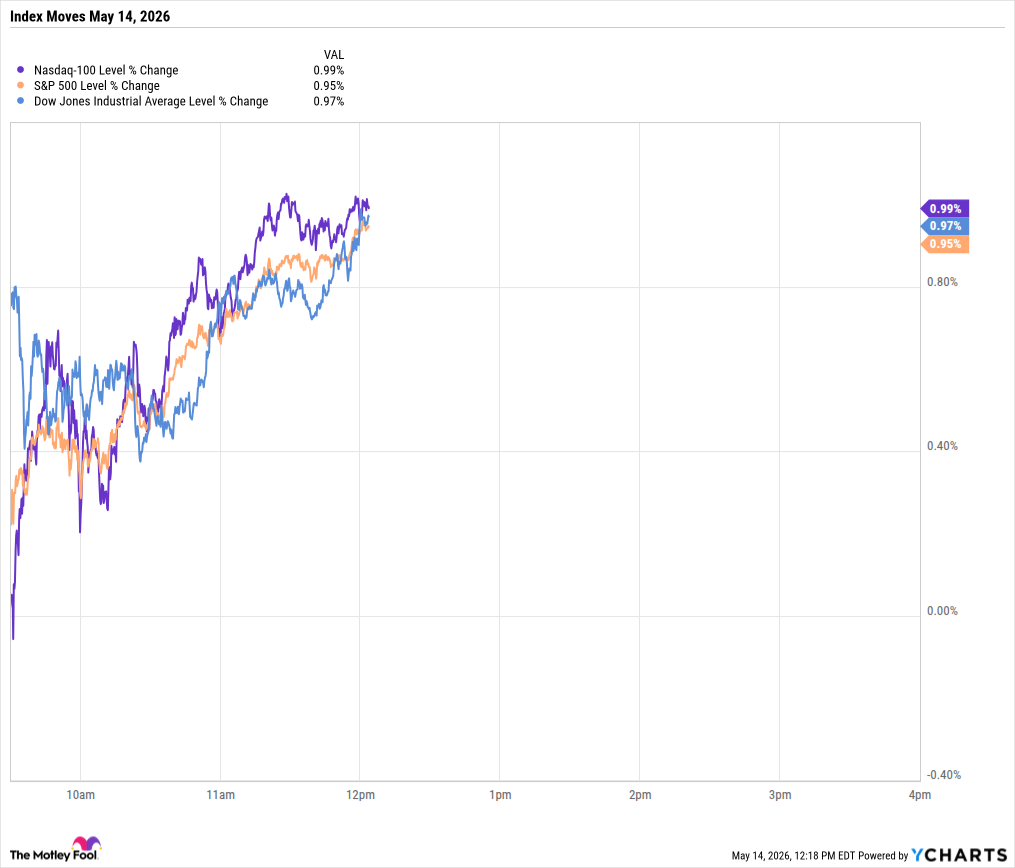
Historic Milestone Marks Investor Confidence in AI-Driven Markets
The Dow Jones Industrial Average crossed the 50,000 mark for the first time in history on May 14, 2026, signaling sustained investor appetite for equities despite persistent macroeconomic uncertainties. The milestone reflects a broader market rally, with all three major indexes gaining approximately 1% during the trading session. The surge was propelled primarily by strength in artificial intelligence-related equities, particularly semiconductor manufacturers positioned at the forefront of the AI infrastructure boom.
The historic breakthrough underscores a fundamental shift in market dynamics, where technology stocks—especially those in the AI chip sector—have become the primary drivers of index performance. Nvidia and Broadcom emerged as the session's standout performers, leveraging positive regulatory developments and market enthusiasm to fuel the broader equity advance. This concentration of gains in a narrow set of mega-cap tech stocks raises important questions about market breadth and the sustainability of the current rally structure.
Regulatory Approval and Semiconductor Tailwinds Drive Trading Activity
The catalyst for the market's upward momentum centered on Nvidia's regulatory approval to sell its H200 accelerators in China—a development that removes a significant constraint on the semiconductor giant's addressable market. The approval represents a potential inflection point for Nvidia, which has faced restrictions on advanced chip exports to China in recent years due to national security concerns.
Key market developments from the session include:
- Dow Jones Industrial Average reached 50,000 for the first time ever
- Major indexes gained approximately 1% across the board
- Nvidia and Broadcom led semiconductor sector higher following regulatory approval
- Cisco surged 17% following earnings announcement
- Boeing declined 4.5% despite positive trade news developments
The approval of H200 accelerator sales carries substantial implications for Nvidia's revenue trajectory, given China's status as a critical market for AI infrastructure buildout. The company has invested heavily in research and development for AI training and inference hardware, positioning itself as the dominant supplier of GPUs for large language model development and deployment. Access to the Chinese market, previously constrained by export controls, represents a meaningful upside to current consensus estimates.
Broadcom, which provides essential networking and telecommunications infrastructure components for data centers, benefited from the broader semiconductor enthusiasm. The company has positioned itself strategically to capture demand from hyperscalers upgrading their infrastructure to support AI workloads. The stock's outperformance reflects investor recognition of Broadcom's integral role in the AI supply chain.
Market Context: AI Dominance and Valuation Questions
The market's continued fixation on AI-related equities reflects a fundamental belief that artificial intelligence represents the next transformative technological wave. This conviction has driven valuations for leading semiconductor stocks to historically elevated levels, with market participants willing to pay significant premiums for exposure to AI infrastructure plays.
Cisco's unexpected 17% jump on earnings results demonstrates that AI enthusiasm extends beyond pure-play chip stocks. The networking equipment manufacturer likely benefited from investor enthusiasm regarding its positioning within enterprise AI adoption cycles and data center modernization trends. Cisco's strong earnings reaction suggests that the market continues to reward companies demonstrating concrete progress in capitalizing on AI-driven infrastructure spending.
Conversely, Boeing's 4.5% decline despite positive trade news illustrates the selective nature of current market enthusiasm. The aerospace and defense giant appears to be trading in a different narrative—one focused on supply chain normalization, production ramp challenges, and geopolitical uncertainties—rather than benefiting from the broader technology tailwinds propelling the market higher. The divergence between Boeing's fundamentals and the AI-driven rally highlights the concentration risk embedded in current market structure.
The semiconductor sector has emerged as the clear market leader, with investors viewing chip manufacturers as essential infrastructure plays for the AI era. This positioning has created a self-reinforcing dynamic where positive developments—regulatory approvals, capacity announcements, or earnings beats—trigger substantial outperformance. However, the concentration of market gains in a narrow segment raises questions about whether the broader market is sufficiently capturing the benefits of AI adoption across multiple sectors and industries.
Investor Implications: Concentration Risk and Valuation Sustainability
For equity investors, the Dow's 50,000 milestone presents a complex backdrop. While the milestone itself is psychologically significant and reflects nominal market appreciation over decades, the mechanism driving recent gains warrants careful analysis. The disproportionate outperformance of AI-related stocks has created a top-heavy market structure where a small number of mega-cap technology names significantly influence broad index performance.
Key considerations for investors include:
- Concentration risk: AI chip stocks driving index gains creates vulnerability if sentiment shifts
- Valuation sustainability: Premium multiples assigned to AI plays depend on earnings growth materializing
- Regulatory environment: Government approval of chip sales (as evidenced by Nvidia's China approval) remains critical to investment thesis
- Market breadth: Divergence between AI leaders and other sectors suggests uneven economic participation
- Competitive dynamics: Semiconductor market faces potential supply chain normalization as demand moderates
For shareholders in Nvidia, Broadcom, and similarly positioned companies, the regulatory approval for H200 sales represents material upside to growth projections. The Chinese market represents an enormous opportunity, and removal of export restrictions could accelerate revenue and profit growth trajectories. However, investors should monitor whether regulatory approval translates into actual demand from Chinese enterprises and whether the Chinese government develops indigenous alternatives to reduce dependence on U.S. semiconductor exports.
The 17% rally in Cisco suggests that enterprise AI spending extends beyond pure infrastructure plays, potentially supporting valuations across a broader swath of technology names. However, the divergence with Boeing demonstrates that not all large-cap companies are benefiting equally from current market dynamics. Investors seeking exposure to AI trends should evaluate whether current valuations adequately reflect execution risks and competitive pressures.
Looking Ahead: Sustainability and Market Breadth
The Dow's breakthrough to 50,000 represents an undeniable achievement for equity markets and reflects decades of nominal economic growth and capital accumulation. However, the mechanism driving recent gains—concentrated outperformance by AI-related semiconductors—warrants monitoring for sustainability.
Market participants should focus on several forward-looking indicators: whether earnings growth for AI-exposed companies materializes at levels justifying current valuations, whether regulatory developments continue supporting semiconductor export opportunities, and whether AI infrastructure spending drives broader economic growth beyond the technology sector. The 50,000 milestone itself is largely symbolic, but the underlying market structure creating the conditions for this achievement deserves scrutiny from investors concerned about concentration risk and valuation sustainability in an environment where a handful of technology stocks exert outsized influence on broad indexes.