
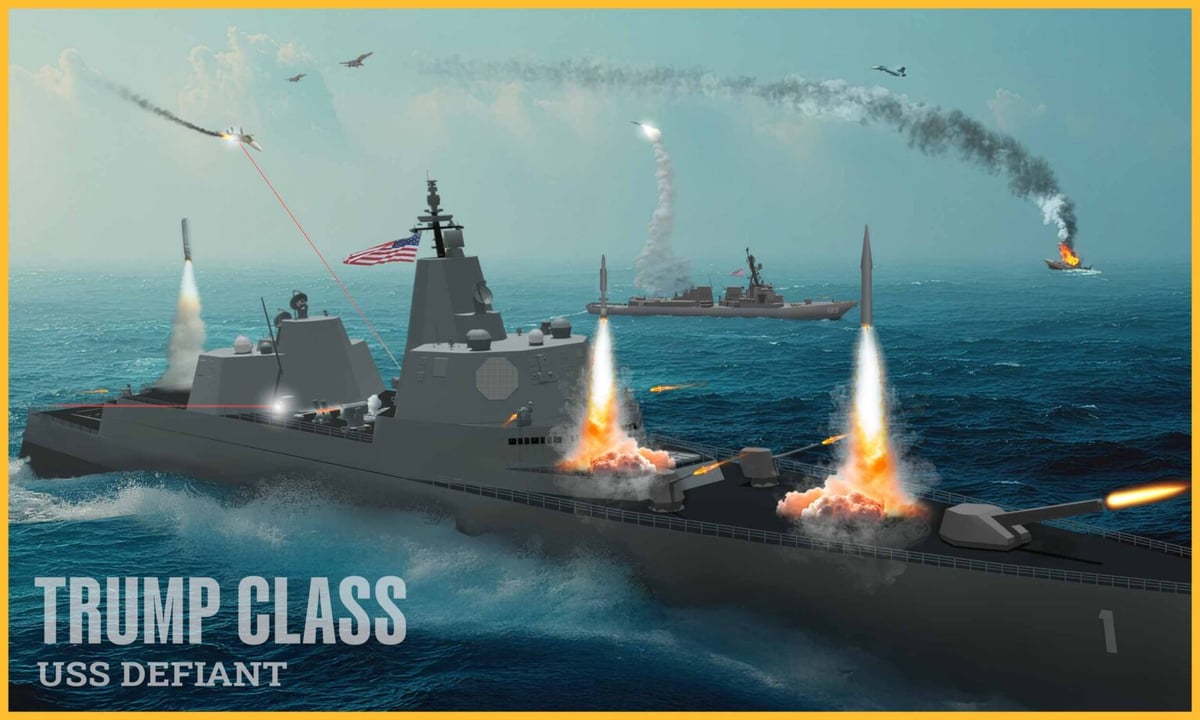
Trump's $255 Billion Nuclear Battleship Initiative Signals Major Defense Spending Shift
President Trump has unveiled an ambitious proposal to construct 15 nuclear-powered Defiant-class battleships at an estimated total cost of $200-255 billion, marking a potential seismic shift in U.S. naval strategy and defense procurement spending. The initiative would represent one of the largest military construction programs in recent history, with individual vessels projected to cost approximately $14.5 billion each—a price tag that rivals the cost of a single Ford-class aircraft carrier. The proposal immediately captured attention from major defense contractors and military analysts, who see the program as a potential catalyst for reshaping the U.S. Navy's force structure and generating significant long-term revenue streams.
The Battleship Program: Scale and Cost Structure
The ambitious scope of Trump's battleship proposal centers on the creation of an entirely new class of warship designed to project American naval power across global waters. Key financial metrics and program parameters include:
- Total program cost: $200-255 billion across the fleet
- Individual vessel cost: Approximately $14.5 billion per ship
- Fleet size: 15 nuclear-powered Defiant-class battleships
- Construction timeline: Multi-year program spanning potentially 15-20+ years
- First-of-class premium: Initial ship costs typically exceed subsequent production vessels
The per-ship cost of $14.5 billion positions these battleships in the ultra-premium military vessel category, placing them in direct financial comparison with Ford-class aircraft carriers, which similarly cost in the $13-15 billion range when accounting for total program costs. This pricing structure reflects the significant research, development, engineering, and advanced technology integration required for nuclear-powered warships designed for extended blue-water operations.
The nuclear propulsion component represents a critical cost driver, as these vessels would require advanced reactor systems, specialized fuel handling infrastructure, and extensive safety systems. Extended deployment cycles enabled by nuclear power—potentially 20+ years between refueling—justify the substantial upfront investment for military planners focused on sustained force projection capabilities.
Market Context: Defense Contracting and Industry Implications
Two major defense contractors emerge as the primary beneficiaries of this proposed initiative: General Dynamics and Huntington Ingalls Industries (HII), which dominate the U.S. naval shipbuilding landscape. These companies have historically captured the majority of large-scale military vessel construction contracts through their respective divisions.
General Dynamics operates through its Electric Boat division in Connecticut, which specializes in nuclear submarine construction and has extensive expertise in nuclear propulsion systems—critical capabilities for this battleship program. Huntington Ingalls, meanwhile, operates Ingalls Shipbuilding in Mississippi, a facility with decades of experience constructing large-displacement naval vessels and amphibious platforms.
The broader defense sector context reveals several important dynamics:
- The U.S. defense budget has experienced sustained growth post-2020, with naval modernization representing a strategic priority
- China's expanding naval capabilities have driven Pentagon analysis favoring large-displacement combat vessels
- Nuclear propulsion technology development has received accelerated focus through programs like the Columbia-class submarine construction
- Shipbuilding capacity constraints in the U.S. have created bottlenecks for simultaneous large programs
- Long-term sustainment and maintenance contracts often exceed construction costs over vessel service lives
Competitively, this program could shift market dynamics by absorbing significant industrial capacity, potentially affecting timelines and costs for other naval construction initiatives. The proposal also signals potential changes in Navy force structure strategy, moving away from carrier-centric naval doctrine toward a more distributed battleship-based approach.
Revenue Potential and Long-Term Financial Impact
For defense contractors, the financial implications extend far beyond initial construction contracts. A $200-255 billion program generates substantial revenue across multiple dimensions:
Construction Phase Revenue: With first ships costing ~$14.5 billion and subsequent production vessels potentially declining 15-25% in unit cost through manufacturing learning curves, the program could distribute $200-255 billion across both lead contractor and subcontractors over 15-20 years. This translates to $10-17 billion in annual industry revenue at peak program execution.
Long-Term Sustainment Contracts: Nuclear-powered warships require continuous maintenance, refueling, modernization, and crew training throughout their 40-50 year service lives. Sustainment revenue often equals or exceeds construction costs, potentially adding another $200+ billion in contracting opportunities across the fleet's operational lifetime.
Supply Chain Expansion: The program would require significant expansion of specialized suppliers, component manufacturers, and subsystem integrators, creating secondary market opportunities throughout the defense industrial base.
For General Dynamics and Huntington Ingalls, this program represents potential multi-decade revenue visibility and operating leverage. Both companies have demonstrated strong margins on large naval construction contracts, with gross margins often exceeding 8-12% on defense platforms. A successful battleship program could provide sustained earnings growth and enhance predictability of future cash flows—metrics institutional investors value highly.
Investor Implications and Market Considerations
This proposal carries significant implications for investors analyzing the defense sector:
Positive factors for major contractors:
- Multi-decade revenue visibility from a single program
- High-margin defense spending on advanced systems
- Reduced competition, as few shipyards can execute this scale of work
- Strategic importance likely ensures bipartisan congressional support
- Sustainment revenue extending 40+ years post-construction
Risk and uncertainty factors:
- Program approval requires Congressional appropriation and sustained political commitment
- Construction timelines and costs often exceed initial projections on complex military programs
- Nuclear propulsion technology development adds schedule and cost risk
- Industrial capacity constraints could necessitate facility expansion investments
- Potential congressional pushback on total program cost or prioritization versus carrier programs
The proposal's advancement would likely benefit broader defense supply chains beyond primary contractors, as systems integrators, electronics manufacturers, and specialized component suppliers would capture subcontract opportunities. Investors should monitor Congressional budget discussions and Navy strategic planning documents for program status.
Looking Ahead: Strategic Implications and Program Status
Trump's battleship proposal represents a fundamental reconsideration of American naval force structure, moving away from carrier-centric operations toward large-displacement surface combatants. The $200-255 billion investment signals confidence in distributed surface warfare capabilities as a counterbalance to emerging adversary naval capabilities.
While the proposal faces the substantial hurdle of Congressional authorization and appropriation—particularly given its massive budget implications amid competing defense priorities—the strategic rationale for advanced surface combatants enjoys reasonable support across military and policy circles. Defense analysts widely acknowledge the need for enhanced surface warfare capabilities and long-range strike platforms.
For investors, this initiative warrants close attention regarding program development, contractor selection decisions, and Congressional funding action. Should the proposal advance, primary beneficiaries General Dynamics ($GD) and Huntington Ingalls ($HII) could experience meaningful valuation expansion driven by enhanced earnings visibility and reduced execution risk on long-term contracts. The program exemplifies how geopolitical competition and strategic military doctrine shifts translate into sustained financial opportunity within the defense contracting landscape.