
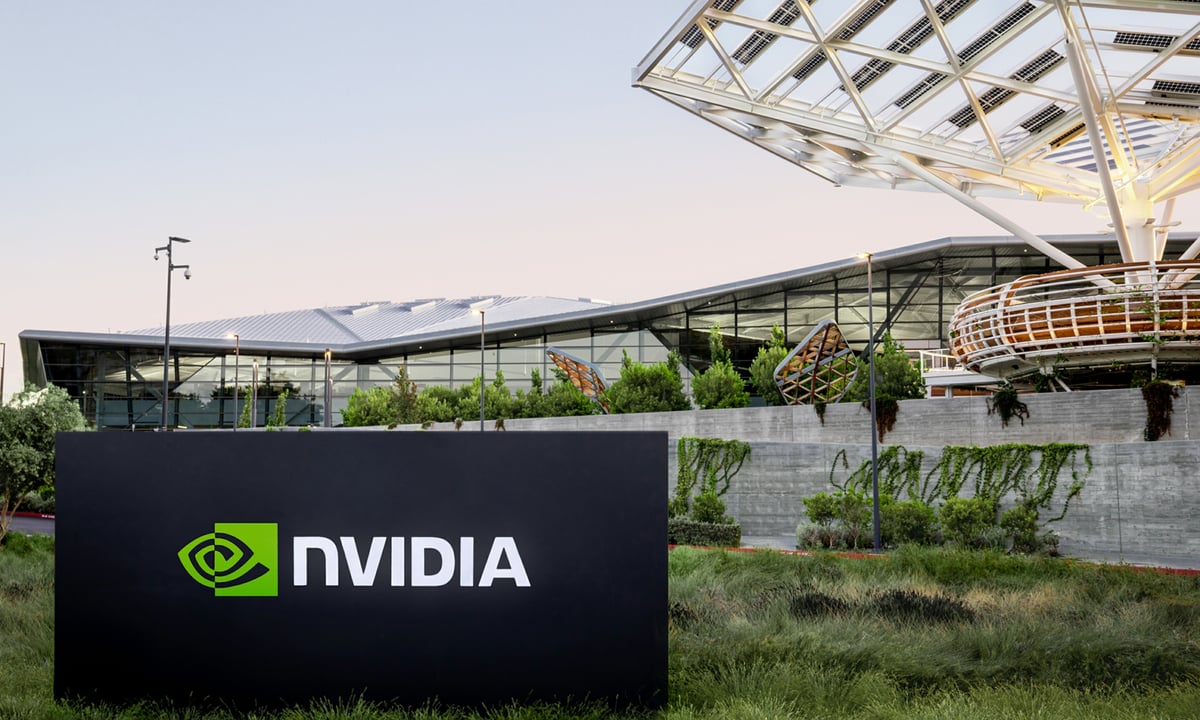
Nvidia Stock Seen Climbing to $430 by 2028 as AI Giant Expands Beyond GPUs
Nvidia, already commanding the world's largest market capitalization at $5.5 trillion, is projected to roughly double in valuation to $10.5 trillion by the end of 2028, with shares trading around $430, according to analyst predictions. The bullish outlook reflects confidence that the GPU powerhouse will successfully transition from a pure chip manufacturer into a comprehensive end-to-end AI infrastructure platform, leveraging strategic investments across data centers, photonics, and wireless networks to entrench its dominance in the artificial intelligence ecosystem.
This ambitious transformation represents a fundamental shift in how Nvidia generates value—moving beyond selling processors to controlling critical segments of the entire AI infrastructure stack. The strategy hinges on a series of multibillion-dollar investments in specialized infrastructure companies positioned to capture value across the AI supply chain, effectively locking in demand and enabling premium pricing throughout the ecosystem.
Strategic Infrastructure Investments: The New Nvidia Playbook
Nvidia's expansion strategy centers on acquiring or investing heavily in companies that address critical gaps in the AI infrastructure value chain. Key targets include:
- CoreWeave: Data center infrastructure and GPU cloud services provider
- Lumentum: Optical and photonic components for high-speed data transmission
- Coherent: Semiconductor equipment and photonics technologies
- Nokia: Wireless networking infrastructure and telecommunications backbone
These investments are designed to create a vertically integrated empire that controls multiple layers of the AI infrastructure stack. Rather than allowing competitors or third-party providers to capture value in adjacent segments, Nvidia is betting that direct ownership or strategic control of these complementary technologies will yield superior returns while simultaneously making it more difficult for rivals to compete.
The photonics investments are particularly significant, as optical technologies are becoming increasingly critical for connecting and cooling the massive GPU clusters required for AI workloads. Similarly, data center infrastructure investments ensure that Nvidia benefits directly from the infrastructure buildout required to support AI adoption, while wireless networking plays gives the company exposure to 5G and beyond, where AI compute will be increasingly distributed.
Market Context: Consolidation in an AI-Centric World
The semiconductor industry has historically been fragmented, with different companies specializing in different layers of the stack. Nvidia's strategic pivot reflects a broader trend toward vertical integration and ecosystem control among dominant platform companies. In parallel with Nvidia's infrastructure expansion, competitors are pursuing different strategies:
- Intel ($INTL) faces existential challenges and has shifted focus toward foundry services
- AMD ($AMD) competes aggressively in data center but lacks comparable infrastructure leverage
- Taiwan Semiconductor Manufacturing Company ($TSM) remains the critical fabrication partner but operates as a foundry rather than an integrated player
- Broadcom ($AVGO) and other infrastructure providers increasingly find themselves dependent on Nvidia's ecosystem decisions
The current environment is characterized by unprecedented capital expenditure from cloud hyperscalers—Amazon ($AMZN), Microsoft ($MSFT), Google ($GOOGL), and others—racing to build AI infrastructure. These companies are investing hundreds of billions annually in GPUs, data centers, and networking. Nvidia's strategy is to ensure that it captures value not just from the chips themselves, but from the entire supporting infrastructure ecosystem that makes those chips functional at scale.
The photonics and data center infrastructure investments are particularly noteworthy given industry trends. High-bandwidth interconnects between GPUs have become critical as AI models grow larger, and optical technologies offer superior bandwidth and thermal efficiency compared to traditional electrical connections. By controlling the photonics layer, Nvidia could effectively set standards for AI infrastructure while generating recurring revenue from components and systems.
Investor Implications: Valuation, Risk, and Growth Trajectory
The path from $5.5 trillion to $10.5 trillion represents approximately 91% growth over roughly four years, implying an annualized growth rate of roughly 17-18%. This projection assumes several critical developments:
- Sustained AI Demand: Continued exponential growth in AI compute requirements across enterprise, cloud, and emerging applications
- Market Share Preservation: Nvidia maintains dominant market position despite intensifying competition
- Successful Integration: Strategic infrastructure investments generate acceptable returns and create meaningful competitive moats
- Pricing Power: Ability to maintain or expand margins despite massive capital investments
For shareholders, the investment thesis hinges on Nvidia's ability to execute this vertical integration while maintaining profitability. The company will be competing for capital with its core GPU business, which has historically generated extraordinary margins. Diversifying into lower-margin infrastructure businesses requires confidence that ecosystem control will justify the dilution.
The risks are substantial. Integration of acquired companies presents operational complexity, and many infrastructure investments are capital-intensive with longer return cycles than semiconductor design. Additionally, the strategy assumes that hyperscalers and other major customers will accept Nvidia ownership of infrastructure layers rather than building competing alternatives or supporting rival ecosystems. Regulatory scrutiny of Nvidia's market dominance could also constrain its ability to leverage its position across multiple layers of the stack.
Conversely, if the strategy succeeds, Nvidia would emerge as an unparalleled dominant platform in AI infrastructure—analogous to how Microsoft built its enterprise dominance by controlling both operating systems and enterprise software. The valuation multiple expansion from current levels would reflect not just earnings growth but multiple expansion driven by reduced competitive risk and enhanced strategic positioning.
Looking Ahead: The Broader AI Infrastructure Consolidation
The prediction of $430-per-share Nvidia by 2028 reflects a bet on accelerating AI infrastructure consolidation and the value of ecosystem control. Whether this valuation is achievable depends heavily on macroeconomic conditions, sustained AI adoption, Nvidia's execution on integration, and the company's ability to convert strategic investments into genuine competitive advantages.
What's clear is that the semiconductor industry is undergoing structural transformation. No longer is it sufficient to be the best chip designer; controlling the broader ecosystem increasingly determines long-term competitive position and valuation multiples. Nvidia's aggressive moves into adjacent infrastructure segments represent a strategic gambit that, if successful, could reshape competitive dynamics across the technology industry for the remainder of the decade.