
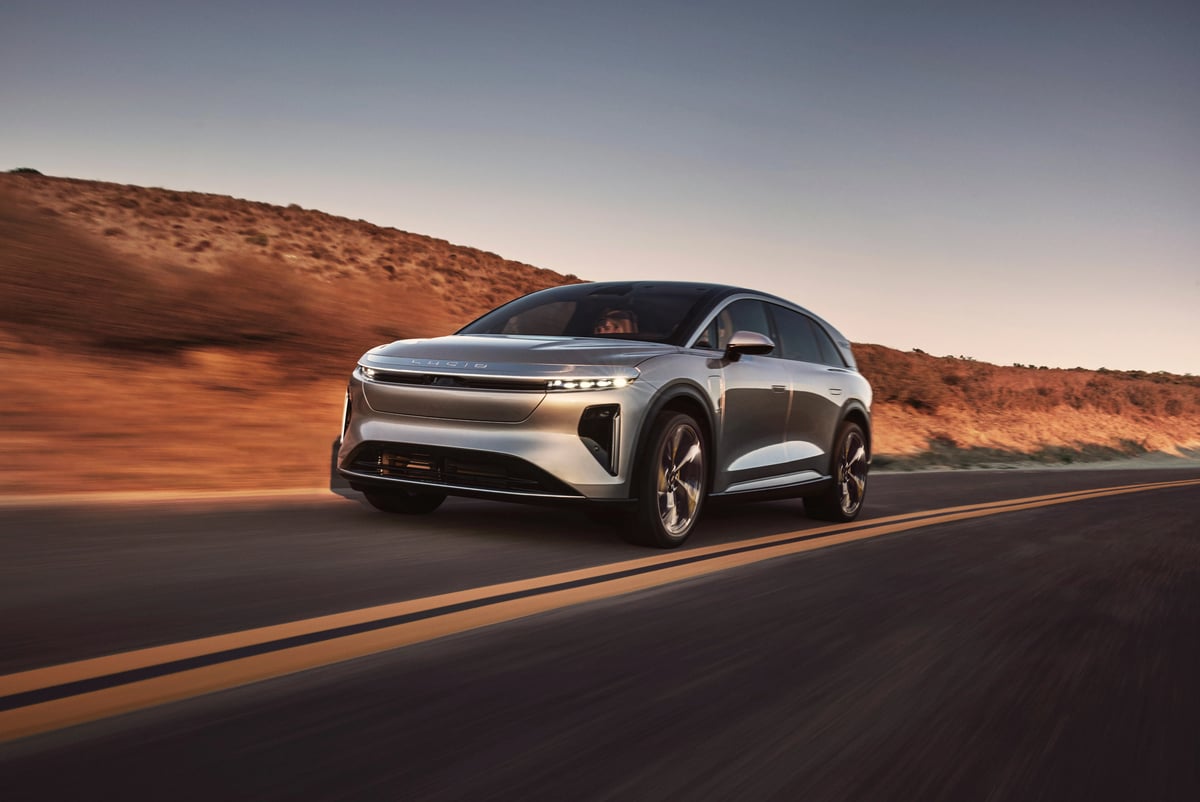
Lucid's Production Woes and Funding Gaps Signal Deep Risks for Investors
Lucid Group faces a precarious financial and operational crossroads as investors weigh the electric vehicle manufacturer's mounting challenges. The company is grappling with persistent production delays affecting its anticipated Gravity SUV, mounting uncertainty around continued backing from Saudi Arabia's Public Investment Fund (PIF), and a troubling lag in gross profitability metrics relative to rival Rivian. These converging headwinds have prompted analysts and investment professionals to urge caution, with many recommending that most retail investors steer clear of the stock entirely.
The obstacles facing Lucid ($LCID) extend beyond typical startup growing pains in the competitive EV sector. The company's ability to execute on its production roadmap remains questionable, while its financial lifeline—dependent heavily on the Saudi sovereign wealth fund—faces renewed scrutiny following PIF's recent decision to withdraw support from the LIV Golf venture. For equity holders and prospective investors, these dynamics create a high-risk environment where execution risk, funding risk, and competitive disadvantage converge.
Production Delays and Operational Execution Risks
At the heart of Lucid's challenges lies a fundamental problem: the company has repeatedly struggled to translate its engineering vision into reliable production volumes. The Gravity SUV, positioned as a critical growth driver for the manufacturer, has experienced significant delays that continue to hamper the company's ability to generate meaningful revenue from expanded product offerings.
Key operational concerns include:
- Delayed Gravity SUV rollout affecting revenue growth projections
- Manufacturing scalability issues limiting production capacity ramp
- Supply chain complications impacting delivery timelines
- Quality control challenges during production scaling
These production headwinds directly impact Lucid's path to profitability. The company has been burning through capital at an alarming rate, and delays in launching and scaling the Gravity SUV extend the timeline for achieving positive gross margins. In the capital-intensive EV manufacturing sector, delays translate directly into cash burn, making execution on production timelines absolutely critical to investor returns.
Funding Uncertainty and Strategic Pivot Risks
Perhaps more concerning than production challenges is the cloud of uncertainty surrounding Lucid's primary source of capital. Saudi Arabia's PIF has been the company's financial anchor, providing crucial funding that has allowed Lucid to continue operations and development. However, recent strategic decisions by the sovereign wealth fund are raising red flags about its commitment to supporting the automaker.
PIF's recent decision to pull support from LIV Golf—despite substantial prior investment—demonstrates a willingness to cut losses and reassess strategic commitments. This move signals that the Saudi fund may be applying increased scrutiny to its portfolio companies, particularly those facing operational challenges or uncertain paths to profitability. For Lucid, this represents a tangible risk: if PIF reassesses its commitment to the automaker, the company's ability to fund operations and capital expenditures could be severely compromised.
The dependency on a single major investor—particularly a foreign sovereign wealth fund—introduces geopolitical and strategic risks that many equity investors prefer to avoid. Changes in PIF's investment priorities, leadership, or broader Saudi economic strategy could leave Lucid scrambling for alternative funding sources in a market that has grown increasingly skeptical of EV startups.
Competitive Disadvantage Against Rivian and Industry Leaders
Lucid faces an increasingly crowded competitive landscape, and its financial metrics paint a troubling picture relative to peers. Most notably, the company's gross profitability progress significantly lags behind Rivian, another EV startup that has struggled but has made relatively more progress on the path toward positive unit economics.
Rivian ($RIVN), while facing its own challenges, has demonstrated:
- Better gross margin trajectories in early production phases
- More diversified revenue streams across multiple vehicle platforms
- Stronger operational scaling in manufacturing facilities
- Better cost control in production ramp-up phases
Beyond Rivian, Lucid competes against better-capitalized legacy automakers pivoting to electric vehicles and well-funded Chinese EV manufacturers like BYD and NIO. The window for EV startups to prove viability is narrowing as the sector consolidates around companies with deeper pockets, proven manufacturing capability, and established distribution networks. Lucid's position—with limited cash reserves, production challenges, and profitability concerns—leaves it vulnerable in this increasingly competitive environment.
Market Context: The EV Startup Reckoning
The broader EV sector has undergone a significant reassessment over the past 18-24 months. The initial euphoria around electric vehicle startups has given way to sober analysis of unit economics, capital requirements, and execution capability. Companies like Rivian, Fisker, and others have faced significant stock price declines as investors recognized that transforming a concept into a profitable, scaled manufacturing business is exponentially harder than initially priced into valuations.
Lucid entered this period of market skepticism at a particularly vulnerable moment—after raising capital at high valuations but before demonstrating the production scale and profitability metrics necessary to justify those valuations. The company's stock has experienced sharp declines as the reality of its operational challenges has become apparent to the broader investment community.
Furthermore, the macroeconomic environment has shifted. Rising interest rates have increased the cost of capital, making it more expensive for cash-burning companies to finance operations. Meanwhile, EV demand has proven more elastic to pricing and economic conditions than some bullish observers anticipated, complicating growth projections for all EV manufacturers, including Lucid.
Investor Implications: Risk Assessment and Portfolio Positioning
For most investors, Lucid ($LCID) presents a risk-reward profile that skews heavily toward risk. The investment thesis relies on several simultaneous positive developments:
- Gravity SUV production ramp exceeding current guidance
- Continued funding from PIF or successful capital raises from alternative sources
- Gross margin improvement at a pace significantly faster than current trajectory
- Market demand for premium electric luxury vehicles remaining strong despite macroeconomic headwinds
Each of these represents a material execution risk. The probability of all four materializing simultaneously appears modest based on current evidence. For equity holders, this creates a scenario where downside risk (further dilution from capital raises, bankruptcy risk, or continued share price decline) appears to outweigh upside potential.
Institutional investors with longer time horizons and higher risk tolerance might view Lucid as a potential recovery play if the company manages to stabilize operations and secure long-term funding certainty. However, for retail investors with limited capital and typical portfolio constraints, most financial advisors recommend avoiding the position entirely or allocating only discretionary capital one can afford to lose completely.
Looking Forward: The Critical Path
Lucid Group stands at a critical juncture. The next 12-24 months will likely determine whether the company survives as an independent entity or faces existential challenges. The company must simultaneously:
- Demonstrate consistent Gravity SUV production at or near guidance levels
- Secure long-term funding certainty beyond near-term capital raises
- Achieve measurable gross margin improvement across its product portfolio
- Preserve cash while investing adequately in manufacturing capacity
Until Lucid demonstrates meaningful progress on these fronts—particularly production execution and gross margin trajectory—the investment case remains highly speculative. For investors seeking exposure to the EV sector, better-positioned peers with stronger balance sheets, clearer paths to profitability, and more proven manufacturing capability present superior risk-adjusted opportunities.
The cautionary stance toward Lucid reflects not a judgment on the company's long-term vision or engineering capabilities, but rather a clear-eyed assessment of execution risks, funding uncertainty, and competitive dynamics in a sector where capital discipline and operational excellence have become prerequisites for survival.