
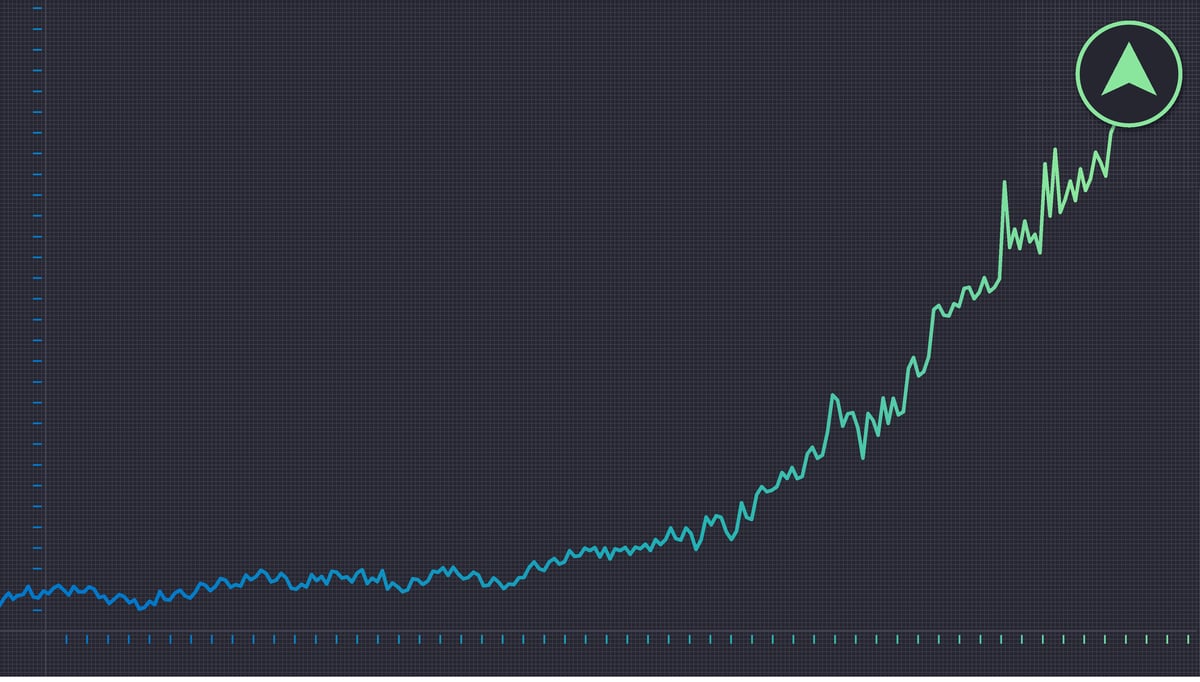
A Historic Milestone Amid the AI Boom
Micron Technology has officially entered the exclusive trillion-dollar valuation club, crossing a historic threshold that cements its position as America's 10th-most-valuable company. The semiconductor manufacturer's stock has surged 19% in recent trading, propelled by an insatiable appetite for memory chips in artificial intelligence infrastructure. This milestone represents a dramatic acceleration in the company's market standing and reflects the seismic shift in investor sentiment toward chipmakers positioned at the center of the generative AI revolution.
Wall Street's enthusiasm for Micron ($MU) appears far from peaked. UBS has become the most bullish analyst on the stock, tripling its price target to an ambitious $1,625 per share—a valuation that would place the company's market capitalization at approximately $1.8 trillion. At that level, Micron would leapfrog both Tesla ($TSLA) and Meta ($META), two of the world's most recognizable mega-cap stocks. Such a scenario, while not consensus among Wall Street analysts, underscores the transformative potential that institutional investors see in Micron's position within the artificial intelligence ecosystem.
The Drivers Behind Exceptional Growth
The dramatic acceleration in Micron's valuation stems from several converging tailwinds that address long-standing structural challenges in the memory semiconductor industry:
- AI-Driven Demand Surge: The explosive growth in large language models and AI data centers has created unprecedented demand for high-bandwidth memory (HBM) and other advanced memory technologies that Micron specializes in manufacturing
- Multi-Year Customer Contracts: Micron has secured long-term supply agreements with major AI infrastructure customers, providing rare visibility and stability in what has historically been a volatile cyclical industry
- Capacity Advantage: As a major memory manufacturer alongside competitors like Samsung and SK Hynix, Micron is positioned to benefit from the structural undersupply of advanced memory chips
- Technology Leadership: The company's advanced manufacturing processes and product portfolio align perfectly with the computing requirements of next-generation AI systems
The combination of these factors represents a potential inflection point for an industry that has long struggled with cyclical overcapacity and commodity-like pricing dynamics. Investors are increasingly betting that the AI era will fundamentally alter the demand-supply dynamics that have plagued memory chip manufacturers for decades. The multi-year customer contracts are particularly significant, as they represent a departure from the spot-market dynamics that historically characterized the memory business.
Market Context: A Semiconductor Sector in Transition
Micron's ascent must be viewed within the broader context of the semiconductor industry's transformation. The AI revolution has created a clear hierarchy among chipmakers, with companies positioned to supply AI infrastructure—including Nvidia ($NVDA), AMD ($AMD), and now Micron—commanding premium valuations relative to their peers.
The memory chip sector, specifically, had been languishing for years prior to the AI boom. Chronic oversupply, price competition, and geopolitical fragmentation had compressed margins and limited growth prospects. Micron, despite its technological capabilities, had seen its market valuation stagnate relative to fabless design companies and foundries like TSMC ($TSM). The AI inflection fundamentally changes this calculus by creating genuine scarcity in the specific memory architectures required for advanced AI systems.
However, it's worth noting that the industry structure remains complex. While Micron benefits from AI demand, it faces competition from Samsung and SK Hynix, both of which are similarly positioned to capitalize on the trend. Additionally, the success of specialized AI chip manufacturers like Nvidia has somewhat obscured the essential role that memory suppliers play—a reality that is finally being reflected in valuations.
Regulatory considerations also matter. The semiconductor industry operates within increasingly complex geopolitical frameworks, particularly regarding export controls to China and Taiwan's strategic importance. Micron's domestic manufacturing footprint in the United States provides some regulatory advantages compared to competitors with greater dependence on Asian production.
Investor Implications: Opportunity and Caution
For investors evaluating Micron at these valuation levels, several critical considerations emerge:
The Bull Case: The structural demand for memory chips in AI infrastructure is likely to be sustained for years. Unlike previous technology cycles that peaked and subsequently crashed, artificial intelligence represents a broad, fundamental shift in computing architecture. Multi-year customer contracts reduce downside risk and provide revenue visibility that memory chip manufacturers have rarely enjoyed. At a $1.8 trillion valuation, Micron would command premium multiples, but potentially justified ones if AI demand proves as durable as investors believe.
The Risk Factors: The memory chip business remains fundamentally cyclical. If AI investment spending moderates, demand could contract sharply. The 19% stock surge and potential path to $1,625 per share implies that a significant portion of the upside scenario is already reflected in current valuations. Any unexpected weakness in customer spending, technological disruption, or geopolitical developments could trigger sharp reversions. Additionally, the intense analyst attention and bullish sentiment create conditions susceptible to mean reversion if reality diverges from expectations.
Investors should also consider competitive dynamics. Samsung and SK Hynix have comparable technological capabilities and may gain market share through aggressive pricing. The concentration of AI infrastructure demand among a few customers also creates customer concentration risk, despite the multi-year contracts.
Looking Forward: Execution Will Determine Value
Micron's transformation from a cyclical commodity chip manufacturer to a critical infrastructure supplier for the AI era represents one of the most significant revaluations in the semiconductor industry. The company's $1 trillion milestone is not merely a numerical achievement but a fundamental reassessment of its strategic importance and long-term earnings power.
Whether Micron ultimately surpasses Tesla and Meta in market capitalization will depend on several factors: the sustained intensity of AI infrastructure spending, the company's ability to maintain or expand market share against competitors, the durability of long-term customer contracts, and broader macroeconomic conditions. The UBS price target of $1,625 represents an ambitious but not implausible scenario if the most constructive AI forecasts prove accurate.
For equity investors, Micron represents a classic growth-at-a-reasonable-price opportunity, albeit at prices that are no longer unreasonably cheap. The key will be monitoring whether demand growth sustains analyst expectations or whether the inevitable cyclical pullback arrives sooner than consensus believes. The next few quarters of customer guidance, quarterly results, and commentary on AI demand sustainability will be critical data points for reassessing the validity of current valuations.