
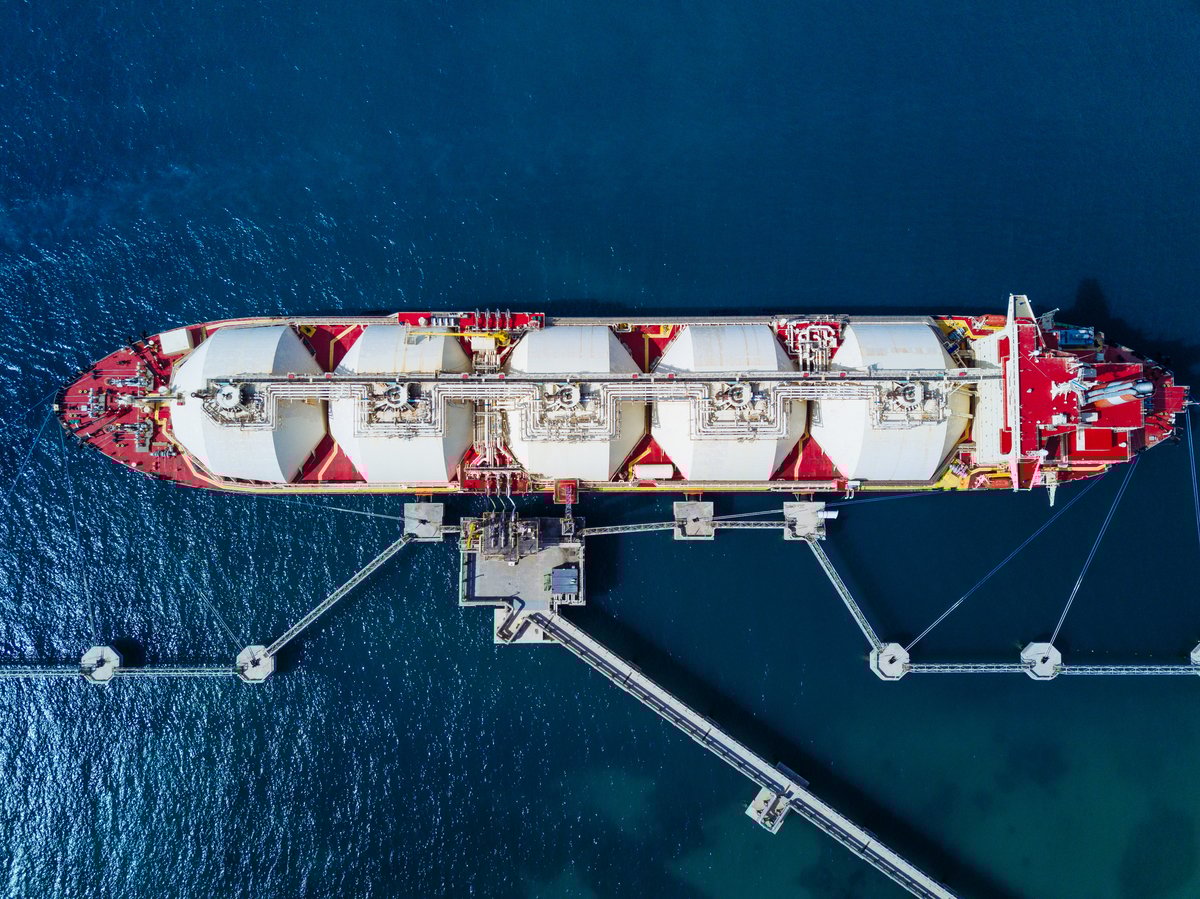
New Fortress Energy Teeters on Brink of Restructuring
New Fortress Energy Inc. ($NFE), a liquefied natural gas (LNG) company once positioned as a growth story in the booming energy sector, finds itself in severe financial distress that threatens to wipe out common equity holders. The company is grappling with nearly $9 billion in total debt, with a staggering $6.5 billion due within the next 12 months, while simultaneously burning cash at an alarming rate. Most critically, New Fortress is already delinquent on approximately $500 million in payments and is actively negotiating with creditors to forestall an outright default—a precarious position that underscores the existential risks facing equity investors.
The company's operational performance tells a grim story. Over the trailing twelve months, New Fortress generated negative free cash flow of $1.73 billion, meaning it consumed far more cash than it produced from operations. This dynamic is particularly treacherous for a highly leveraged company already struggling to service its massive debt burden. The combination of negative free cash flow and near-term debt maturities creates an immediate liquidity crisis that threatens the company's continued viability without dramatic intervention.
The Numbers Behind the Crisis
Understanding the severity of New Fortress Energy's situation requires examining the financial metrics in granular detail:
- Total debt: $9 billion, an enormous liability relative to the company's market capitalization
- Near-term debt obligations: $6.5 billion due within 12 months—representing a crushing refinancing burden
- Current arrears: $500 million in missed payments already owed to creditors
- Trailing twelve-month free cash flow: Negative $1.73 billion, indicating the company is not self-sustaining
- Cash burn rate: Approximately $1.73 billion annually based on current operational performance
These figures paint a picture of a company facing a potential liquidity event. With $6.5 billion in debt coming due imminently and only negative cash generation to show for its operations, New Fortress lacks the internal resources to meet its obligations. The company's negotiation with creditors signals that stakeholders recognize a restructuring—whether informal debt negotiations, a debt exchange, or formal bankruptcy proceedings—may be inevitable.
The $500 million already in arrears is particularly significant. While this represents only about 5.5% of total debt, it signals that the company has already begun missing payments, which typically triggers acceleration clauses in debt covenants. These clauses can require immediate repayment of all outstanding debt, further accelerating the crisis timeline.
Market Context: LNG Sector Strength Masks Company-Specific Troubles
The irony of New Fortress Energy's predicament is that it unfolds against a backdrop of genuine strength in the broader LNG market. Global demand for liquefied natural gas remains robust, driven by:
- Energy security concerns in Europe following geopolitical disruptions
- Asian demand growth as countries seek alternatives to coal and renewables
- Natural gas price strength, which typically supports LNG project economics
- Long-term contracting trends favoring LNG suppliers with stable production capacity
However, New Fortress Energy's troubles are company-specific rather than sector-wide. While competitors like Cheniere Energy ($LNG) and other well-capitalized LNG producers have benefited from favorable market conditions, New Fortress appears to have miscalculated its capital requirements, cash generation timeline, or execution risks when taking on its debt load.
The company does possess valuable assets in a growing market—a significant mitigating factor. Its LNG infrastructure, production capacity, and contracted revenues represent real economic value. However, the structure of financial distress means these assets will primarily benefit creditors through a restructuring process, not common shareholders. In bankruptcy or debt restructuring scenarios, the absolute priority doctrine and creditor hierarchies typically result in common equity being written down to zero before creditors experience significant losses.
Investor Implications: Equity in Restructuring Rarely Survives
For common shareholders considering investment in New Fortress Energy, the situation presents a stark reality: the company is highly likely to undergo a significant restructuring that will dramatically dilute or eliminate equity value. Several factors explain why:
The math of the capital structure: With $9 billion in debt and negative free cash flow, there is no path to organic deleveraging. The company cannot grow its way out of this problem or wait for market conditions to improve. Only a substantial reduction in debt through refinancing, exchange, or bankruptcy can resolve this situation.
Creditor prioritization: When companies restructure, creditors sit ahead of equity holders in the capital stack. Assuming the company's assets are worth $7-8 billion (a reasonable estimate for a going-concern LNG producer), creditors holding $9 billion in claims would experience losses but likely recover a majority of their principal. Common equity, by contrast, would typically be eliminated entirely to make creditors whole.
The negotiation trajectory: The fact that New Fortress is already negotiating with creditors suggests informal restructuring discussions are underway. These negotiations typically conclude with some form of debt exchange (where creditors convert debt into equity) or a refinancing at punitive terms. In either case, existing common shareholders face severe dilution.
Time decay and option value: For equity holders, the situation worsens with each passing quarter. As the company burns cash and debt maturities approach, the window for avoiding formal bankruptcy narrows. Meanwhile, negotiations increasingly favor creditors as they gain bargaining power from the company's deteriorating liquidity position.
For investors, the fundamental question is whether the potential upside—if markets improve, asset values rise, and the company somehow avoids restructuring—justifies the downside risk of complete equity loss. Given the near-certainty of restructuring under current conditions, this calculus tilts heavily toward avoidance for risk-averse investors.
Forward Outlook: The Restructuring Path Ahead
New Fortress Energy's immediate future will likely involve one of three scenarios: (1) an out-of-court debt restructuring where creditors exchange debt for equity or extend maturities; (2) a formal Chapter 11 bankruptcy that achieves the same result in a court-supervised process; or (3) asset sales or operational changes that dramatically improve cash generation.
The third scenario is possible but increasingly unlikely given the company's operational constraints and market conditions. The first two scenarios are not mutually exclusive—informal negotiations often precede formal bankruptcy if creditors cannot agree on terms.
Common shareholders must recognize that their equity stake is a junior claim on assets that are already pledged to support $9 billion in debt. In restructuring, the goal is typically to reduce debt to sustainable levels relative to operational cash flow. If the company generates $400-500 million in annual EBITDA (a reasonable estimate for an LNG producer), sustainable debt would be in the $3-4 billion range. That implies $5-6 billion in debt will be written off—a loss that falls primarily on junior creditors and equity.
The lesson for investors is clear: while New Fortress Energy operates in a structurally attractive industry with real asset value, the company's capital structure has become inverted, with liabilities far exceeding the sustainable debt capacity of its business. Unless there is a dramatic operational improvement or significant asset value discovery, restructuring will transfer wealth from equity holders to creditors. New investors should approach this situation with extreme caution, viewing any investment as highly speculative and appropriate only for those with high risk tolerance and deep conviction in an improbable recovery scenario.