
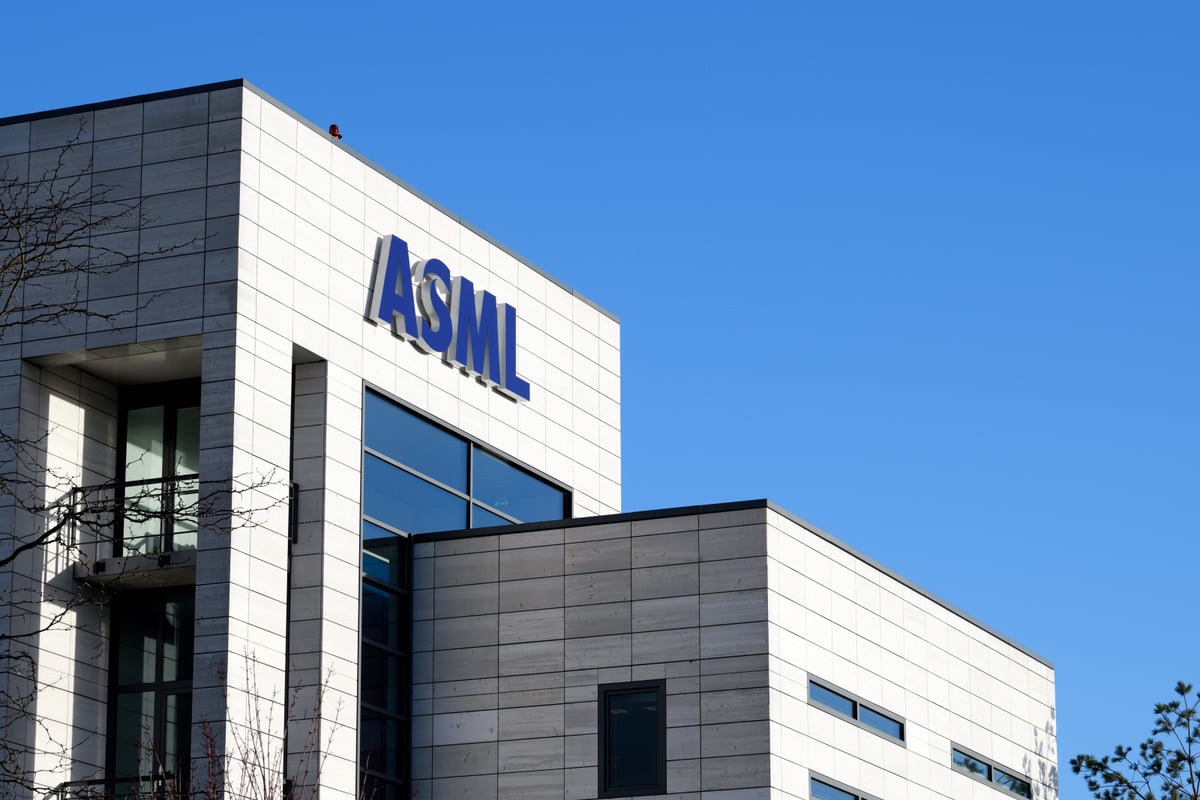
AI Inference Market Set to Explode to $255B: Why $ASML Is the Ultimate Winner
The artificial intelligence infrastructure boom is creating a once-in-a-generation opportunity for semiconductor equipment manufacturers, and ASML Holding NV is uniquely positioned to dominate. With the global AI inference market projected to reach $255 billion by 2030—driven by massive deployment of AI models across enterprise and consumer applications—the semiconductor fabrication equipment supplier holds an almost insurmountable competitive advantage that could deliver outsized returns for shareholders willing to capitalize on the infrastructure buildout.
The Unmatched EUV Monopoly
ASML's dominance stems from its near-complete control of extreme ultraviolet (EUV) lithography technology, the most advanced manufacturing process available for creating cutting-edge semiconductor chips. This isn't simply a technological lead—it's a near-monopoly with formidable barriers to entry.
The company's EUV machines represent the crown jewel of semiconductor manufacturing:
- Unit price: Up to $400 million per machine, making each sale a transformative revenue event
- Maintenance costs: Millions of dollars annually in required service and upgrades, creating a sticky recurring revenue stream
- Technical complexity: No serious competitor has successfully developed competing EUV technology at production scale
- Industry criticality: Essential for producing the most advanced chips required for AI inference workloads
As the global race to build AI inference capacity intensifies—with companies like NVIDIA ($NVDA), AMD ($AMD), and custom chip designers requiring cutting-edge manufacturing—demand for ASML's equipment will surge. Every new advanced semiconductor fab that comes online globally requires ASML's machines. There is no alternative supplier of comparable capability.
The financial implications are staggering. With each machine generating $400 million in upfront revenue plus millions in annual maintenance fees, ASML is essentially printing money from the AI infrastructure buildout. Unlike chip manufacturers themselves, ASML collects revenue before the inference chips are even sold, de-risking its business model.
Market Context: The AI Inference Buildout and Geopolitical Tailwinds
The $255 billion AI inference market projection reflects the computational intensity of deploying large language models and AI systems at scale. Unlike AI training—which captured headlines but occurs less frequently—inference represents the continuous, recurring computation required every time someone uses ChatGPT, Copilot, or enterprise AI applications.
This market expansion is driving an unprecedented semiconductor manufacturing race:
- TSMC ($TSM), the world's largest foundry, is expanding capacity across Arizona, Japan, and Taiwan
- Samsung ($SSNLF) is investing billions in advanced fabs to compete
- Intel ($INTC) is building new fabrication plants domestically
- New entrants are announcing fabs globally
Each of these capacity expansions creates immediate demand for ASML's EUV equipment. The company isn't dependent on any single customer winning or losing market share—it benefits from the entire industry's expansion.
Crucially, ASML operates from the Netherlands, a Western democracy with stable rule of law and no geopolitical vulnerability. This contrasts sharply with TSMC, which faces significant geopolitical risk concentrated in Taiwan. As Western governments increasingly prioritize semiconductor independence and onshoring—through initiatives like the US CHIPS Act—they're effectively mandating purchases of ASML's equipment. Fabs cannot be built in the US, Europe, or Japan without ASML's technology.
The regulatory environment actively favors ASML. Export controls on advanced semiconductors increase the strategic importance of the company's equipment as a chokepoint in the global semiconductor supply chain. The Dutch government's willingness to restrict ASML's sales to certain geographies actually reinforces the company's power—it becomes the sole supplier for sanctioned regions while capturing the entire Western buildout.
Investor Implications: Structural Advantage in a Growth Market
For equity investors, ASML's positioning represents a rare confluence of favorable factors:
1. Secular Growth from AI Inference Buildout The $255 billion market projection represents growth from current levels of approximately $10-15 billion, implying compound annual growth rates in the 35-40% range through 2030. This growth will directly translate to equipment sales as new fabs come online.
2. Recurring Revenue Model Unlike semiconductor manufacturers that face cyclical demand and pricing pressure, ASML benefits from multi-year maintenance contracts. Each machine sold generates decades of service revenue, improving cash flow visibility and valuation multiples.
3. Pricing Power and Margin Expansion With no competitors at ASML's technological level, the company maintains pricing discipline. As demand intensifies during the AI boom, the company can raise prices with minimal risk of losing orders—customers have no alternative.
4. Capital-Light Returns While chip manufacturers require massive capex to build and maintain fabs, ASML generates returns on capital by licensing technology and selling equipment. Its business model is fundamentally more capital-efficient.
5. Geopolitical Safety Premium Investors increasingly demand geographic diversification of critical technology sources. ASML's Netherlands location and Western alignment make it a strategic asset, likely attracting government support and investment.
6. Minimal Competition Risk No credible competitor exists. Building a competing EUV capability would require:
- 10-15 years of development
- $10+ billion in R&D investment
- Solving fundamental physics problems ASML has already solved
- Overcoming 30+ years of ASML's intellectual property moat
This makes ASML a true monopoly positioned in the critical infrastructure layer of the AI economy.
The valuation multiple expansion potential is significant. As investors recognize ASML's role as the essential equipment supplier for the $255 billion AI inference market, and as the company demonstrates its ability to convert growing demand into expanding profits, the stock could attract institutional capital fleeing cyclical semiconductor manufacturers for a pure-play infrastructure beneficiary.
Conclusion: The Inevitable Winner in AI Infrastructure
ASML represents an exceptionally rare investment opportunity: a monopolistic supplier of critical infrastructure for a transformative technology experiencing explosive demand growth. While headlines focus on AI chip designers and data center operators, the real winner is the company that sells them the tools to manufacture advanced semiconductors.
As the $255 billion AI inference market materializes through 2030, every advanced fab globally will require ASML's equipment. With pricing power, recurring revenue, minimal competition, and geopolitical tailwinds, ASML is structurally positioned to capture outsized value from the AI infrastructure buildout for years to come.