
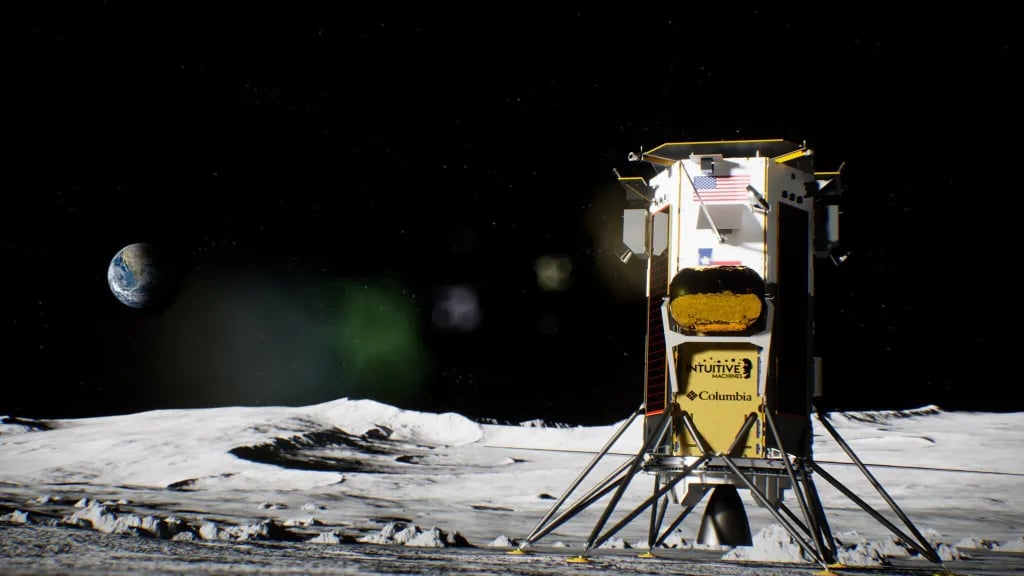
Earnings Miss Sends Intuitive Machines Stock Lower
Intuitive Machines stock tumbled nearly 10% today following a significant earnings disappointment that exposed the widening gap between Wall Street's profitability expectations and the company's near-term financial trajectory. The space technology firm reported a Q4 loss of $0.33 per share, substantially underperforming analyst consensus estimates of just $0.06 per share—a miss of more than 450%. Full-year results proved equally troubling, with annual losses of $0.59 per share compared to the more modest $0.40 per share that Wall Street had forecasted, signaling deeper operational challenges than investors anticipated.
Beyond earnings per share, the company's operational metrics painted a picture of significant cash burn and revenue headwinds. Intuitive Machines disclosed negative free cash flow of $56 million during the period, while revenues declined year-over-year—a particularly concerning sign for a company already operating at a substantial loss. The combination of accelerating losses, deteriorating cash generation, and declining topline performance triggered the market selloff, as investors reassessed the company's path to profitability and cash flow sustainability.
Bold 2026 Projections Follow Major Acquisition
Despite disappointing near-term results, management attempted to redirect investor sentiment by unveiling an ambitious growth strategy anchored by a transformative corporate transaction. The company announced a $800 million acquisition of Lanteris, a move designed to substantially reshape its revenue profile and competitive positioning within the commercial space sector. Following this deal, Intuitive Machines has projected aggressive 2026 revenue growth to between $900 million and $1 billion, representing roughly double or more of the company's current revenue run rate.
However, management conspicuously avoided committing to a profitability timeline, a notable omission that likely contributed to investor disappointment. While Wall Street currently expects $0.16 per share in earnings by 2026, company executives declined to endorse that consensus view. This lack of commitment to specific profitability metrics—particularly amid current operational losses and negative free cash flow—suggests management is prioritizing revenue growth and market share expansion over near-term financial returns. For investors accustomed to clear guidance and transparent margin improvement timelines, this ambiguity represents a significant risk factor.
Market Context: Space Technology Sector at Inflection Point
Intuitive Machines operates within the rapidly evolving commercial space exploration sector, an industry experiencing significant structural shifts as government agencies increasingly outsource space operations to private contractors. The company competes alongside industry leaders like SpaceX, specialized satellite operators, and emerging commercial space infrastructure providers. This competitive landscape has compressed margins and accelerated the need for scale, explaining management's rationale for pursuing the Lanteris acquisition.
The broader space technology sector has attracted substantial venture capital and institutional investment in recent years, driven by secular tailwinds including:
- Rising demand for satellite communications and remote sensing services
- Government space agency contracts and NASA partnerships
- International space exploration ambitions
- Commercial space station development initiatives
- Increased private sector interest in lunar and orbital infrastructure
Yet the sector has also demonstrated the challenges inherent in scaling capital-intensive businesses with long development cycles and significant execution risk. Intuitive Machines' earnings miss underscores how difficult it remains to achieve reliable, profitable operations in this space, despite strong industry demand.
Investor Implications: Profitability Remains Distant
Today's stock decline reflects a fundamental disconnect between management's revenue growth aspirations and its willingness to commit to profitability. For investors, several critical questions emerge:
Cash Burn Sustainability: With negative free cash flow of $56 million and expanding losses, when will the company require additional capital? The $800 million Lanteris acquisition suggests sufficient liquidity currently, but extended losses could necessitate equity dilution or debt financing at unfavorable terms.
Integration Risk: Major acquisitions in capital-intensive sectors frequently encounter execution challenges. Success of the Lanteris integration remains uncertain, and failing to realize projected synergies could further delay profitability.
Profitability Guidance Gap: Wall Street's $0.16 per share earnings forecast for 2026 appears increasingly optimistic given management's reluctance to endorse it. If the company misses again, further stock declines would likely follow.
Valuation Reset: The earnings miss and profitability ambiguity suggest investors may need to reprice Intuitive Machines based on a more distant profitability horizon, potentially compressing valuations further.
For growth-oriented investors, the company's ambitious $900 million to $1 billion 2026 revenue target remains appealing. However, the path to achieving these revenues while simultaneously returning to profitability remains unclear and undisclosed. Value investors and income-focused portfolios should likely remain on the sidelines until management provides clearer profitability commitments.
Looking Ahead
Intuitive Machines faces a critical inflection point. The company is betting that the Lanteris acquisition will catalyze substantial revenue growth and eventually drive profitability, but today's market response demonstrates that investors remain skeptical of this thesis without concrete profitability commitments. Management must successfully integrate the acquisition, demonstrate expanding margins, and provide credible guidance toward positive earnings if it hopes to restore investor confidence. Until then, expect continued volatility as the market struggles to reconcile accelerating losses with ambitious growth promises.