
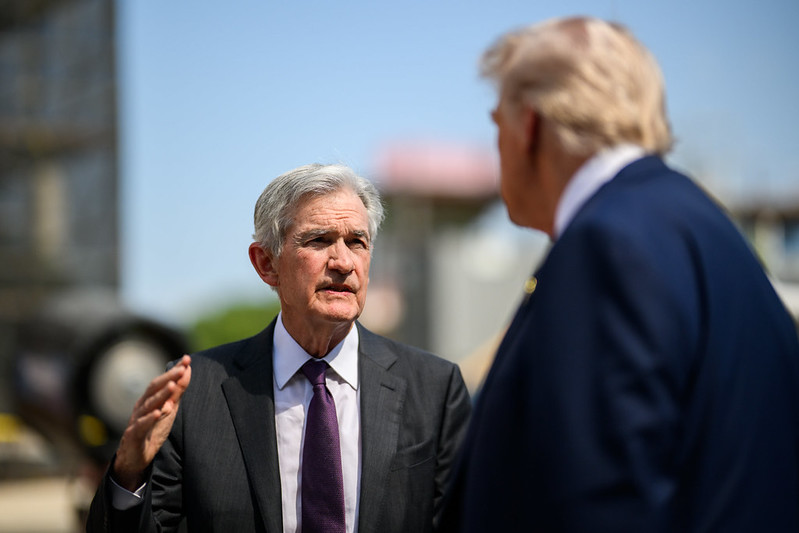
Powell Stands Firm on Rates Despite Trump Pressure in Final Fed Leadership
Federal Reserve Chair Jerome Powell has maintained the central bank's benchmark interest rate at 3.50%-3.75%, directly resisting pressure from President Donald Trump to implement aggressive rate cuts. The decision underscores Powell's commitment to inflation control over political influence, with market expectations now pointing to rate stability extending well into 2027—a timeline that extends beyond Powell's tenure as chair.
The Fed's Rate Decision and Political Backdrop
Powell's latest decision to hold rates steady represents a calculated pushback against mounting political pressure. The Trump administration has publicly advocated for lower interest rates to stimulate economic growth, but Powell has prioritized the Fed's dual mandate of price stability and maximum employment over political considerations.
Key factors influencing the Fed's stance include:
- Persistent inflation concerns that remain elevated despite months of moderate cooling
- Geopolitical uncertainty stemming from the Iran conflict, which threatens oil prices and supply chains
- Mixed economic signals that complicate the case for immediate rate reductions
- Labor market resilience that provides less urgency for accommodative monetary policy
The significance of this decision extends beyond the current rate level. By maintaining the status quo at a meeting where easing pressures were particularly acute, Powell has established a clear boundary between the Fed's independence and executive branch demands. Market participants are now pricing in a scenario where the federal funds rate remains anchored at current levels through mid-2027, suggesting Powell expects economic conditions to warrant caution rather than accommodation.
Market Expectations and Powell's Final Act as Chair
Powell's tenure as Fed chair is scheduled to conclude in May 2026, making this particular holding pattern especially noteworthy. At his final monetary policy meeting as chair, market expectations suggest Powell will likely maintain rates unchanged once again, cementing a legacy of inflation-fighting resolve even as his term winds down.
The current market consensus reflects several interconnected factors:
- Inflation remains above the Fed's 2% target, necessitating continued vigilance
- Wage growth pressures persist in pockets of the labor market despite overall cooling
- Oil price volatility from Middle East tensions creates additional uncertainty for price trends
- Uncertainty about fiscal policy under the new administration complicates economic forecasting
This extended hold pattern represents a significant break from the aggressive rate-cutting cycles the Fed pursued in 2023 and early 2024. Then, policymakers moved swiftly to reduce rates by 100 basis points as inflation began descending from four-decade highs. Today's environment is markedly different—inflation has proven stickier than initially expected, and geopolitical risks have introduced new variables into the Fed's decision-making framework.
Market Context: Independence Under Scrutiny
The current dynamic between Powell and the Trump administration touches on fundamental questions about Federal Reserve independence. Historically, the Fed has maintained its decision-making authority separate from executive branch pressure, a principle enshrined in the Federal Reserve Act. Yet this independence is increasingly tested in an era of politicized economic policy.
Powell's steadfast approach contrasts sharply with suggestions from some administration officials that the Fed should be more responsive to growth objectives. The $33 trillion U.S. economy operates with interest rates that significantly impact mortgage rates, auto loans, and business investment—decisions with profound political consequences. By resisting immediate rate cuts despite White House preferences, Powell is asserting that technical economic indicators, not political convenience, should drive monetary policy.
The broader financial markets have largely accepted this positioning:
- 10-year Treasury yields have stabilized in the 4.0-4.5% range, reflecting market expectations for stable rates
- Equity markets have shown resilience despite persistent rate uncertainty, suggesting investors are pricing in economic growth scenarios even without monetary easing
- The U.S. dollar has maintained relative strength, supported by higher U.S. interest rates compared to other developed economies
- Credit markets show manageable stress levels, with corporate bond spreads remaining within historical norms
Investor Implications and Portfolio Considerations
For investors, Powell's rate-holding stance carries several critical implications:
Fixed Income Strategy: Bond investors face an extended period of elevated yields. The prospect of rates remaining at 3.50%-3.75% through mid-2027 suggests that bond valuations will remain under pressure if economic surprises prove favorable. However, this also means attractive yield opportunities persist for income-focused portfolios.
Equity Market Dynamics: Stock valuations have been supported partly by expectations of Fed accommodation. A prolonged holding pattern at current rates could create headwinds for growth stocks, which benefit from lower discount rates. Meanwhile, value stocks and dividend-paying equities may find support from sustained yields.
Credit Risk: Corporate borrowers face continued high refinancing costs as maturing debt rolls over at elevated rates. Companies with floating-rate debt or near-term refinancing needs may experience margin pressure, while those with locked-in low-rate debt maintain competitive advantages.
Currency and International Exposure: The Fed's relative hawkishness compared to other central banks continues to support dollar strength. International investors should account for currency headwinds when allocating to U.S. assets.
For long-term investors, the key takeaway is that the financial environment remains in a "higher for longer" regime. This necessitates portfolio adjustments that account for higher discount rates, elevated borrowing costs, and compressed valuation multiples relative to the zero-rate era that characterized 2010-2021.
Looking Ahead: The Leadership Transition
As Powell approaches his final meeting as chair in May 2026, the question of Fed leadership succession looms. His designated successor will inherit a complex economic landscape: persistent inflation concerns, geopolitical uncertainties, and a political environment less tolerant of Fed independence than previous eras.
The extended rate-hold scenario through mid-2027 suggests that whoever succeeds Powell will face pressure to eventually reduce rates from current levels. Yet the timing and magnitude of those reductions will depend on whether inflation continues trending toward the Fed's 2% target or resumes climbing from today's elevated levels.
Powell's steadfast commitment to inflation control despite political headwinds may ultimately prove to be his most consequential legacy—a demonstration that technical policy decisions can and should remain insulated from electoral politics. Whether his successor maintains this independence under potentially greater pressure remains one of the most significant questions facing markets and the economy in 2026 and beyond.