
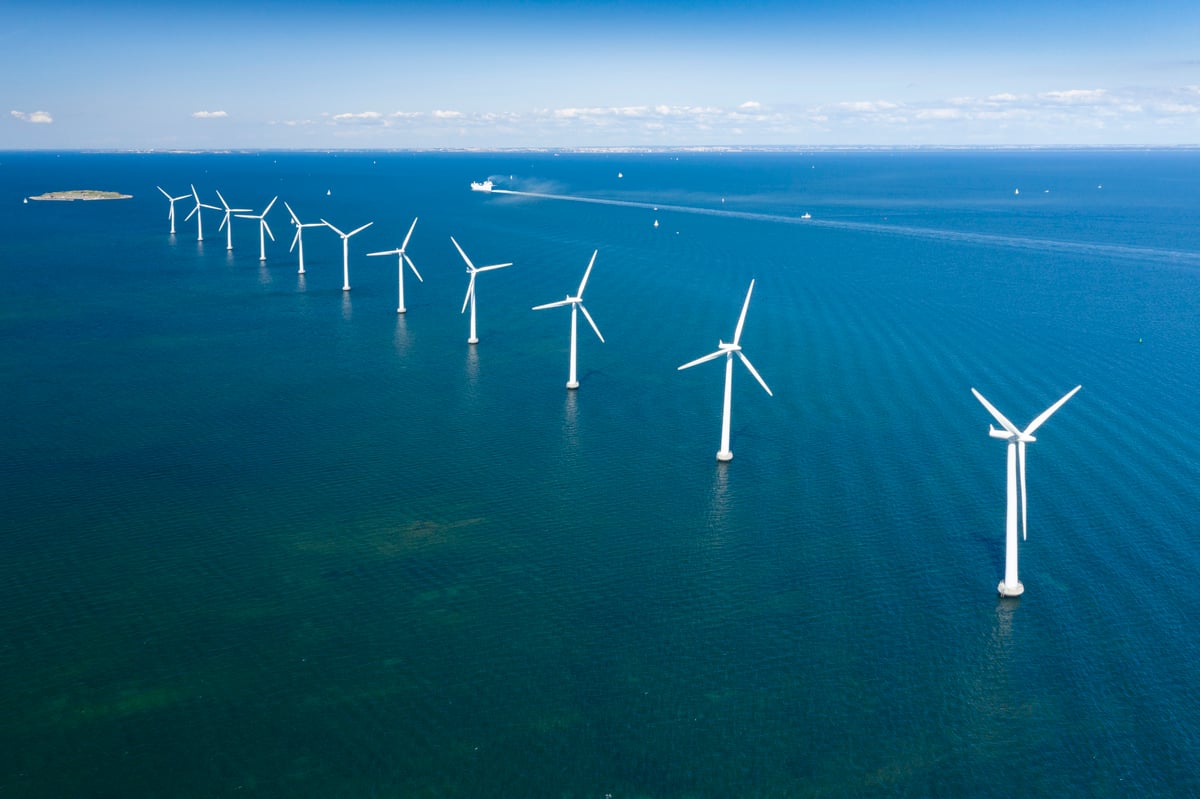
U.S. Energy Infrastructure Enters New Era as Dominion Energy Launches Historic Offshore Wind Project
Dominion Energy has officially commenced operations at its Coastal Virginia Offshore Wind project, marking a watershed moment for renewable energy infrastructure in the United States. The facility represents the largest offshore wind installation in American waters, generating 2.6 gigawatts of clean electricity—enough to power approximately 660,000 homes. This milestone underscores the company's ambitious pivot toward renewable energy while simultaneously raising important questions about valuation for income-focused investors evaluating the utility giant.
The operational launch arrives as Dominion ($D) embarks on a transformational five-year capital expenditure plan totaling $64.7 billion, an investment extraordinarily concentrated in Virginia infrastructure development. This massive deployment reflects management's conviction that the commonwealth will become a critical hub for data center operations—facilities that increasingly demand reliable, stable power supplies to support artificial intelligence and cloud computing workloads. The strategy positions Dominion Energy at the intersection of two megatrends: the decarbonization of America's electric grid and the explosive growth in computational demand from the digital economy.
Breaking Down the Numbers and Strategic Positioning
The Coastal Virginia Offshore Wind project's 2.6-gigawatt capacity places it squarely ahead of competitor installations and represents a significant operational achievement for offshore wind technology in North America. The infrastructure supports Dominion's long-term earnings trajectory, with the company projecting 5-7% annualized earnings growth through 2030—a respectable figure for the utility sector, though hardly spectacular compared to broader equity market returns.
Critical metrics for equity investors include:
- Current valuation: Trading at 16-17x 2026 forward earnings—a moderate multiple for a growth-oriented utility
- Dividend yield: 4.4% annual distribution, providing meaningful current income
- Capital intensity: $64.7 billion five-year capex plan representing a substantial commitment to long-term growth
- Service territory focus: Virginia-centric strategy betting heavily on regional data center proliferation
- Renewable generation: 2.6-gigawatt capacity addressing clean energy mandates and corporate procurement commitments
The earnings growth projection assumes successful execution of the capital program and materialization of data center demand in Virginia. Any delays in infrastructure completion, regulatory headwinds, or softening data center growth could compress these projections significantly.
Market Context: Utility Sector Dynamics and Competitive Landscape
Utility stocks occupy a unique position in the broader equity ecosystem, offering stability and income generation in exchange for capped growth potential and regulatory oversight. Dominion Energy's strategic pivot toward renewable infrastructure and data center-adjacent investment aligns with sector-wide trends, though it introduces execution risk absent from traditional regulated utility models.
The renewable energy transition continues reshaping the utility sector landscape. Competitors and peers face similar pressures to decarbonize infrastructure while maintaining financial returns sufficient to attract long-term capital. However, Dominion's scale and regional positioning—particularly its proximity to major data center growth corridors—provide competitive advantages unavailable to many counterparts. The company's Virginia focus specifically targets a region experiencing unprecedented demand for computational capacity, driven by major technology companies' AI infrastructure buildouts.
Regulatory environment represents both tailwind and constraint. Clean energy mandates and renewable portfolio standards provide policy support for offshore wind development, while utility commission oversight ensures predictable but limited returns on equity capital. The company's ability to recover extraordinary capital investments through regulated rate mechanisms depends on continued regulatory cooperation and demonstrated operational competence.
Investor Implications: Timing, Valuation, and Risk-Reward Profile
For equity investors, Dominion Energy presents a nuanced opportunity requiring clarity on personal investment objectives and time horizon. The stock appeals primarily to:
- Income-focused investors seeking stable, above-market dividend yields with modest capital appreciation potential
- Long-term growth investors positioned to wait 5-7 years for earnings accretion from capital investments
- ESG-oriented portfolios requiring exposure to renewable energy infrastructure and decarbonization themes
The critical consideration remains valuation timing. At 16-17x 2026 earnings, the stock reflects moderate enthusiasm for growth prospects while pricing in execution risk and regulatory uncertainty. Financial advisors and institutional investors increasingly recommend patience—waiting for modestly lower entry points before accumulating significant positions. This perspective acknowledges the inherent value of the business while recognizing that current valuations offer limited margin of safety for new capital deployment.
Capital intensity during the five-year investment phase presents dual implications. Successfully deployed capital should generate returns sufficient to support the projected earnings growth trajectory. Conversely, any shortfalls in capital efficiency, longer-than-expected project timelines, or regulatory setbacks could compress returns materially. The risk-reward asymmetry currently favors patience over aggressive accumulation.
The data center thesis underlying Virginia infrastructure investment remains largely unproven at the required scale. While major technology companies have announced facilities in the region, materializing sufficient demand to justify $64.7 billion in capex requires sustained corporate capital deployment and power consumption growth. Any disruption to AI infrastructure buildout cycles or corporate cost-cutting could undermine return assumptions.
Forward Outlook: Execution Risk Meets Long-Term Opportunity
Dominion Energy's official launch of the Coastal Virginia Offshore Wind project represents genuine technical and operational achievement—a milestone validating the company's strategic direction in renewable energy. The 2.6-gigawatt facility demonstrates engineering capability and construction execution at an impressive scale.
However, operational success in offshore wind development does not automatically translate to shareholder value creation. The company's broader thesis depends on successfully deploying $64.7 billion in capital with acceptable returns during a period of elevated interest rates and capital competition. For existing shareholders, the multi-year investment phase tests patience as capital intensity pressures near-term per-share metrics. For prospective investors, current valuations provide adequate but not exceptional opportunity—suggesting that disciplined investors might benefit from awaiting more compelling entry points while monitoring the company's capital deployment execution and regional data center demand materialization.
The renewable energy transition will ultimately require substantial investments in infrastructure like Dominion's offshore wind facility. The question for investors remains whether Dominion Energy represents the optimal vehicle for capturing this transition's value creation, or whether superior opportunities exist among peers with better valuation profiles or lower execution risk. Time and execution results will determine whether today's moderate valuation represents genuine opportunity or appropriate caution.