
NASA's New Chief Charts Bold Course: Moon Landings, Space Stations, Mars by 2028
NASA Administrator Jared Isaacman has unveiled an ambitious five-year strategic plan that positions the space agency at the forefront of humanity's next era of exploration. The initiative encompasses dozens of lunar landings through the revamped Project Artemis, the establishment of privately-operated commercial space stations in low Earth orbit, and the development of a nuclear-powered spacecraft capable of reaching Mars by 2028. This sweeping agenda signals a significant shift in how NASA approaches space exploration, leaning heavily on public-private partnerships while maintaining aggressive timelines that will test both technological and financial limits.
Isaacman's appointment as NASA Administrator brought fresh momentum to an agency that has long struggled with schedule delays and budget overruns. His vision represents a departure from incremental approaches to space exploration, instead favoring a more aggressive posture that mirrors the competitive dynamics reshaping the aerospace industry. The plan's scope suggests Isaacman intends to cement NASA's position as the driving force in space commerce and exploration, even as private companies like SpaceX, Blue Origin, and Axiom Space increasingly dominate headlines.
Key Details of the Five-Year Plan
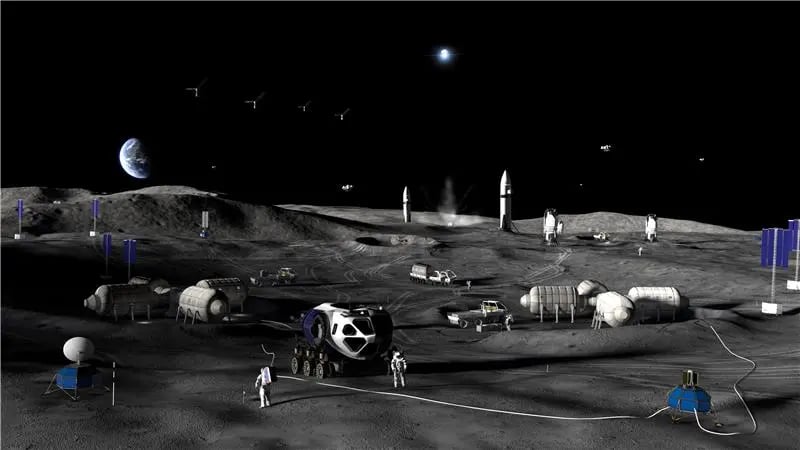
The centerpiece of Isaacman's agenda is the revitalization of Project Artemis, NASA's flagship lunar program designed to return humans to the Moon and establish sustainable operations there. The plan calls for dozens of moon landings over the next five years, a dramatic acceleration from previous projections. This intensive schedule would make the lunar surface a hub of continuous human activity rather than episodic visits, fundamentally changing how NASA allocates resources and manages mission execution.
Equally significant is the emphasis on private commercial space stations in low Earth orbit. Rather than NASA building and operating these facilities entirely in-house—a model that defined the International Space Station (ISS) era—the agency is embracing a model where private aerospace contractors shoulder both development and operational costs. Companies including Axiom Space, Northrop Grumman (NOC), and others have already received contracts to develop these stations, which will serve as research platforms, manufacturing facilities, and stepping stones for deep-space missions.
Perhaps the most striking component is the commitment to a nuclear-powered spacecraft reaching Mars by 2028. This target represents a significant acceleration compared to earlier NASA timelines, which had pushed crewed Mars missions into the 2030s or 2040s. Nuclear thermal propulsion offers substantial advantages over chemical rockets, enabling faster transit times and reduced radiation exposure for astronauts. However, the 2028 target has already drawn scrutiny from space industry experts who question whether sufficient ground testing, crew training, and mission architecture can be completed within that timeframe.
The initiative requires coordination with multiple aerospace contractors, including traditional NASA partners like Lockheed Martin (LMT), Boeing (BA), and Northrop Grumman, as well as newer entrants like SpaceX. This represents a complex web of contracts, regulatory approvals, and technical integration challenges that will occupy NASA's management bandwidth for years to come.
Market Context and Industry Implications
Isaacman's announcement arrives at a pivotal moment for the aerospace and defense sector. The space economy has undergone seismic shifts in the past decade, with private companies demonstrating capabilities that were once exclusively within government domain. SpaceX's reusable rocket technology, Blue Origin's suborbital tourism flights, and emerging lunar lander companies have created a competitive environment that pressures NASA to move faster and smarter.
The shift toward commercial space stations reflects broader trends in how governments envision space infrastructure:
- Privatization of routine operations: LEO infrastructure is increasingly seen as commodity infrastructure, better managed by private entities with financial incentives for efficiency
- Cost reduction: Commercial operators typically achieve lower per-mission costs than government-run facilities
- Innovation acceleration: Private companies compete for contracts, driving technological advancement and operational improvements
- Risk distribution: By distributing development costs across multiple contractors, NASA reduces financial concentration risk
The regulatory environment has also evolved to support this transition. The FAA's Office of Commercial Space Transportation has streamlined licensing procedures, while executive and congressional support for commercial space has remained bipartisan. This creates a favorable backdrop for Isaacman's public-private approach.
However, risks exist. Traditional aerospace contractors like Boeing and Northrop Grumman are simultaneously managing massive government contracts while competing for commercial opportunities. SpaceX, meanwhile, operates with far fewer employees and overhead costs than traditional contractors, creating pricing pressures across the industry. The question of sustainability—particularly regarding how many commercial space stations the market can support—remains unresolved.
Investor Implications and Sector Dynamics
For investors tracking aerospace and defense stocks, Isaacman's plan presents both opportunities and uncertainties. Companies positioned to win contracts under this initiative—including Lockheed Martin, Northrop Grumman, and Boeing—could see significant revenue expansion from lunar and Mars-related work. However, the competitive intensity and public-private partnership model means margins may face pressure.
SpaceX, which remains privately held, will benefit substantially from expanded NASA contracting, though public market exposure to SpaceX is limited. Axiom Space and other commercial space station developers represent emerging opportunities but carry execution risk.
The broader market implications include:
- Sustained government spending: NASA's budget will likely require increases to fund this ambitious agenda, with implications for federal spending debates
- Technology spillovers: Nuclear propulsion, advanced materials, and autonomous systems developed for this program will find applications in commercial and defense sectors
- Geopolitical competition: The accelerated Mars timeline implicitly references competition with other spacefaring nations, particularly China, which announced its own crewed lunar plans
- Supply chain stress: Aggressive timelines will test aerospace supply chains that are already operating near capacity
The investment thesis hinges on whether Isaacman can execute this plan on schedule and budget—a historically challenging proposition for NASA programs. Cost overruns on Project Artemis have already exceeded original projections, raising questions about the feasibility of the broader agenda.
Looking Forward
Jared Isaacman's five-year plan represents a fundamental recalibration of NASA's role in the space age. By embracing commercial partnerships, accelerating timelines, and pursuing multiple simultaneous objectives—lunar operations, commercial stations, and Mars missions—NASA is signaling both ambition and pragmatism. The plan acknowledges that government alone cannot fund or execute America's space aspirations, and that private innovation should be harnessed rather than resisted.
The coming years will reveal whether this vision can withstand the pressures of budgetary constraints, technical setbacks, and the relentless pace of change in commercial space. For investors and industry observers, the unfolding story will determine not just NASA's trajectory, but the shape of the broader aerospace sector for the next decade.