
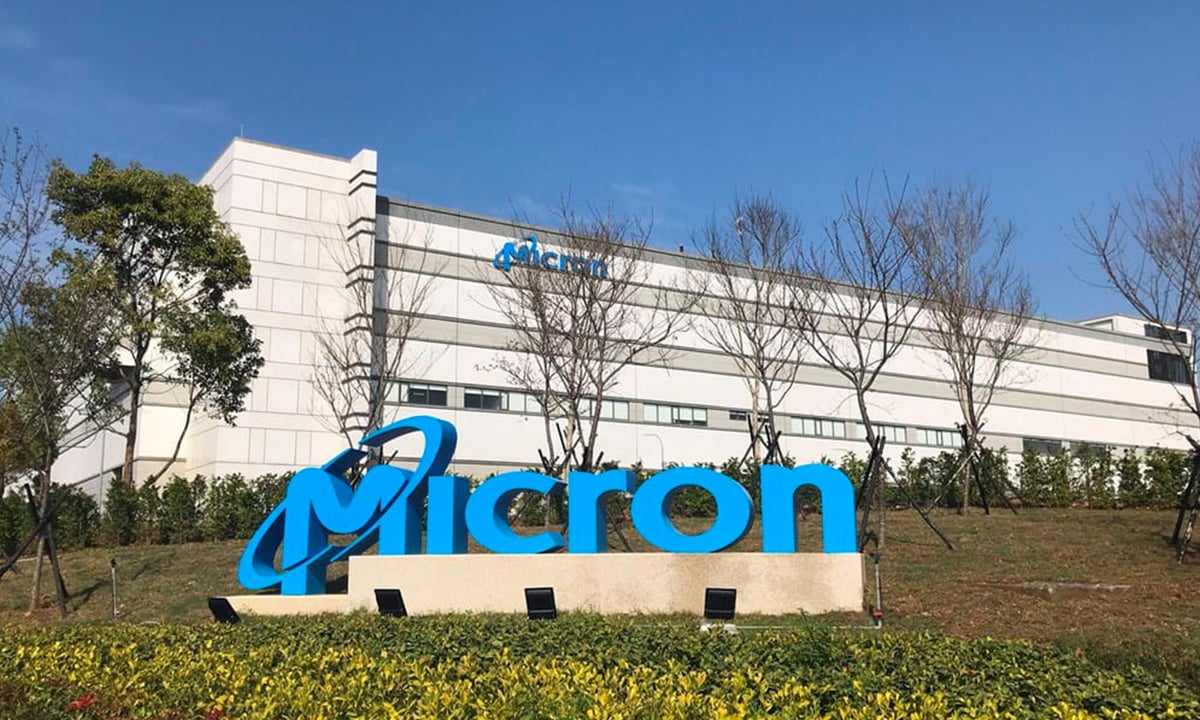
Micron Defies Skepticism With Blowout Earnings
Micron Technology ($MU) has delivered a resounding rebuttal to Wall Street skeptics who had braced for disappointing results in fiscal Q2 2026. The memory semiconductor manufacturer more than tripled its quarterly revenue to $23.9 billion, while posting earnings per share of $12.20—a stunning 45% beat against the company's own guidance of $8.42 EPS. The results underscore a fundamental shift in the semiconductor landscape driven by explosive demand for artificial intelligence infrastructure, a tailwind that many analysts had underestimated in their models.
The earnings surprise arrives even as Micron's stock has already surged 277% over the past year, raising questions about whether the gains are justified or represent an overheated market. Yet beneath the surface of this outperformance lies a compelling narrative: the supply dynamics in memory semiconductors have tightened dramatically, pricing power has returned with unexpected vigor, and the company may be positioned to deliver earnings that dwarf current Wall Street consensus. While cautious analysts maintain a $550 price target—suggesting limited upside from current levels—the underlying operational metrics paint a picture that could vindicate the bulls.
The Supply-Demand Equation Shifts Decisively
The driving force behind Micron's exceptional performance is a fundamental imbalance between supply and demand in the memory chip market. Industry-wide capacity constraints, combined with unprecedented demand from hyperscale data center operators building out AI infrastructure, have created an environment of genuine scarcity for both DRAM and NAND flash memory.
The pricing dynamics tell the story most clearly:
- DRAM pricing has surged 65-67% year-over-year, reflecting tight supply and strong demand from servers and AI accelerators
- NAND pricing has climbed 75-79%, driven by data center storage requirements and AI training workloads
- These increases represent a dramatic reversal from the cyclical oversupply conditions that plagued the memory sector as recently as 2023
For a company like Micron, which commands approximately 22% of the global DRAM market and significant NAND market share, these price increases translate directly to margin expansion and earnings growth. The company's fiscal Q2 results reflected this pricing power, with gross margins likely expanded well beyond historical averages. This is not a temporary blip—it reflects structural changes in how technology companies are architecting their infrastructure around AI and machine learning workloads, which demand far more memory per computing unit than traditional server configurations.
Market Context: Why Consensus May Be Dangerously Conservative
Wall Street's collective caution toward Micron likely stems from several factors. First, the memory chip industry has endured multiple boom-bust cycles, conditioning investors to be skeptical of extended periods of favorable pricing. Second, the 277% stock gain over twelve months has already priced in significant optimism, making many analysts reluctant to make further bullish calls that could appear irresponsible. Third, consensus estimates often lag behind rapidly changing market conditions, particularly in technology sectors.
However, several factors suggest the bears may have fundamentally misread the current cycle:
The AI Data Center Supercycle is Real and Durable. Unlike previous semiconductor booms driven by inventory builds or consumer cyclicality, the current demand surge reflects investments by Microsoft, Google, Amazon, Meta, and Apple in foundational AI infrastructure. These are multi-year capital allocation decisions, not short-term projects subject to rapid reversal. Data center memory requirements for large language models and generative AI applications are orders of magnitude higher than traditional workloads.
Supply Cannot Keep Pace With Demand. Building new semiconductor fabrication capacity requires 18-24 months and billions of dollars in capital investment. Given that demand has exceeded expectations, new supply additions will take years to materialize. This extended supply-constrained environment is precisely what Micron needs to sustain elevated pricing.
Competitor Dynamics Favor Market Discipline. SK Hynix and Samsung Electronics ($005930.KS) are also benefiting from tight memory markets, meaning there is less competitive pressure to slash prices to gain share. All three major DRAM and NAND suppliers have incentive to maintain pricing discipline.
Investor Implications: The Case for Significant Earnings Upside
The current Wall Street consensus price target of $550 implies limited appreciation from current levels, yet the underlying fiscal 2027 earnings potential suggests a dramatic disconnect. If Micron can achieve earnings per share of $98.26 in fiscal 2027—as suggested by optimistic projections based on current pricing and demand dynamics—then at a modest multiple of 15x (below historical averages for high-growth semiconductor companies), the stock could trade to $1,473 per share.
Even at more conservative earnings assumptions, the upside appears substantial. A fiscal 2027 EPS of $65-70 would still imply $975-1,050 per share at reasonable valuations. The key question for investors is whether current memory pricing and data center demand can be sustained through the next fiscal year—and all available evidence suggests they can be.
The risks are not insignificant. A macroeconomic slowdown could reduce AI infrastructure spending. Competitors could bring supply online faster than expected. However, these risks appear adequately reflected in the caution of Wall Street analysts. What may not be reflected is the magnitude of the structural shift toward AI-centric infrastructure and the years-long period of supply constraints that will likely accompany it.
Micron's stock has already made a substantial move, but the earnings trajectory visible in current business conditions suggests that investors who dismissed the company as "priced for perfection" may have underestimated how perfect its execution can be in a supply-constrained, AI-driven market environment. The bears had good reason to be cautious—but they may have been cautious at precisely the wrong time.