
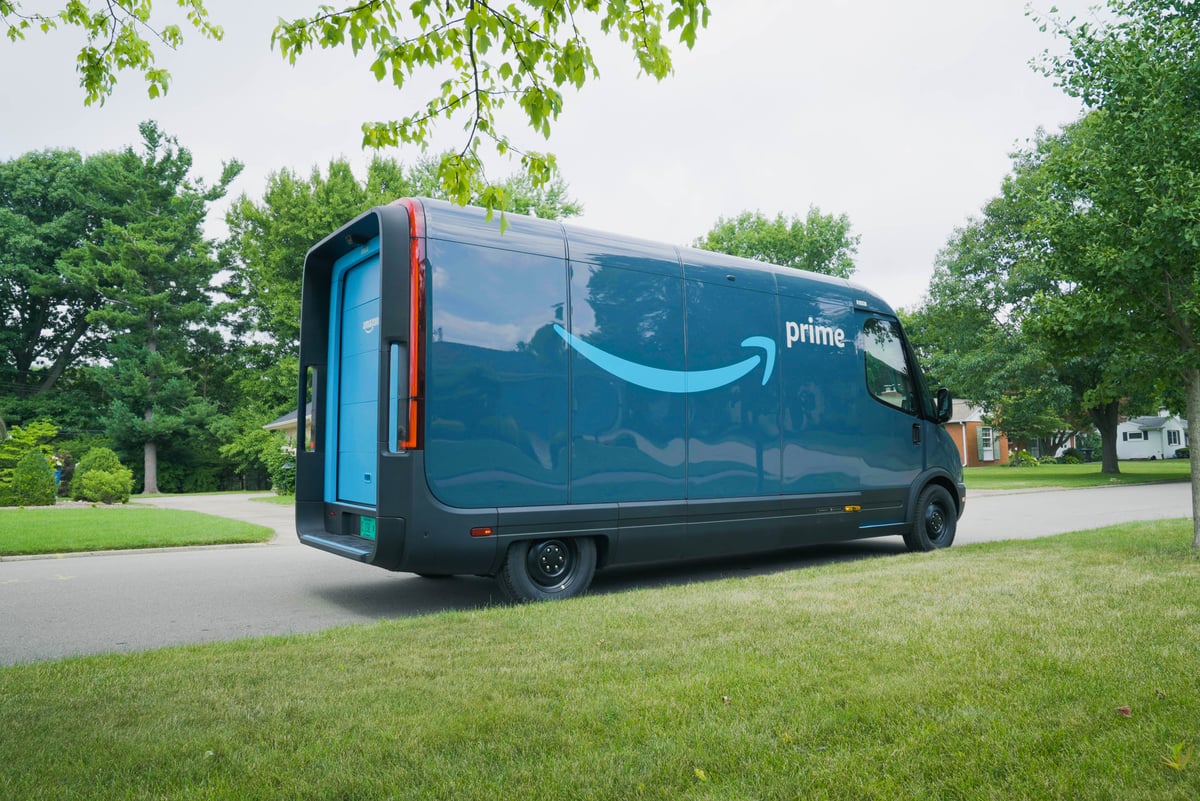
Rivian's Electric Van Gamble: Can Pricing Cuts and New Features Revive Amazon Dream?
Rivian Automotive ($RIVN) faces a critical inflection point as its flagship electric delivery vehicle (EDV) program struggles to gain commercial traction beyond Amazon's initial commitment. Despite landing what appeared to be a transformational 100,000-unit order from the e-commerce giant in 2019, the company has grappled with sluggish additional order momentum, forcing a strategic recalibration that could determine whether the vehicle becomes a billion-dollar revenue driver or an ambitious misstep.
The core problem has been painfully simple: at $80,000 per unit, the EDV faced stiff headwinds from cheaper competitors and failed to differentiate sufficiently to justify its premium positioning in the commercial fleet market. Combined with limited performance specifications that didn't fully address customer pain points, potential buyers—logistics companies and regional delivery operators—opted for established alternatives or waited for competitive offerings at lower price points.
But Rivian appears to be turning the ship. The company has introduced a materially enhanced EDV platform featuring 30% greater driving range and newly available all-wheel-drive capability, addressing two of the most pressing operational concerns for fleet managers. Equally significant, Rivian is positioned to achieve its first full-year gross profit in 2025, a watershed moment that suggests the company has finally cracked the unit economics problem that has plagued EV startups for years.
The Performance Gap That Cost Rivian Orders
When Rivian announced the Amazon partnership in 2019, the market viewed it as validation of the EDV's commercial viability. Yet the subsequent years revealed a widening gap between promise and delivery. The original vehicle specification lagged behind what fleet operators actually needed:
- Range limitations that constrained daily operating routes in colder climates or hilly terrain
- Single-motor configuration that reduced traction and capability in adverse weather conditions
- Premium pricing that failed to reflect operational advantages sufficient to offset higher capital costs versus diesel alternatives
- Slow order conversion from potential commercial customers beyond Amazon's committed volume
The competitive landscape intensified during this period. Traditional automotive suppliers and startups alike developed lower-cost electric delivery solutions. Tesla's Cybertruck and Ford's commercialization efforts raised the bar for performance and features. Meanwhile, fleet operators—notoriously pragmatic decision-makers—demanded proof of total cost of ownership advantages before committing capital. Rivian's inability to demonstrate compelling operational ROI at the $80,000 price point created a feedback loop of disappointed customer pilots and delayed purchase decisions.
The company's response suggests management understands what went wrong. The 30% range increase directly addresses the most common objection from commercial customers testing the vehicle. All-wheel-drive capability opens the EDV to geographic markets and seasonal conditions previously unsuitable. These aren't cosmetic changes—they're functional improvements targeting the specific requirements that fleet operators had consistently identified.
Path to Profitability and the 18-Month Window
Rivian's projected achievement of full-year gross profitability in 2025 represents a fundamental inflection in the company's financial trajectory. For an EV manufacturer, achieving sustained positive unit economics is the gateway to scaled production and commercial viability. This milestone suggests that manufacturing efficiencies, production volume increases, and supply chain optimization have moved the needle sufficiently to cover variable costs and contribute to fixed overhead.
The timing is strategic. With the EDV improvements rolling out and gross profitability approaching, the company enters a critical 18-month window where major commercial fleet operators may finally be willing to commit volume. The calculus changes when potential customers believe the manufacturer can execute reliably and sustainably. Major logistics companies like J.B. Hunt Transport Services, XPO Logistics, and Werner Enterprises—companies that manage thousands of vehicles—typically require multi-year visibility into supply chain stability before placing large orders.
Amazon's original 100,000-unit commitment was contingent on Rivian executing on production targets and vehicle specifications. While the company has ramped production toward those commitments, achieving profitability while delivering enhanced vehicles signals that execution risk is diminishing. This could unlock the pathway to the "significant fleet orders" management anticipates, potentially transforming the EDV from a disappointment into the cornerstone of Rivian's commercial business.
Market Context: A Shifting EV Commercial Landscape
Rivian operates in an increasingly crowded but high-potential market segment. Commercial electric vehicle adoption is accelerating as fleet operators confront regulatory pressures (particularly in California and Europe), fuel cost volatility, and improving total cost of ownership mathematics. The global commercial EV market is projected to grow substantially through the 2020s.
However, Rivian faces competition from multiple directions:
- Legacy automotive suppliers (Daimler, Volvo, Mercedes-Benz commercial division) entering the electric delivery segment with established supply chains and customer relationships
- Tesla leveraging its battery and production expertise into commercial applications
- Smaller startups like Workhorse and Motiv Power Systems targeting similar niches with lower-cost propositions
- Established commercial vehicle manufacturers retrofitting existing platforms with electric drivetrains
The decisive competitive advantage will accrue to companies that can deliver reliable vehicles at prices that genuinely improve fleet operating economics. This means total cost of ownership must improve—not just from a theoretical fuel-savings perspective, but demonstrably, through warranty support, charging infrastructure integration, and maintenance cost reductions that fleet operators can quantify in their budgets.
Rivian's partnership with Amazon remains valuable precisely because it provides proof of commercial deployment and real-world data. Every EDV Amazon operates generates intelligence about reliability, maintenance patterns, and operational efficiency that improves the next generation of vehicles. This flywheel—if executed properly—can become a competitive moat.
Investor Implications: Risk, Reward, and the Profitability Test
For investors in Rivian ($RIVN), the coming 18 months represent a make-or-break period. The company's valuation and future funding capacity depend entirely on proving that the EDV business can scale profitably.
The bull case is straightforward: if Rivian executes on 2025 profitability and converts the expected fleet orders, the EDV program could generate $5+ billion in annual revenue by 2028-2030. That would justify a significantly higher enterprise value and provide the cash generation needed to fund second-generation products and geographic expansion.
The bear case is equally clear: if the improved EDV specs fail to generate substantial new orders, if gross margins compress due to pricing pressure, or if execution stumbles, the company faces a prolonged path to profitability and potential funding challenges. Rivian has already raised substantial capital, but it will need continued access to debt and equity markets if growth investments are required.
For commercial fleet operators, the decision to order Rivian vehicles hinges on credible evidence that the company can deliver vehicles on schedule, maintain quality standards, and support a growing installed base. The next major contract wins will reveal whether confidence is genuinely improving or whether the market remains skeptical.
Looking Forward: Execution Will Define the Narrative
Rivian stands at an inflection point. The company has identified the core problems that undermined the EDV's commercial acceptance and undertaken material improvements to address them. Achieving gross profitability in 2025 would validate the business model and eliminate the most pressing execution risk. The availability of enhanced performance specifications gives the sales team new ammunition to attract fleet operators.
But announcements of improvements and actual commercial order wins are different things. Rivian must convert customer interest into binding contracts over the next 18 months. Major fleet operators will want to see sustained production, proven reliability, and competitive unit economics before committing the capital required for large-scale deployments.
The stakes are high for Rivian shareholders, employees, and the broader EV ecosystem. A successful turnaround of the EDV program would demonstrate that well-capitalized startups can compete in commercial vehicle markets against entrenched incumbents. A failure would reinforce the thesis that EV startups struggle most when targeting cost-sensitive, operations-focused customers rather than premium consumer segments.
Investors should closely monitor 2025 financial results, particularly gross margin trends and order pipeline indicators. The improved EDV specifications are necessary but insufficient—execution on profitability and commercial adoption will ultimately determine whether Rivian's initial Amazon partnership becomes the foundation of enduring business success or an unfulfilled promise.