
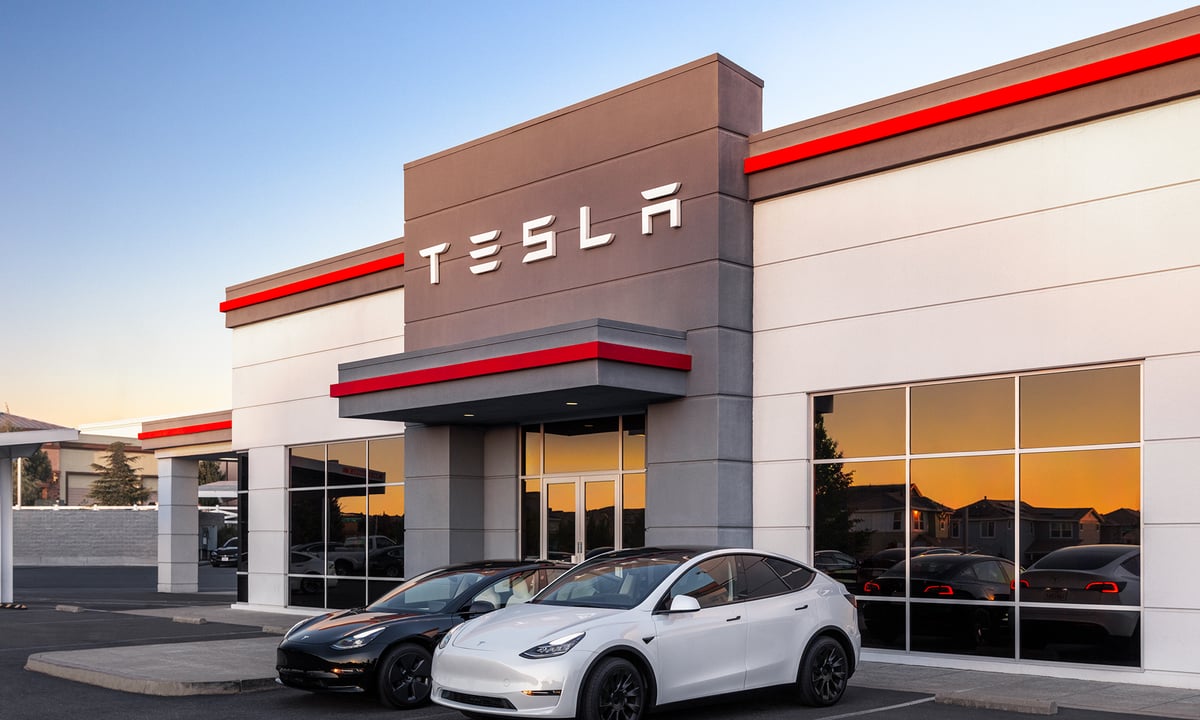
Tesla's Delivery Decline Signals Shifting EV Market Dynamics
Tesla reported a significant sequential decline in vehicle deliveries during Q1 2026, with the electric vehicle manufacturer shipping just 358,023 units—a 14% drop from the previous quarter. The disappointing result fell short of analyst expectations and underscores growing headwinds in the competitive EV market, where the company's dominance is increasingly being challenged by well-capitalized competitors from China and beyond.
The delivery miss comes at a critical juncture for the Palo Alto-based automaker, which has long positioned itself as the global EV leader. However, demand indicators suggest the low-hanging fruit in EV adoption may be ripening more slowly than previously forecast, while competition intensifies across virtually every price segment.
The Numbers Behind Tesla's Stumble and Competitor Gains
The 358,023-unit delivery figure represents more than a quarterly blip—it signals structural challenges in $TSLA's core business model. Tesla's sequential decline of 14% suggests either softening demand or production constraints, and the miss relative to analyst expectations raises questions about demand elasticity and pricing power in key markets.
While Tesla stumbles, competitors are gaining traction:
- BYD delivered 321,000 vehicles in Q1 2026, bolstering its position as a formidable competitor. Notably, this figure includes hybrid vehicles, which continue to capture significant market share in China and other regions
- Nio posted extraordinary 98% annual growth, demonstrating strong momentum in the premium EV segment and capturing affluent consumer demand
- Chinese automakers collectively are gaining market share at a faster rate than Western competitors
These numbers are particularly striking because they show that total EV market growth hasn't stopped—rather, Tesla's relative share is contracting. BYD's 321,000 combined vehicle deliveries are approaching Tesla's quarterly output, a development that seemed unthinkable just three years ago.
Market Context: A Maturing EV Market and Intensifying Competition
The EV market has reached an inflection point. What was once a niche segment characterized by supply constraints is rapidly becoming a competitive, margin-pressured commodity market. Several factors explain Tesla's current predicament:
Competitive Saturation: The entry of established legacy automakers into the EV space—including General Motors, Ford, Volkswagen, and BMW—has fragmented the market. Coupled with aggressive Chinese competitors offering compelling price-to-feature ratios, Tesla faces a fundamentally different competitive landscape than in previous years.
Price Pressure: Tesla's celebrated pricing power has eroded as competitors offer competitive products at lower price points. The company's multiple price cuts since 2023 have demonstrated that demand remains elasticity-dependent, not brand-loyal as some bulls once argued.
Technology Convergence: The technological gap between Tesla and competitors has narrowed considerably. Range anxiety, charging infrastructure, and software capabilities—once Tesla's competitive moats—are no longer exclusive differentiators. BYD's battery technology, in particular, has achieved parity or superiority in several metrics.
Regional Dynamics: China, which represents approximately 25-30% of global EV sales, remains intensely competitive. BYD's dominance in China and growing presence in Southeast Asia and Europe compress Tesla's addressable market and growth runway.
Tesla's Pivot: From Vehicle Sales to Autonomous Ventures
Tesla's management team and investors increasingly acknowledge that the company's growth narrative must evolve beyond traditional vehicle deliveries. The bull case for $TSLA has shifted materially toward two high-stakes bets:
Robotaxi Operations: Tesla's full self-driving (FSD) capabilities and autonomous taxi ambitions represent a potentially massive opportunity—but also face significant regulatory and technical hurdles. Success in this arena would require achieving Level 4-5 autonomy reliably and scaling deployment across multiple jurisdictions.
Optimus Humanoid Robots: The company's push into humanoid robots represents a completely different business model, with potential applications in manufacturing, logistics, and service sectors. However, this remains highly speculative and requires years of development and capital investment.
The strategic pivot is telling: Tesla's management is essentially signaling that mature EV market competition makes vehicle-centric growth insufficient for the company's valuation thesis. Whether these emerging businesses can offset competitive pressures in core vehicle sales remains the central investment question.
Investor Implications: Risk Reassessment Required
For $TSLA shareholders, the Q1 2026 delivery report necessitates a fundamental reassessment of investment thesis and valuation assumptions.
Earnings Multiple Risk: Tesla's historical valuation premium relied heavily on expectations of sustained high-growth vehicle deliveries. A 14% sequential decline forces analysts to revise growth forecasts downward, which could compress the company's valuation multiple toward legacy automaker levels if diversification into robotaxi and Optimus ventures fails to materialize profitably.
Competitive Market Share Erosion: The gains posted by BYD and Nio come directly from addressable market opportunity. If Chinese competitors successfully expand into international markets (as they're actively attempting), Tesla faces sustained margin and volume pressures.
Capital Allocation Uncertainty: Tesla's shift toward robotaxi and Optimus ventures requires substantial capital investment with uncertain returns. Meanwhile, competitors like BYD continue methodically expanding vehicle production capacity and geographic footprint. The company's ability to balance near-term vehicle profitability with long-term technology bets remains unproven.
Comparative Opportunities: For growth-oriented investors seeking EV exposure, the relative strength of Nio's 98% annual growth compared to Tesla's declining deliveries raises the question of whether emerging competitors offer more attractive risk-reward profiles at current valuations.
For value-oriented investors, Tesla's declining growth rates and rising competition may finally bring valuation closer to fundamental metrics, though execution risks on autonomous vehicle and robotics ventures add complexity to traditional discount cash flow models.
Conclusion: A New Era for Tesla and EV Investing
Tesla's Q1 2026 delivery decline marks a watershed moment for both the company and the broader EV sector. The narrative of Tesla as an unstoppable growth company has permanently shifted toward a more complex story involving mature vehicle market competition offset by speculative but potentially transformative technology ventures.
Investors must now grapple with whether Tesla's robotaxi and Optimus businesses can offset competitive pressures in its core market, and whether the company's competitive advantages in autonomous driving and robot development are genuine or merely aspirational. Meanwhile, competitors like BYD and Nio have demonstrated that the EV future need not be Tesla-centric.
The next two to three years will prove decisive: Tesla must either successfully deploy profitable robotaxi operations and Optimus robots at scale, or face valuation compression as vehicle market growth stalls and competitive pressures mount.