
Ford Motor Company faces an unprecedented profitability challenge stemming from a seemingly invisible corner of its business: Ford Credit, the automaker's captive finance subsidiary that punches far above its weight in the earnings equation. While Ford Credit generates between 15-20% of Ford's total profits despite accounting for just 5% of revenue, it now confronts a mounting threat from off-lease electric vehicles losing dramatically more value than anticipated—a crisis that could reshape the company's financial trajectory through the end of the decade.
The core problem centers on a fundamental miscalculation in the EV market: residual values for leased electric vehicles are collapsing far below projections. According to Experian, the off-lease EV market will peak in 2028 with approximately 800,000 vehicles hitting used car lots, each commanding prices roughly $10,000 below forecasted levels. This erosion translates to an estimated $8 billion industrywide loss—a staggering figure that reflects the acute mismatch between what leasing companies bet these vehicles would be worth and their actual market value.
The Mechanics of a Looming Crisis
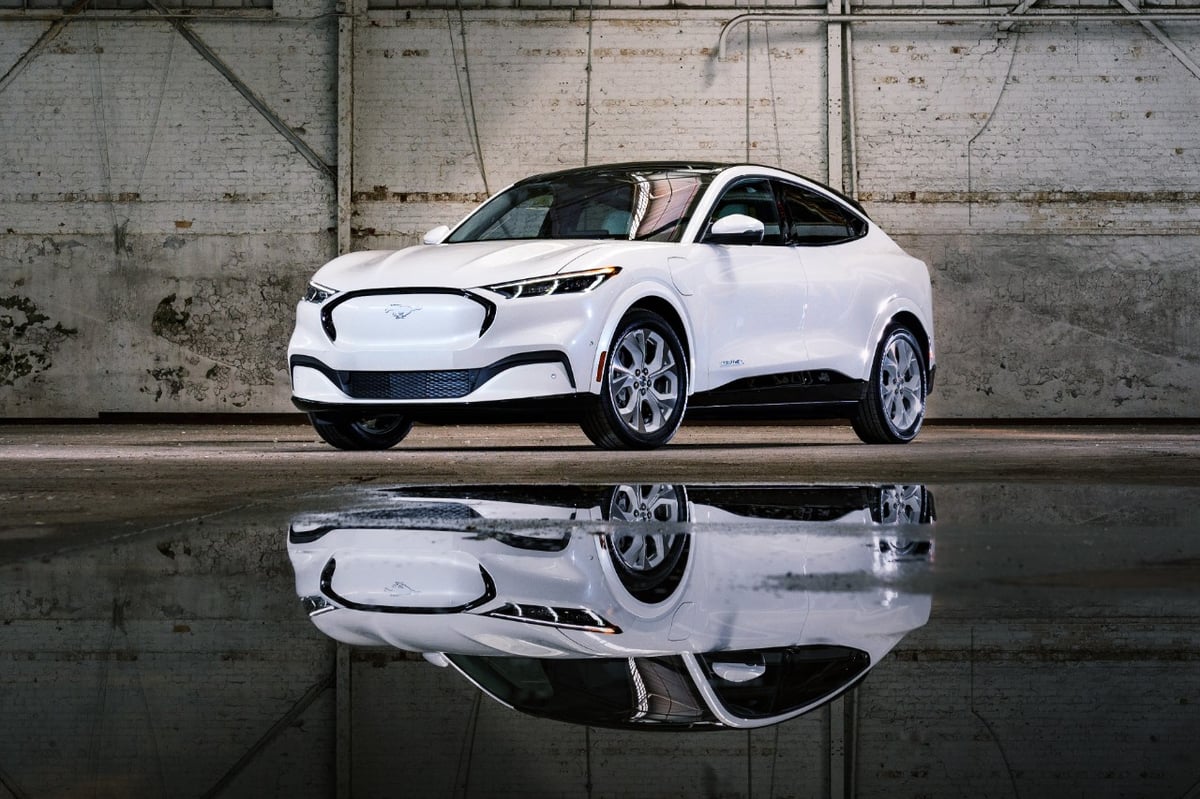
Understanding why this matters requires examining how captive finance operations work. When Ford Credit originates a vehicle lease, it assumes a "residual value"—the estimated worth of that car at lease end. This assumption is baked into the monthly lease payment structure. If a 2024 Ford Mustang Mach-E was leased assuming a residual value of $28,000 at lease termination in 2027, but the vehicle actually fetches only $18,000 on the used market, Ford Credit absorbs that $10,000 loss. Multiply this across hundreds of thousands of vehicles, and the losses become existential.
The dynamics are particularly acute in the EV space for several reasons:
- Battery degradation concerns: Consumer confidence in battery longevity remains fragile, with many used car buyers viewing batteries as ticking time bombs requiring expensive replacement
- Rapid technological obsolescence: EV technology evolves quickly; a 2024 model's range and features may seem dated by 2027
- Charging infrastructure uncertainty: Inconsistent public charging availability creates regional value discrepancies
- Insurance and repair costs: Used EV buyers face higher insurance premiums and fewer repair shops, depressing demand
- Tax credit phase-out effects: The expiration of federal EV tax credits may further compress used EV values
The 2028 peak cited by Experian represents a critical inflection point. This is when the first wave of pandemic-era EV lease cohorts mature simultaneously, flooding the used market with supply precisely when EV demand growth may be plateauing.
Market Context: Ford's Vulnerability and Competitor Exposure
Ford enters this storm from a position of relative insulation compared to some peers. Both Tesla ($TSLA) and General Motors ($GM) have substantially higher EV lease volumes, meaning their captive finance arms—Tesla Financial Services and GM Financial—face theoretically larger aggregate exposure. This is one crucial advantage: Ford's smaller EV lease portfolio means its downside risk, while material, is manageable relative to competitors.
However, the broader automotive finance sector faces synchronized headwinds. The traditional lease model—a cornerstone of modern automotive economics—assumes relatively stable residual values. The EV revolution has shattered this assumption. Leasing companies and their captive finance partners built pricing models based on historical internal combustion engine (ICE) vehicle depreciation patterns, which proved largely predictable. Electric vehicles, conversely, lack a sufficiently long history to generate reliable residual value projections.
Compounding this challenge is the industry's shift toward electrification. Major automakers are accelerating EV production precisely as EV lease volumes are expanding, creating oversupply dynamics. Ford alone committed to massive EV investments, building dedicated electric vehicle plants. If residual values continue eroding, the entire lease economics of the EV transition become questionable.
Regulatory tailwinds also matter. The Biden administration's stricter emissions standards and EV-friendly policies inadvertently accelerated EV lease penetration, as companies seeking to hit fleet fuel economy targets leased EVs aggressively to consumers. Now those leases are maturing into a glutted used market.
Investor Implications: Earnings at Risk
For Ford shareholders, the implications are significant. Ford Credit's outsized profit contribution—generating roughly one-fifth of corporate earnings while representing one-twentieth of revenue—means any deterioration cascades directly to bottom-line results. If the Experian estimate of $8 billion in industrywide losses materializes between 2025 and 2028, and Ford captures even a proportional share, the company could see earnings-per-share (EPS) compression of $0.50-$1.00 per share over the period, depending on how losses are distributed.
This scenario is materially different from the 2008 financial crisis, when captive finance operations nearly collapsed due to systemic credit deterioration and frozen capital markets. Today's challenge is specific to EV residual values—a narrower but still serious threat. The company's balance sheet is stronger, capital markets remain accessible, and Ford maintains flexibility to adjust lease pricing going forward.
Yet investors should monitor several key metrics through 2028:
- Ford Credit's lease originations and average assumed residual values: Are projections being revised downward?
- Used EV auction prices: Real-time data on wholesale EV values provide leading indicators of trouble ahead
- Ford Credit's loan loss reserves: Watch for significant reserve increases, which signal management's deteriorating outlook
- Ford's dividend sustainability: Pressure on profits could force dividend cuts, a major consideration for income-focused shareholders
- Lease penetration rates: Is Ford reducing new EV lease originations to limit future exposure?
The silver lining: Ford can adjust pricing for new leases immediately. Going forward, lease payments will likely rise to reflect lower assumed residual values, protecting Ford Credit from additional deterioration. However, leases already originated cannot be repriced, locking in the losses.
Forward-Looking Landscape
Ford Motor Company faces a profitability test distinct from the catastrophic financial crisis of 2008, but one that demands serious attention nonetheless. The $8 billion industrywide EV residual value loss represents a structural challenge to the captive finance model that has bankrolled vehicle leasing for decades. As off-lease EV volumes accelerate toward their 2028 peak, the financial pain will likely intensify before stabilizing.
For investors, the key distinction lies in timing and containment. Ford's smaller EV lease book provides relative protection, but not immunity. The company's ability to navigate this challenge depends on its willingness to absorb near-term losses, adjust future lease economics, and manage market expectations through the turbulent middle years of this decade. Shareholders should expect Ford Credit to remain a bright spot in the earnings picture—but with dimmer brightness than history suggests.