
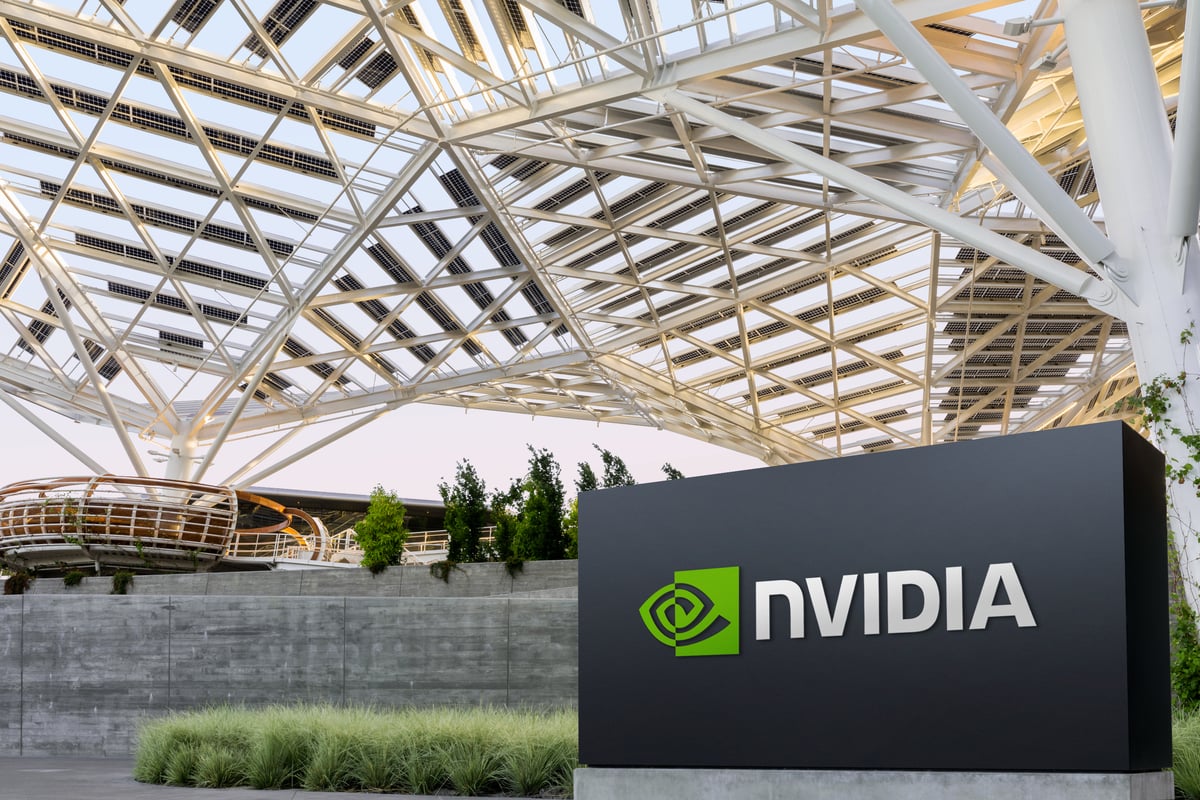
A Dominant Force Marks Three Decades of Exponential Growth
Nvidia celebrates its 33rd anniversary today as the undisputed heavyweight of artificial intelligence infrastructure, a position that has delivered extraordinary returns to early investors. Since the company's 1999 IPO, $NVDA shares have surged approximately 464,000%, transforming the chipmaker from a graphics card manufacturer into Wall Street's most consequential technology enterprise. This meteoric ascent reflects Nvidia's stranglehold on GPU computing—the computational engines powering everything from data center AI models to autonomous vehicles—but raises urgent questions about whether the stock's parabolic trajectory can persist.
The numbers tell a staggering story. An investor who bought $1,000 of Nvidia stock at its 1999 IPO would own shares worth approximately $4.64 million today, assuming no dividends were reinvested. This performance dwarfs comparable mega-cap technology peers and reflects the company's transformation from a niche graphics processor maker into the essential infrastructure layer underpinning the generative AI revolution. Nvidia's market capitalization has swollen to approximately $3 trillion, positioning it among the world's most valuable publicly traded companies alongside Apple, Microsoft, and Saudi Aramco.
The Competitive Moat and Hidden Vulnerabilities
Nvidia's dominance rests on three interconnected competitive advantages that have proven remarkably durable. First, the company maintains superior compute capabilities—its H100 and H200 data center GPUs substantially outperform competitors in training large language models and running inference workloads. Second, Nvidia wields formidable pricing power, commanding premium valuations from cloud providers and enterprises desperate to access scarce AI computing capacity. Third, the company has cultivated an ecosystem lock-in through CUDA, its proprietary software platform that makes switching to alternative chips economically painful for software developers and enterprises.
Yet beneath this fortress lies accumulating structural risk:
- Customer vertical integration: Major cloud providers including Microsoft, Google, Amazon, and Meta have all invested billions developing custom silicon designed to reduce reliance on Nvidia GPUs. These efforts threaten to erode Nvidia's addressable market as customers internalize more compute workloads.
- GPU supply normalization: Nvidia's pricing power and margin expansion have been substantially aided by acute GPU scarcity. As supply chains normalize and competition intensifies, gross margins face compression.
- AI bubble risk: The frenetic investment pace in generative AI training infrastructure may prove unsustainable if AI adoption curves disappoint or if customers face profitability constraints on AI-driven revenue streams.
- Regulatory scrutiny: U.S. export controls on advanced chips to China have already constrained Nvidia's addressable market, and further restrictions could impact growth trajectories.
Market Context: The AI Arms Race Reaches Inflection Point
Nvidia's anniversary arrives at a critical inflection point in the AI industry cycle. The past 18 months have witnessed unprecedented capital deployment toward large language model training and deployment infrastructure. Cloud providers have collectively announced tens of billions in capital expenditure for AI data centers, creating a feeding frenzy that has benefited Nvidia's top and bottom lines.
However, the competitive landscape is rapidly intensifying:
- AMD's EPYC Instinct GPUs have gained market share in specific applications, though Nvidia maintains substantial leadership
- Intel's data center ambitions have encountered repeated setbacks, leaving AMD as the primary x86 competitor
- Qualcomm, Broadcom, and emerging startups like Cerebras and Graphcore are developing specialized silicon for different AI workload categories
- Custom silicon development by cloud hyperscalers represents the most significant long-term threat, as these companies control sufficient capital and engineering talent to develop competitive alternatives
The semiconductor industry remains consolidated around a handful of architectural winners, and Nvidia's CUDA ecosystem has demonstrated remarkable stickiness. However, network effects are finite, and the stakes are sufficiently high that customers will invest extraordinary resources to reduce dependency on any single supplier.
Investor Implications: Rewarding Past Performance vs. Assessing Future Growth
For shareholders, the critical question isn't whether Nvidia has been a spectacularly successful investment—the 464,000% return settles that decisively—but rather whether the stock's current valuation reflects reasonable expectations for future growth.
Key metrics to monitor include:
- Revenue growth rates: Whether Nvidia can sustain double-digit percentage revenue expansion as the market matures
- Gross margin trajectory: Whether margins can hold above 50% or face compression toward more normalized semiconductor industry levels (35-40%)
- Customer concentration risk: The degree to which sales concentration among a handful of hyperscalers creates revenue volatility
- Market share erosion: Evidence of custom silicon adoption or competitive gains by AMD and others
- Capital intensity of AI infrastructure: Whether the cumulative capital deployment toward AI data centers yields sufficient return on invested capital to justify continued massive expenditures
The stock's valuation implies Nvidia will maintain commanding competitive advantages and sustain extraordinary growth rates for many years. This remains plausible but represents a high bar given market maturation and competitive intensification. Investors holding Nvidia shares have benefited from generational wealth creation; prospective investors face a much more nuanced calculus about whether current valuations appropriately reflect execution risks and competitive threats.
As Nvidia marks three decades since its founding, the company stands at an inflection point between its past—a period of dominant market leadership and protected competitive advantages—and its future, where normalization of GPU supply chains, customer vertical integration, and intensifying competition will test whether the GPU emperor can maintain its crown. The company's engineering talent and CUDA ecosystem remain formidable advantages, but history suggests that even the most dominant technology companies face inevitable margin compression and competitive challenges. Nvidia's anniversary provides an opportune moment for investors to reassess whether the extraordinary past returns presage equally extraordinary future performance or represent a transition toward more normalized—though still healthy—growth rates.