
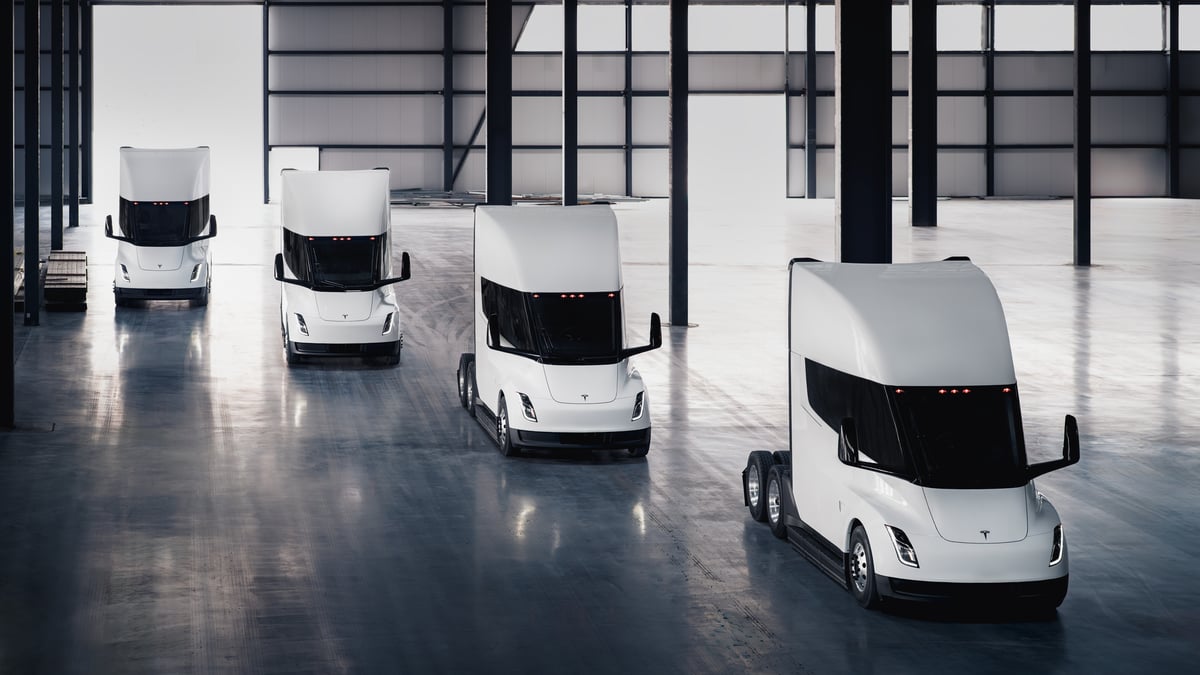
Tesla Semi Accelerates Production Despite Premium Pricing Challenge
Tesla is ramping up production of its Cybertruck-sibling electric Semi in 2026, targeting between 5,000 and 15,000 units annually. While the long-delayed Class 8 truck has matured considerably since its 2017 debut—now achieving payload parity with conventional diesel counterparts and demonstrating strong performance in pilot programs—its steep $300,000 price tag, roughly double the cost of comparable diesel trucks, threatens to temper investor enthusiasm even as the vehicle positions the automaker to disrupt the massive commercial trucking sector.
The tension between Tesla's technical achievement and market reality underscores a critical challenge facing the company's expansion beyond passenger vehicles: premium pricing for emerging technologies must eventually compete on economics, not just innovation credentials.
The Evolution of Tesla's Heavy-Duty Ambitions
Tesla first unveiled the Semi concept in 2017, when the promise of electric long-haul trucking seemed distant and speculative. Nearly a decade later, the company has materially improved the vehicle's capabilities, addressing early skeptics who questioned whether battery technology could deliver the range, payload capacity, and durability required for commercial trucking operations.
Key developments in the Semi's evolution include:
- Payload parity achievement: The truck now matches the cargo-carrying capacity of diesel Class 8 trucks, eliminating a major technical objection
- Extended pilot programs: Real-world testing with logistics companies has validated performance claims
- Charging infrastructure development: Expansion of Tesla's Supercharger network designed for commercial vehicles
- Supply chain maturation: Battery production scaling and component sourcing stabilization
These improvements represent genuine engineering progress. By most technical measures, the Semi is no longer a prototype—it's a production-ready vehicle with demonstrated capabilities. Pepsi and other early adopters have operated units in commercial service, providing proof points that the technology functions in real-world conditions.
However, technical success and commercial viability operate on different timelines. Tesla's target of 5,000 to 15,000 units annually by 2026 reflects a measured ramp compared to the overall Class 8 market, which sold approximately 300,000 trucks in the United States alone in 2023.
The Pricing Paradox and Market Adoption Reality
The $300,000 price point represents the crux of the Semi's commercial challenge. While this figure reflects the manufacturing costs, engineering complexity, and battery expenses embedded in the vehicle, it also creates a substantial economic hurdle for fleet operators accustomed to $150,000-$160,000 diesel alternatives.
For trucking companies operating on thin margins—typically 2-5% net profit—the capital cost differential translates into years of total cost of ownership comparison before advantages in fuel savings and maintenance become apparent. A fleet operator must:
- Justify the capital expenditure to shareholders and lenders despite higher upfront costs
- Navigate operational uncertainty around charging infrastructure availability on long-haul routes
- Train maintenance staff on unfamiliar technology and electrical systems
- Manage charging logistics that differ fundamentally from refueling patterns
While Tesla and industry analysts point to lower fuel costs and reduced maintenance requirements as offsetting advantages over a vehicle's 10+ year lifespan, the traditional trucking industry's skepticism toward new technologies—rooted in decades of diesel standardization—creates friction.
Initial sales volumes reflect this adoption curve reality. Despite the production ramp announcement, Tesla has shipped limited numbers of Semis since deliveries began in late 2023. The gap between the company's optimistic annual targets and actual near-term volumes suggests a slow climb toward the 5,000-15,000 unit range.
Market Context: A Massive Opportunity With Structural Barriers
The Class 8 heavy-duty trucking market represents one of the largest remaining transportation segments vulnerable to electrification. With approximately 2.9 million Class 8 trucks operating in the United States and replacement cycles occurring over 5-10 years, the total addressable market spans hundreds of billions of dollars.
Competitive dynamics are shifting:
- Traditional OEMs (Daimler, Volvo, Paccar) are developing electric Class 8 trucks but face legacy cost structures and dealer networks optimized for diesel maintenance
- Startup competitors face Tesla's advantage in battery access and manufacturing scale
- Regulatory tailwinds from EPA emissions standards will eventually mandate electrification, supporting long-term demand
- Fuel price volatility and driver shortage economics make alternative powertrains increasingly attractive
Tesla's advantages in battery supply chain, manufacturing automation, and software integration position it well for long-term dominance. However, the company faces a classic innovator's dilemma: superior technology doesn't guarantee rapid market adoption when incumbent alternatives function adequately and cost substantially less.
The semiconductor and battery supply constraints that have plagued Tesla's passenger vehicle production also pose risks to semi production scaling. Any global battery supply disruption or manufacturing bottleneck could delay the 2026 ramp targets.
Investor Implications: Execution Risk and Timeline Expectations
For Tesla shareholders, the Semi represents a genuine long-term growth opportunity that could eventually contribute meaningful revenue and margin expansion. Class 8 trucks command higher price points and potentially stronger margins than passenger vehicles, and the addressable market dwarfs current automotive competitors.
However, several risk factors warrant investor caution:
- Extended timeline to scale: Reaching even the midpoint of the 5,000-15,000 annual target may require 2027-2028 or later
- Pricing power erosion: Competitive pressure from legacy OEMs and new entrants could compress the $300,000 premium faster than currently anticipated
- Capital intensity: Scaling Semi production requires factory buildout and supply chain investment that diverts resources from passenger vehicle programs
- Customer credit dynamics: Fleet operators may require financing terms and warranties that compress effective margins
- Regulatory uncertainties: Changes in EPA standards, charging infrastructure subsidies, or grid capacity policies could accelerate or decelerate adoption
The Semi's success should not be measured against passenger vehicle growth metrics. Instead, investors should evaluate whether the company can achieve 10,000+ annual units by 2028-2029, with gross margins exceeding 20%, and whether these economics justify the capital allocation.
Looking Forward: A Credible But Uncertain Path
Tesla's decision to accelerate Semi production in 2026 reflects genuine engineering progress and demonstrated pilot success. The vehicle's achievement of payload parity with diesel trucks represents a technical milestone that validates the overall electrification strategy for heavy-duty applications.
Yet the original headline captured a central truth: the Semi could be a remarkable technical achievement and still disappoint investors expecting rapid market penetration. The gap between technological capability and commercial adoption—particularly at premium pricing in a price-sensitive market—remains substantial.
The coming 24-36 months will prove instructive. If Tesla demonstrates production scaling beyond 2,000 annual units and achieves pricing reductions toward $250,000 through manufacturing learning curves, the narrative shifts bullishly. Conversely, if initial demand remains constrained below 1,000 units annually and pricing remains rigid, investors should moderate expectations for near-term semi-truck revenue contribution.
The electric semi truck market's long-term inevitability doesn't guarantee Tesla profitably captures that opportunity on a timeline matching investor expectations. Execution, customer education, and the pace of charging infrastructure buildout will determine whether the Semi becomes a transformative business line or a valuable but niche product.