
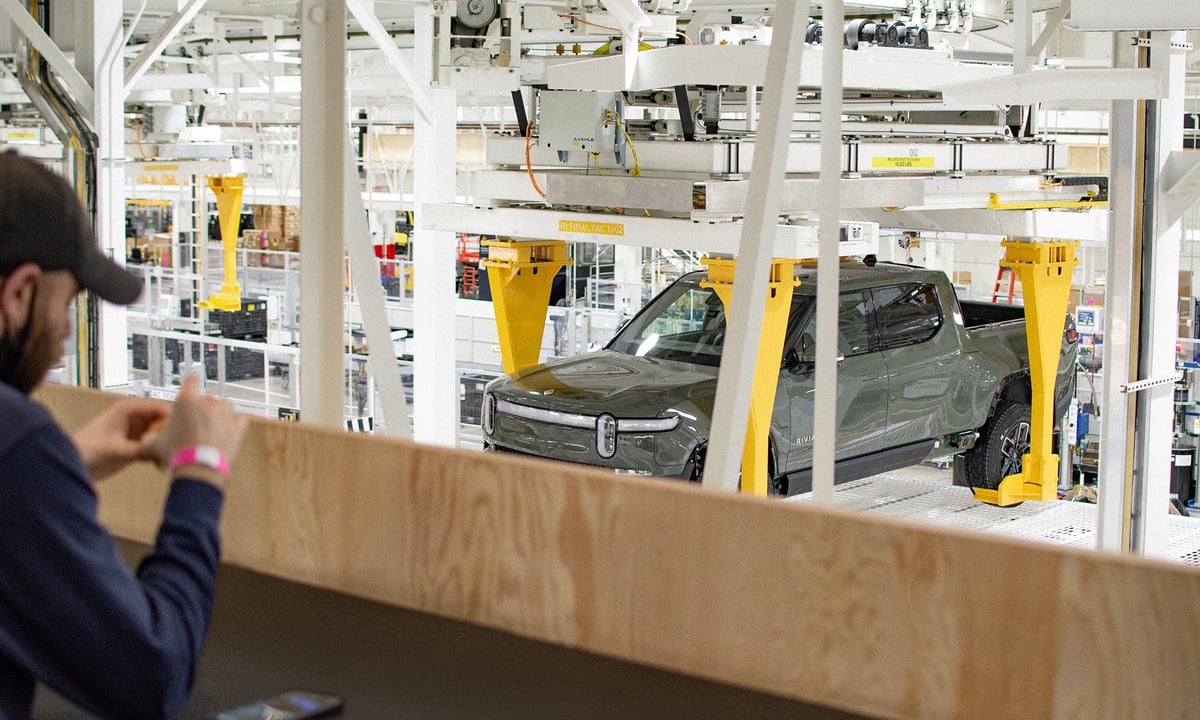
Tesla and Rivian Poised for $1 Trillion Growth as EV Market Shifts
Two electric vehicle manufacturers are positioned to capture enormous market value over the coming years, with $1 trillion in combined upside potential reshaping the automotive landscape. Tesla ($TSLA), which has already generated $1 trillion in shareholder value through its Model Y dominance, faces a pivotal inflection point as it introduces autonomous robotaxi capabilities. Meanwhile, Rivian ($RIVN), valued at approximately $20 billion, is executing an aggressive strategy to replicate Tesla's growth trajectory while leveraging strategic partnerships and emerging autonomous driving technologies.
Tesla's Dual Growth Engines: From EVs to Autonomous Robotaxis
Tesla has fundamentally transformed the automotive industry through the extraordinary success of its Model Y, which has become the world's best-selling vehicle model and established the company as the market leader in electric vehicles. The Model Y's commercial success laid the foundation for $1 trillion in value creation, demonstrating Tesla's ability to scale manufacturing, optimize costs, and capture consumer demand in an increasingly competitive EV market.
However, Tesla's true growth opportunity may lie beyond traditional vehicle sales. The company's robotaxi initiative, centered on the Cybercab, represents a potential second wave of value creation with analysts projecting another $1 trillion in upside potential. This autonomous vehicle platform addresses a fundamentally different market opportunity than traditional EV sales:
- Market expansion: Autonomous robotaxi services could tap into the global mobility services market, estimated in the trillions
- Technology differentiation: Tesla's proprietary autonomous driving technology, developed through real-world data collection across millions of vehicles, creates significant competitive advantages
- High-margin services: Robotaxi operations offer recurring revenue and superior unit economics compared to one-time vehicle sales
- Infrastructure advantages: Tesla's existing Supercharger network and manufacturing capabilities position it uniquely to scale autonomous fleets
The Cybercab announcement signals Tesla's strategic pivot toward autonomous mobility services, moving the company beyond its traditional automotive manufacturing model into technology-driven transportation solutions.
Rivian's Strategic Positioning: Following Tesla's Playbook
Rivian ($RIVN) is executing a carefully calibrated growth strategy designed to capture significant market share from both traditional automakers and Tesla. Currently valued at $20 billion, Rivian's valuation reflects considerable room for expansion if the company successfully executes its product roadmap and scaling ambitions.
The centerpiece of Rivian's near-term strategy is the R2 SUV, a mass-market electric vehicle positioned to compete directly with mainstream consumer segments currently dominated by traditional manufacturers. This represents a critical evolution from Rivian's initial focus on premium adventure vehicles:
- Market addressability: The R2 targets significantly larger addressable markets than Rivian's flagship R1 vehicles
- Cost structure: Designed for volume production at accessible price points, the R2 enables Rivian to compete across broader consumer demographics
- Supply chain leverage: Production scaling requires significant operational refinement but creates path to meaningful volume
- Gross margin trajectory: Mass-market vehicle production typically operates at lower initial margins but benefits from manufacturing economies of scale
Beyond traditional vehicle sales, Rivian is developing AI-driven autonomous driving capabilities that position the company to participate in the autonomous vehicle opportunity that Tesla is pioneering. This technology development represents significant long-term value creation potential if successfully commercialized.
Strategic Capital and Partnership Framework
Rivian's growth trajectory has been substantially bolstered by Uber's $1.25 billion investment commitment, a landmark partnership that provides both capital resources and commercial validation. This investment framework serves multiple strategic purposes:
- Capital availability: Provides essential funding for R2 scaling and autonomous technology development
- Commercial pathway: Establishes a potential distribution channel for Rivian's autonomous vehicles through Uber's platform
- Technology validation: Demonstrates confidence from a major mobility services operator in Rivian's autonomous capabilities
- Strategic alignment: Links Rivian directly to the autonomous mobility services opportunity that Uber is actively developing
The Uber partnership represents more than financial support; it signals Rivian's positioning as a credible competitor in both the EV manufacturing and autonomous mobility services spaces where Tesla has established early leadership.
Market Context: Industry Transformation and Competitive Dynamics
The electric vehicle market has undergone dramatic transformation over the past five years, shifting from a speculative technology bet to mainstream automotive demand. However, the industry remains in early innings of a multi-decade structural shift in transportation.
Key market dynamics supporting both Tesla and Rivian:
- EV adoption acceleration: Global EV sales continue expanding despite market maturation in leading regions, driven by regulatory mandates, improving technology, and expanding charging infrastructure
- Autonomous vehicle development: Multiple technology platforms (Tesla, traditional OEMs, ride-sharing companies) are advancing autonomous capabilities toward commercial viability
- Traditional automotive disruption: Legacy automakers face significant challenges in transitioning to electric platforms while managing declining internal combustion engine businesses
- Capital market enthusiasm: Investors remain engaged with EV and autonomous technology opportunities despite recent market volatility
The competitive landscape remains fragmented, with Tesla maintaining clear technology and market leadership while traditional automakers (General Motors, Volkswagen, Ford) and emerging EV manufacturers (NIO, XPeng, BYD) compete aggressively for market share. In this context, Rivian's strategy of combining mass-market vehicle production with autonomous driving technology development positions the company as a credible long-term competitor.
Investor Implications: Risk, Opportunity, and Valuation Dynamics
The dual $1 trillion opportunity highlighted by Tesla's current position and Rivian's forward-looking potential carries significant implications for investors evaluating EV sector exposure:
For Tesla investors: The robotaxi opportunity represents genuine fundamental optionality. Successful autonomous platform deployment could drive substantial additional value creation beyond current market expectations. However, execution risk remains substantial—autonomous driving technology development has proven more challenging than initially anticipated across the industry.
For Rivian investors: The valuation at $20 billion reflects both execution opportunity and substantial risk. Rivian must successfully scale the R2 production, improve manufacturing economics, and demonstrate credible autonomous driving technology progress. The Uber partnership significantly de-risks the company's financial runway but does not guarantee commercial success.
Sector implications: The combination of EV market growth and autonomous vehicle opportunity development could drive substantial value creation across the automotive sector over the next decade. However, competitive intensity remains high, and only companies demonstrating both manufacturing excellence and technology leadership will capture meaningful value.
Investors considering exposure to this opportunity should evaluate:
- Manufacturing execution capability and capital efficiency
- Autonomous technology progress versus competitive benchmarks
- Financial runway and capital structure sustainability
- Regulatory environment evolution affecting EV adoption and autonomous deployment
- Competitive positioning relative to Tesla, traditional OEMs, and emerging EV manufacturers
Looking Forward: Critical Inflection Points
Both Tesla and Rivian stand at critical junctures where company-specific and industry-wide outcomes will determine whether the projected $1 trillion in value creation materializes. Tesla's challenge is executing the transition from EV manufacturing leadership to autonomous mobility services dominance. Rivian's challenge is successfully scaling mass-market vehicle production while simultaneously developing credible autonomous driving technology.
The next 18-24 months will prove pivotal as Rivian launches the R2, scales production volumes, and demonstrates measurable progress on autonomous capabilities. Similarly, Tesla's Cybercab timeline and commercial deployment strategy will clarify the robotaxi opportunity's true magnitude and timeline.
For investors, the opportunity is substantial but execution-dependent. The EV and autonomous vehicle transitions represent genuine structural market opportunities—the question is which companies will successfully capture meaningful portions of the available value.