
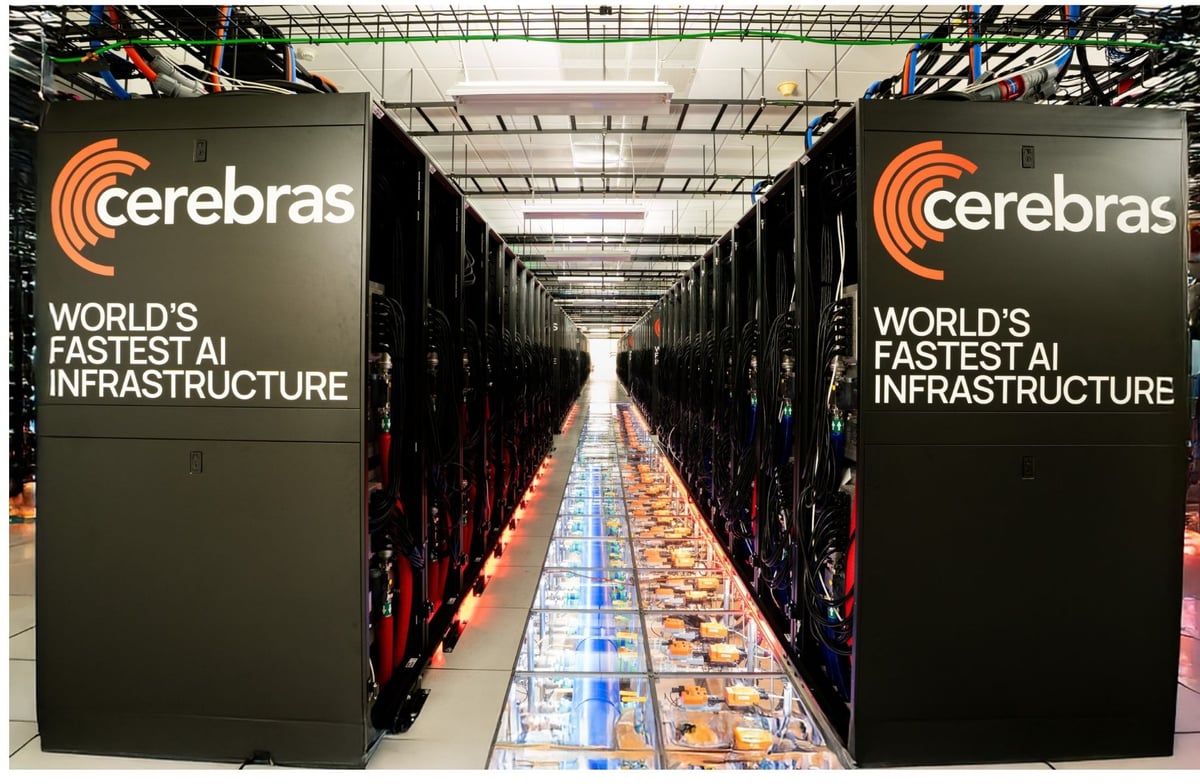
Cerebras Emerges as AI Chip Challenger with High-Growth IPO Filing
Cerebras Systems, a Silicon Valley-based artificial intelligence semiconductor specialist founded in 2015, has officially filed for an initial public offering on the Nasdaq under the ticker symbol $CBRS. The company's entry into public markets arrives at a pivotal moment for the AI infrastructure sector, as demand for specialized computing chips continues to accelerate globally. With a roster of blue-chip customers including OpenAI, Amazon, and Meta, Cerebras is positioning itself as a serious contender in the increasingly crowded competitive landscape currently dominated by Nvidia ($NVDA).
Cerebras's IPO filing comes on the heels of exceptional financial performance that underscores the market's appetite for AI computing solutions beyond Nvidia's traditional offerings. The company reported 2025 revenue of $510 million, representing 76% year-over-year growth—a rate that demonstrates strong market traction and customer adoption. This revenue milestone, combined with strategic partnerships and institutional backing, has attracted significant investor interest as the firm prepares to transition from private to public ownership.
Key Financial Metrics and Strategic Positioning
The company's financial trajectory reflects the broader boom in AI infrastructure investment. Cerebras's $510 million annual revenue run rate places it firmly in the upper echelon of specialized chipmakers, though still substantially smaller than Nvidia's massive installed base. What distinguishes Cerebras, however, is its specialized focus on wafer-scale AI computing—a technology approach that differs fundamentally from conventional chip architectures.
Cerebras's customer base demonstrates confidence in its technology differentiation:
- OpenAI: Major customer with ongoing partnership; OpenAI has made a $20 billion investment commitment that signals confidence in Cerebras's technology roadmap
- Amazon: Strategic partnership providing both customer revenue and potential infrastructure support
- Meta: Large-scale AI computing requirements driving significant engagement
The company's rapid growth trajectory—76% year-over-year revenue expansion—outpaces many semiconductor peers and reflects sustained demand for alternative chip architectures optimized for large language model training and inference workloads. This growth rate is particularly noteworthy given the maturity of the semiconductor industry overall and suggests Cerebras has successfully carved out distinct market demand.
Market Context: The Intensifying AI Chip Competition
Cerebras's IPO filing arrives during a period of extraordinary competition and consolidation in the AI chip sector. While Nvidia maintains commanding market share in GPU-accelerated computing for AI workloads, alternative architectures and specialized chip manufacturers have begun gaining traction among hyperscale cloud providers and AI research organizations.
The competitive landscape includes several emerging dynamics:
- Hyperscaler Investment: Major tech companies including Google, Amazon, and Microsoft have significantly increased investment in custom silicon development, reducing dependency on Nvidia
- Alternative Architectures: Beyond traditional GPUs, companies are exploring neuromorphic chips, tensor processing units, and application-specific integrated circuits optimized for AI inference
- Geopolitical Considerations: Export restrictions on advanced semiconductors have incentivized both domestic chip development and international alternatives to U.S.-based suppliers
- Cost Pressures: As AI infrastructure costs escalate, enterprises increasingly seek more power-efficient and cost-effective computing solutions
Cerebras's wafer-scale computing approach addresses several pain points in current AI infrastructure. The company's technology consolidates conventional multi-chip systems onto single large-scale wafers, potentially reducing latency, improving energy efficiency, and simplifying system architecture—advantages that resonate particularly strongly with organizations managing enormous language models and extensive training operations.
The broader AI chipmaker market has already attracted substantial venture capital and institutional investment. Beyond Cerebras, competitors include Intel's ($INTCL) Gaudi accelerators, AMD's ($AMD) EPYC and MI-series chips, Groq (still private), SambaNova Systems (private), and various custom silicon efforts from hyperscalers themselves. Each competitor targets specific workload optimization or cost advantages, creating a segmented market rather than a single "winner-take-all" outcome.
Investor Implications and Market Significance
Cerebras's public market entry carries several significant implications for investors analyzing the AI infrastructure and semiconductor sectors.
Valuation Benchmarking: The IPO pricing will provide crucial market signals regarding how institutional investors value specialized AI chip manufacturers relative to Nvidia. Current Nvidia valuations—driven by dominant market share and sustained demand—have created questions about whether alternative chip architectures can command premium valuations or whether they represent more moderately-valued alternatives.
Market Fragmentation: A successful Cerebras IPO would reinforce the thesis that Nvidia's market dominance, while substantial, is not absolute. The existence of multiple well-capitalized competitors with significant customer bases and differentiated technology suggests the AI chip market is becoming more competitive and fragmented than the GPU-centric era of recent years.
Capital Allocation Signal: The $20 billion investment commitment from OpenAI represents a massive vote of confidence in Cerebras's technology and roadmap. This commitment suggests major AI researchers and developers believe wafer-scale computing offers meaningful advantages for large-scale model training and operation—a conviction that could accelerate broader adoption if Cerebras successfully executes its commercialization strategy.
Growth Trajectory Sustainability: Investors will scrutinize whether Cerebras can sustain 76% year-over-year growth post-IPO. Semiconductor markets are notoriously cyclical, and maintaining hypergrowth rates requires consistent demand, successful product launches, and expanding customer bases—challenges that intensify as companies mature and saturation effects emerge.
Supply Chain Resilience: For enterprises concerned about over-reliance on Nvidia, Cerebras and other alternative suppliers offer portfolio diversification benefits. This consideration may prove increasingly important if supply constraints emerge or if geopolitical factors further restrict chip availability.
Forward-Looking Outlook
Cerebras's IPO filing marks another milestone in the rapid evolution of AI infrastructure markets. The company enters public markets during a period of sustained enthusiasm for artificial intelligence investment, substantial customer demand, and meaningful technological differentiation from incumbent suppliers. However, the path forward requires flawless execution—delivering on technology roadmaps, expanding the customer base beyond current anchor accounts, and managing the inevitable challenges of public company operations and investor expectations.
The IPO also reflects broader confidence in the durability of AI infrastructure demand. Unlike previous technology cycles where specialized hardware providers faced obsolescence, the current AI buildout appears durable and multi-decade in nature, driven by fundamental shifts in how organizations compete and operate. For Cerebras, the challenge is not demand-side but rather execution and competitive positioning against both established chipmakers and emerging competitors.
Investors evaluating Cerebras should monitor several key metrics post-IPO: revenue growth sustainability, customer concentration and retention, gross margins and profitability trajectory, R&D spending relative to revenue, and competitive win rates against alternative chip architectures. These factors will ultimately determine whether Cerebras evolves into a meaningful challenger to Nvidia's dominance or remains a valuable but niche player in a fragmented AI chip market.