
AI Supercycle Shifts to Physical and Agentic Systems; $NVDA and $PLTR Lead Next Wave
The artificial intelligence investment boom is far from exhausted—it's simply entering a new chapter. As traditional generative AI applications mature, the market is pivoting toward physical AI, agentic AI, and inference-heavy workloads, creating fresh opportunities for investors willing to shift their focus. Two companies appear especially well-positioned to capitalize on this evolution: Nvidia ($NVDA), the chip manufacturing titan, and Palantir Technologies ($PLTR), the data intelligence specialist, each commanding different segments of this expanding landscape.
The transition from large language model development to practical, real-world AI applications marks a significant inflection point for the entire sector. Rather than slowing, the AI supercycle is accelerating along new vectors that promise to reshape industries from manufacturing to logistics to autonomous systems.
The Numbers Behind the Next Wave
Nvidia's dominance in the AI infrastructure space continues to deepen, particularly through its emerging physical AI segment. The company generated over $6 billion in physical AI revenue during the past year, representing a significant and expanding portion of its total business. More strikingly, analysts project the physical AI market could reach $3.25 trillion by 2040, suggesting we're still in the earliest innings of this transformation.
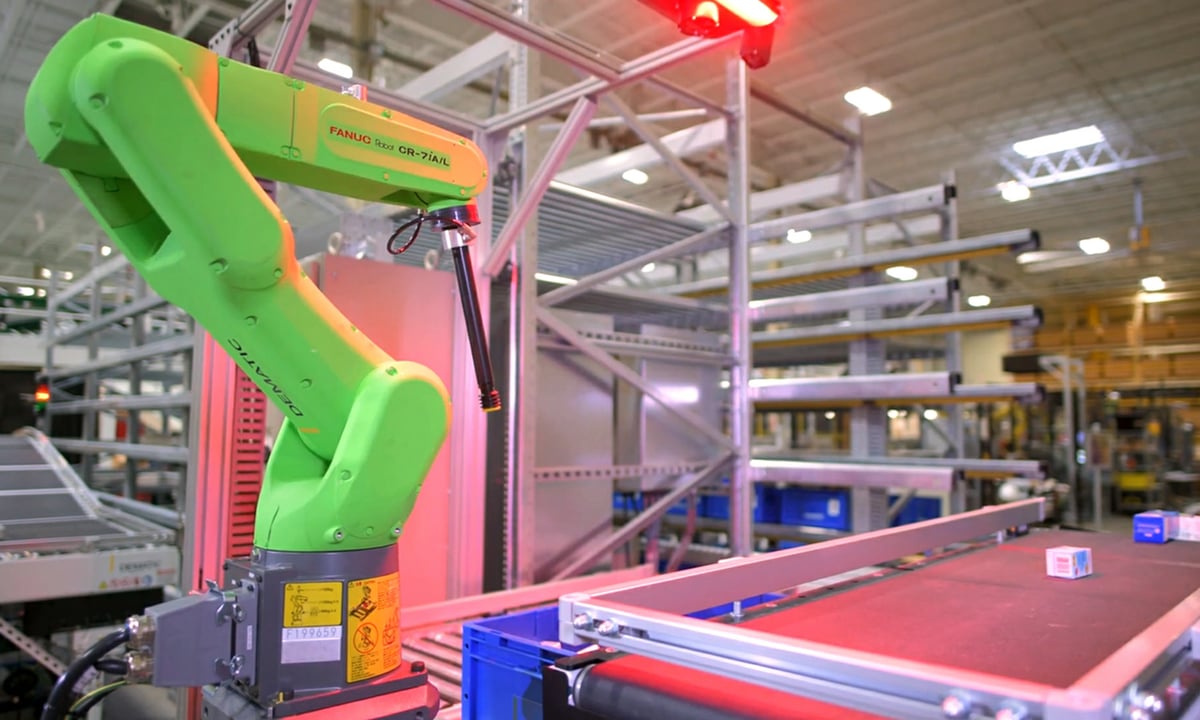
Physical AI encompasses systems that extend beyond digital environments to control robots, autonomous vehicles, and industrial automation—technology that interacts with the real world. This represents a fundamental expansion of where artificial intelligence can create value:
- Robotics and automation: Manufacturing, warehousing, and logistics applications
- Autonomous systems: Self-driving vehicles and delivery drones
- Industrial control: Smart factories and predictive maintenance systems
- Edge computing: AI processing at the device level rather than in centralized data centers
Palantir Technologies ($PLTR) has carved out leadership in the agentic AI space, where autonomous AI systems can independently identify problems, formulate solutions, and take action with minimal human intervention. Palantir's platform is positioned to benefit from an expected 46% annual growth rate in agentic AI solutions through 2030, representing the acceleration of a market still in its infancy.
The distinction between these two opportunities matters enormously. Nvidia plays the foundational infrastructure role—providing the chips and computing power that physical AI systems require. Palantir occupies the software and decision-making layer, creating the intelligence frameworks that agentic systems use to operate autonomously.
Market Context: From Large Models to Practical Applications
The AI investment landscape has evolved considerably since the 2023 ChatGPT explosion. While large language models captured headlines and investor capital initially flowed toward training these massive systems, the market has matured. The economics of training increasingly favor a handful of technology leaders with access to enormous capital and energy resources. This natural consolidation is pushing investment toward the next tier of innovation.
Physical AI and agentic AI represent the logical evolution. Enterprises and consumers have incorporated generative AI tools into workflows; the next frontier involves systems that don't merely provide information but actively solve problems. A manufacturing company doesn't need another LLM—it needs intelligent robots that can adapt to production challenges in real time. A logistics company requires autonomous agents that can optimize supply chains without constant human oversight.
The competitive landscape reflects this maturation:
- Training-heavy players face narrowing margins and capital intensity
- Inference and applications providers are experiencing faster growth and better unit economics
- Hardware manufacturers serving physical AI gain new demand beyond data centers
- Software and decision-making layers become increasingly valuable as systems must operate autonomously
Nvidia's $6 billion in physical AI revenue demonstrates the company's ability to pivot beyond its foundational data center GPU business. Meanwhile, traditional semiconductor companies lacking physical AI expertise risk being sidelined as workload requirements diverge from training-optimized architectures.
Palantir's positioning in agentic AI reflects years of investment in making sense of complex data and enabling autonomous decision-making. The company's government and commercial clients are increasingly deploying these systems, creating recurring revenue streams with high switching costs.
Investor Implications: Rethinking AI Exposure
For investors holding broad AI exposure through companies focused primarily on training infrastructure or generative AI applications, this shift carries meaningful implications. The $3.25 trillion potential market for physical AI by 2040 dwarfs current revenue contributions, suggesting a significant repricing opportunity as recognition grows.
Nvidia's physical AI segment, currently $6 billion annually, likely represents a fraction of what it could become as robotics, autonomous vehicles, and industrial automation scales. The company's existing manufacturing expertise, customer relationships, and CUDA software ecosystem position it naturally for this expansion. However, the shift also requires Nvidia to succeed in markets where incumbent industrial companies possess deep relationships.
Palantir's growth trajectory in agentic AI carries different dynamics. The company has demonstrated ability to penetrate the government contracting market and is actively expanding commercial deployments. A 46% annual growth rate through 2030 would substantially transform the company's revenue and profitability profile, though execution risk remains as competition in this space will intensify.
Investors should also consider that physical and agentic AI applications may face greater regulatory scrutiny than their generative AI predecessors. Autonomous systems that make consequential decisions in the physical world—from industrial automation to autonomous vehicles—will attract government attention regarding safety, liability, and labor displacement. Companies that proactively engage with regulators and establish trust may gain competitive advantages.
The broader market context suggests that companies positioned in this transition stand to outperform the broader AI sector over the next 3-5 years. The initial AI supercycle focused heavily on training infrastructure and model development, creating concentrated value capture among a small number of leaders. The next phase, driven by physical and agentic AI, offers more distributed opportunities with longer runways.
Looking Ahead: The Expansion Phase
The AI supercycle isn't decelerating—it's expanding beyond the markets that captured headlines during 2023 and 2024. Nvidia and Palantir represent two different but complementary ways to access this evolution. Nvidia provides the physical substrate upon which these systems operate, while Palantir supplies the intelligence layer.
For investors positioned primarily in large language models or foundational model development, this shift suggests the need for portfolio rebalancing. For those seeking exposure to the next wave of AI value creation, companies excelling in physical infrastructure and autonomous decision-making deserve careful examination.
The coming years will determine whether the AI supercycle truly lives up to its transformative promise, moving from experiments with chatbots to systems that reshape manufacturing, transportation, and industrial work at massive scale.