
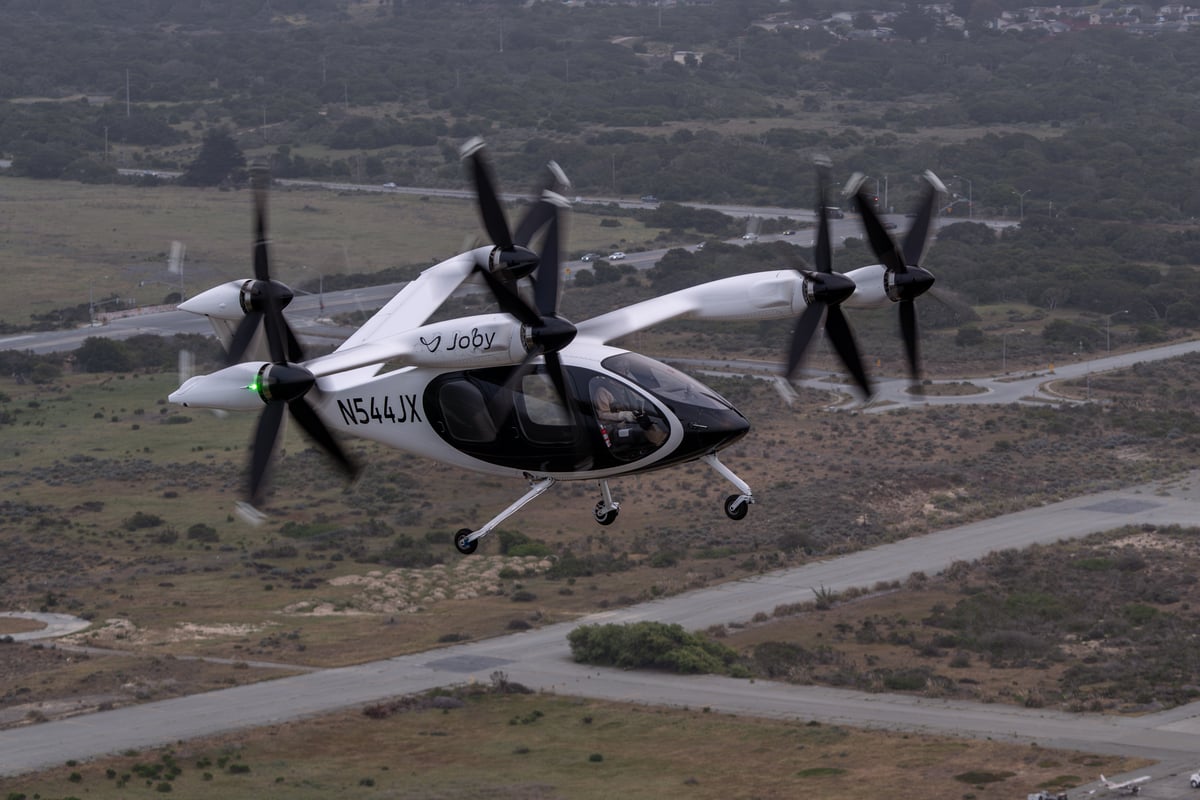
Joby's Manhattan-to-JFK Test Flight Proves Engineering, Not Economics
Joby Aviation achieved a notable technical milestone this week, successfully completing its first test flights from Manhattan to John F. Kennedy Airport—a demonstration that its electric vertical takeoff and landing (eVTOL) aircraft can navigate one of the world's most congested airspace corridors. Yet this engineering accomplishment masks a deeper challenge: whether the economics of urban air mobility can ever justify the operational complexity and passenger costs required to compete with existing transportation options.
The test flights represent years of development and regulatory approval efforts by the San Francisco-based startup, which has positioned itself as a leader in the emerging urban air taxi sector. However, the company's proposed pricing model—at $200 per seat for the Manhattan-to-JFK route—faces fundamental headwinds that transcend engineering capability, raising questions about whether Joby can achieve commercial viability at scale.
The Engineering Achievement and Operational Reality
The successful test flights from Manhattan to JFK Airport demonstrate that Joby's technology works in a real-world, high-stakes environment. Key aspects of this achievement include:
- Successfully navigating airspace constraints around one of America's busiest metropolitan areas
- Completing point-to-point flights between Manhattan and the outer-borough airport
- Proving the aircraft's reliability in complex urban conditions
- Meeting regulatory requirements from aviation authorities
These are legitimate technical achievements that validate years of research, development, and federal certification efforts. The company has overcome substantial engineering hurdles that competitors like Archer Aviation ($ACHR), Lilium ($LILM), and Vertical Aerospace have also pursued with varying degrees of success.
However, completing a test flight and operating a profitable commercial service are fundamentally different challenges. The Manhattan-to-JFK route covers approximately 15 miles, a distance that could be covered by conventional transportation in roughly 45 minutes to an hour depending on traffic conditions.
Market Economics: The Case Against $200-Per-Seat Viability
The proposed $200 per seat pricing for Joby's urban air taxi service faces substantial competitive and economic headwinds. Current transportation alternatives for the Manhattan-to-JFK route include:
- Taxi/Uber services: Approximately $50-75 depending on traffic
- Public transit (AirTrain + subway): Approximately $10-15 with 45-60 minute travel time
- Helicopter services (Blade): Already struggling with economics and high operating costs
- Airport shuttle services: $15-25 with moderate travel times
At twice the price of a conventional taxi for a route already served by lower-cost alternatives, Joby must offer meaningful advantages beyond marginal time savings. The company's pitch relies on speed advantage—potentially cutting travel time to 5-10 minutes—but this benefit applies only to a narrow window of high-urgency travelers willing to pay a significant premium.
The helicopter service precedent is particularly instructive. Blade, which operates helicopter flights from Manhattan to area airports, has struggled to build a sustainable business model despite offering superior speed compared to ground transportation. Blade's challenges reveal structural limitations of the urban air mobility market:
- A limited addressable market of affluent business travelers and time-sensitive professionals
- Weather dependency that reduces operational frequency
- Inconvenient ground logistics requiring surface transportation to and from vertiports
- Regulatory and noise restrictions that constrain operations and routing flexibility
- High operating costs driven by fuel, maintenance, and pilot expenses
While Joby's electric aircraft promise lower operating costs than helicopter fuel, the company still faces significant fixed costs including vertiport infrastructure, regulatory compliance, insurance, and pilot compensation. These costs must be spread across a passenger base that, by definition, will be substantially smaller than traditional airport transportation.
Market Context: The Broader Urban Air Mobility Landscape
Joby's test flights occur within a sector experiencing significant momentum but facing persistent profitability questions. The urban air mobility (UAM) market has attracted billions in venture capital and strategic investments, with the U.S. Federal Aviation Administration (FAA) establishing regulatory frameworks to enable commercial operations.
Key sector developments include:
- FAA certification progress: Multiple companies approaching final certification for commercial operations
- Capital availability: Significant venture and corporate investment continuing despite industry-wide challenges
- Technological maturity: Electric vertical takeoff and landing technology demonstrating operational reliability
- Regulatory clarity: Increasingly defined pathways for commercial deployment
However, the sector remains unproven at commercial scale. No urban air mobility company has yet demonstrated a profitable business model, and several well-funded competitors are pursuing similar Manhattan-to-airport routes. The addressable market for premium air transportation may be insufficient to support multiple competing services.
Moreover, Joby faces additional headwinds specific to the Manhattan market:
- Extreme real estate costs for vertiport infrastructure
- Complex airspace requiring sophisticated traffic management systems
- Limited suitable landing zones within Manhattan proper
- Noise sensitivity in densely populated urban areas
- Potential regulatory restrictions on flight paths and frequencies
The company's path to profitability requires either achieving dramatically higher passenger volumes through lower pricing or finding a sustainable premium market willing to pay $200+ per trip consistently. The Blade precedent suggests the latter is insufficient for scale.
Investor Implications: Technical Success Doesn't Equal Market Success
For investors evaluating Joby Aviation and competitors in the urban air mobility space, the Manhattan-to-JFK test flights highlight a critical distinction: technological achievement and commercial viability are separate questions. The test flights prove Joby can build and operate eVTOL aircraft in complex environments, which matters for long-term value creation but doesn't resolve fundamental business model uncertainties.
Key considerations for investors include:
- Market size validation: Will sufficient passengers sustain operations at required price points?
- Operating cost structure: Can electric aircraft economics beat helicopter services despite initial capital costs?
- Capital requirements: How much additional funding will be needed for infrastructure and fleet expansion?
- Regulatory risk: Will FAA restrictions limit operations below break-even levels?
- Competitive dynamics: Can Joby maintain advantages as other well-funded competitors deploy services?
The eVTOL sector broadly faces a "valley of death" between proof-of-concept and profitable commercial operations. Multiple competitors—including Lilium, Archer Aviation, and Vertical Aerospace—are pursuing similar routes with different aircraft designs, fragmenting the already-limited market.
For Joby Aviation specifically, the test flights provide valuable validation for investor confidence and regulatory progression, but they do not resolve the underlying economic questions about the Manhattan-to-JFK market. The company remains pre-revenue and will require sustained capital infusions before reaching profitability.
Looking Forward: The Path to Profitability
Joby Aviation's successful test flights represent genuine technical progress and validate the fundamental feasibility of electric urban air mobility. However, the company still faces the more challenging task of proving that customers will pay sufficient fares to sustain profitable operations.
The $200-per-seat pricing for Manhattan-to-JFK appears optimistic given competitive alternatives and Blade's historical struggles with economics in the same market. For the urban air mobility sector to achieve mainstream viability, either fares must decrease substantially as costs decline, or the addressable market must expand beyond Manhattan-to-airport routes toward broader urban transportation applications.
Until Joby and competitors demonstrate sustainable commercial operations with transparent unit economics, the sector remains a speculative investment with proven technology but unproven business models. The engineering works; the economics remain unresolved.