
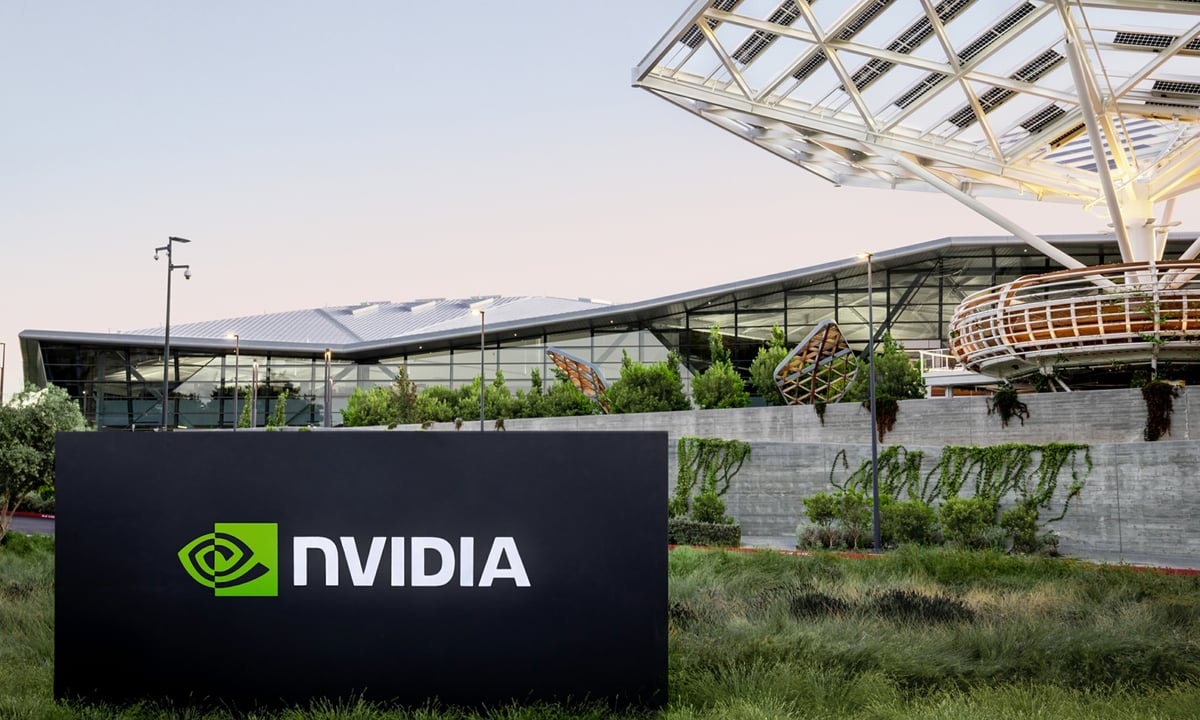
Nvidia's Latest Stumble Amid China Headwinds
Nvidia ($NVDA) shares declined 3.3% today, underperforming the broader market's pullback, as investor sentiment soured following CEO Jensen Huang's recent visit to China that failed to yield any significant new chip orders. The sell-off signals growing concerns about the artificial intelligence chipmaker's ability to expand its footprint in one of the world's most critical markets, even as the company maintains dominance in global AI infrastructure. Yet with earnings scheduled for May 20, analysts and market observers are weighing whether today's weakness represents a genuine warning sign or a tactical buying opportunity ahead of what could be a pivotal quarterly update.
The timing of today's decline is particularly notable given the geopolitical and competitive pressures intensifying around Nvidia's China business. For years, the company has derived meaningful revenue from Chinese customers despite U.S. export restrictions on advanced AI chips. Huang's trip—ostensibly aimed at strengthening relationships and securing orders—appears to have disappointed investors expecting concrete commercial progress. Instead, the visit underscored the headwinds facing the semiconductor giant in a region where it once held unchallenged sway.
The China Challenge: Domestic Competitors Rising
The fundamental issue driving today's selloff reflects a longer-term structural shift in China's technology landscape. Tencent and Alibaba, two of the country's most powerful tech conglomerates, are aggressively ramping up domestic chip production capabilities. This push represents more than routine R&D investment—it signals a strategic national imperative to reduce reliance on foreign semiconductor suppliers, particularly for artificial intelligence applications.
Key competitive developments include:
- Tencent and Alibaba building proprietary AI chip capabilities to power internal applications
- Chinese regulatory pressure on foreign semiconductor vendors creating friction for Nvidia partnerships
- Domestic alternative chips improving in performance and cost competitiveness
- Government incentives driving state-sponsored chip design and manufacturing initiatives
These developments matter significantly because China represents a substantial portion of the global AI infrastructure market. While U.S. export controls already limit Nvidia's ability to sell its most advanced chips to Chinese customers, the company has maintained a presence through restricted product lines and licensing arrangements. If Chinese tech giants successfully develop viable domestic alternatives, Nvidia's addressable market in the region could shrink considerably over the next 18-24 months.
Investors today appeared to price in a scenario where Huang's empty-handed return from China signals diminishing future growth prospects in a region that contributed meaningfully to recent revenue expansion. The 3.3% decline, while not catastrophic, reflects the market's sensitivity to China-related risks amid broader concerns about AI sector valuation.
Looking Ahead: Earnings as the Reset Button
However, the narrative may shift dramatically when Nvidia reports earnings on May 20. The company has established a powerful track record of beating analyst guidance and raising forward projections, a pattern that has repeatedly rewarded patient investors during periods of temporary weakness. That historical execution advantage creates a compelling asymmetry: today's decline may have already priced in near-term China disappointments, while the May 20 report could highlight offsetting strength elsewhere in the business.
Consider the broader context:
- Nvidia's data center revenue remains extraordinarily strong, driven by demand from U.S. hyperscalers and cloud providers investing heavily in AI infrastructure
- The company's gross margins have expanded significantly, reflecting the commanding pricing power of its H100 and newer generation chips
- Forward guidance for the next quarter and beyond could demonstrate that non-China markets are more than compensating for geopolitical headwinds
- Any commentary on new product roadmaps or next-generation architecture could reignite investor enthusiasm
Market participants who view today's 3.3% dip through this lens see an opportunity to accumulate shares before management's May 20 presentation potentially re-rates the stock upward. Nvidia's history of positive earnings surprises suggests the market may be temporarily overweighting China risks relative to the company's fundamental growth drivers elsewhere.
Market Implications and Sector Context
The broader artificial intelligence infrastructure market remains in early innings, with demand from enterprise customers, cloud providers, and technology companies showing no signs of abatement. Nvidia's commanding 80%+ market share in AI accelerators insulates it from many competitive pressures, even if China becomes increasingly off-limits. The company's ability to sustain premium pricing and volume growth in other geographies—particularly North America and Europe—remains the critical question for long-term investors.
Today's decline also occurs within a sector experiencing typical consolidation and repricing after extraordinary gains. The AI boom of 2023-2024 lifted many semiconductor stocks to elevated valuations, and pullbacks like today's are normal calibration events. Investors should distinguish between temporary weakness driven by headline risk (China setbacks) and structural deterioration in business fundamentals (which are not evident in Nvidia's quarterly results).
For context, Nvidia's position as the essential vendor for artificial intelligence infrastructure remains virtually uncontested in most global markets. Competitors like AMD ($AMD) and Intel ($INTC) have failed to narrow the performance and software ecosystem gap significantly. This structural advantage suggests that even with meaningful headwinds in China, Nvidia's growth trajectory remains substantially above market growth rates.
The Verdict: Timing and Patient Capital
Today's 3.3% decline appears to reflect investor anxiety about China rather than any fundamental deterioration in Nvidia's core business. CEO Huang's unsuccessful trip clearly disappointed those hoping for evidence that the company could maintain or expand its China footprint despite geopolitical constraints. That disappointment is legitimate and the selloff rational in the immediate term.
Yet for investors with a May 20 earnings date circled on their calendars, today's weakness presents a risk-reward asymmetry worth considering. Nvidia's historical pattern of beating guidance, combined with the company's demonstrated ability to grow substantially even without meaningful China expansion, suggests that next week's report could provide a compelling re-entry point for investors spooked by today's headlines.
The core question for shareholders and prospective investors: Is this a meaningful inflection point signaling structural decline in Nvidia's addressability, or temporary noise ahead of earnings that could easily be rendered immaterial by strong results and forward commentary? History suggests patience and evidence-gathering—both pointing toward the May 20 earnings call—remain the prudent approach.