
Billionaire Laffont Dumps Cloud Giants for AI Chip Infrastructure Play
Philippe Laffont's Coatue Management executed a significant portfolio realignment during the first quarter, trimming stakes in some of the world's largest cloud computing providers while dramatically increasing exposure to semiconductor infrastructure companies. The strategic shift reveals a calculated bet that the artificial intelligence boom will continue to reward chipmakers and equipment suppliers over cloud service providers—a thesis gaining traction among institutional investors as competition intensifies across the AI software and services landscape.
The move represents a notable departure from the traditional "picks and shovels" narrative that has dominated AI investment discourse. Rather than chasing companies building AI applications and services, Laffont has positioned Coatue's portfolio to benefit from the foundational hardware requirements that enable AI systems to function at scale.
The Portfolio Pivot: From Consumption to Production
Coatue Management reduced positions across a constellation of cloud infrastructure giants during Q1, including:
These reductions were paired with substantially increased stakes in two critical semiconductor infrastructure players: TSMC (Taiwan Semiconductor Manufacturing Company) and ASML (ASML Holding N.V.), the Dutch lithography equipment manufacturer.
The timing of this reallocation carries particular significance given the capital intensity of AI infrastructure buildout. While Amazon, Alphabet, and Microsoft have collectively invested hundreds of billions of dollars in data centers and AI computing capacity, Laffont's thesis suggests diminishing returns from these heavy-spending incumbents. Instead, the real value accrual—and margin expansion—occurs upstream, in the companies that manufacture the chips and produce the equipment to make them.
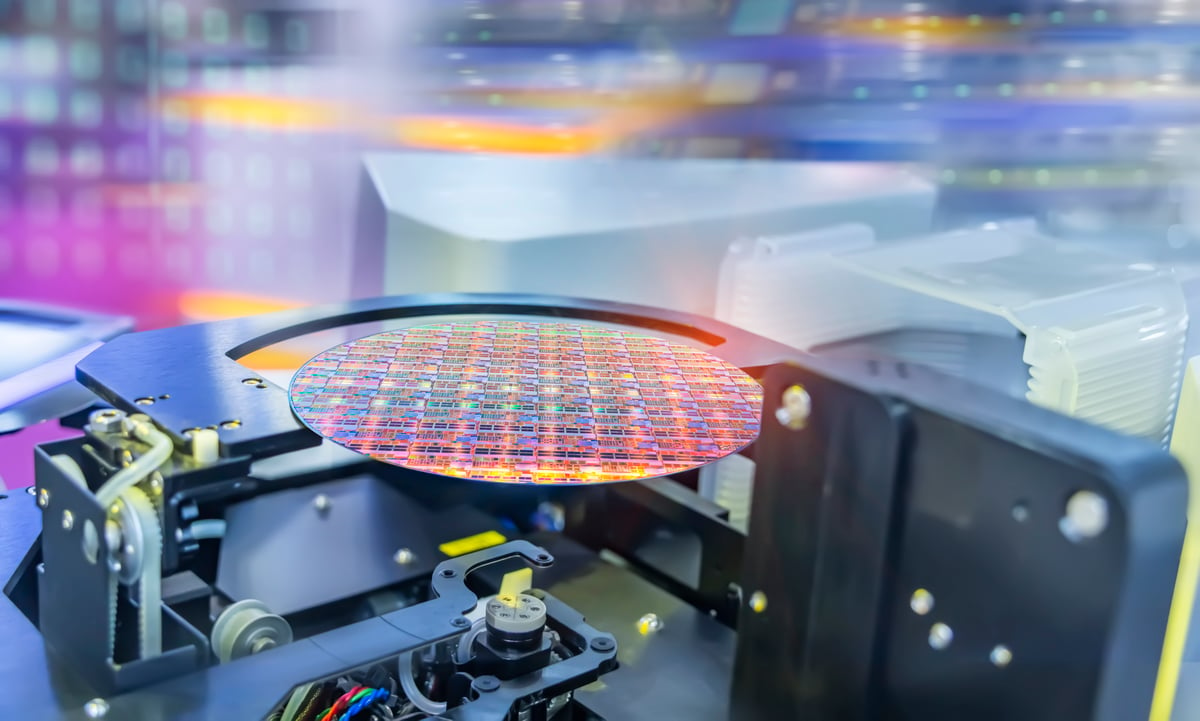
TSMC stands as the world's most advanced semiconductor manufacturer, holding a virtual monopoly on cutting-edge chip production for artificial intelligence applications. The company manufactures processors for NVIDIA ($NVDA), AMD ($AMD), and countless other AI chipmakers, positioning it as an indispensable chokepoint in the AI supply chain. ASML, meanwhile, dominates the global market for extreme ultraviolet (EUV) lithography machines—the extraordinarily complex equipment required to manufacture chips at the sub-5 nanometer scales necessary for advanced AI processors.
Neither company directly competes with the cloud giants Laffont is de-emphasizing, yet both benefit enormously from the same AI infrastructure investment wave that would theoretically support cloud providers. The distinction lies in structural advantage: semiconductor manufacturers and equipment suppliers have far higher gross margins, less capital intensity relative to revenue, and less exposure to commodity pricing pressure in cloud services.
Market Context: The AI Infrastructure Hierarchy
The semiconductor sector has emerged as perhaps the clearest beneficiary of the AI boom, even as valuations for pure-play AI software companies have compressed following initial euphoria. Industry analysts note that the marginal dollar spent on AI infrastructure disproportionately flows to chipmakers and equipment suppliers rather than cloud providers:
- Gross margins: ASML operates with gross margins exceeding 50%, while semiconductor manufacturers like TSMC achieve similar levels. Cloud providers, by contrast, typically operate at 20-35% gross margins and face increasing pricing pressure from competition.
- Capital requirements: While Amazon, Microsoft, and Alphabet must continuously deploy tens of billions annually in data center construction and infrastructure, TSMC and ASML have more measured capital expenditure profiles relative to revenue growth.
- Supply constraints: The global semiconductor industry remains capacity-constrained for advanced nodes, providing pricing power. Cloud services face no such constraint.
- Customer diversification: TSMC serves hundreds of fabless semiconductor companies across consumer electronics, automotive, and AI. Its revenue streams are less concentrated than cloud providers' reliance on a handful of large enterprise customers.
The broader semiconductor equipment and manufacturing sector has outperformed cloud computing stocks significantly throughout 2024, with investors rotating away from mega-cap cloud providers toward more specialized infrastructure plays. Laffont's move formalizes a rotation that institutional investors have been executing incrementally throughout the year.
Competitive dynamics within cloud computing have also intensified substantially. Amazon Web Services ($AMZN) maintains market leadership, but Microsoft Azure ($MSFT) and Google Cloud ($GOOGL) have captured meaningful share gains. This intensifying competition has compressed margins and forced all three providers into heavy generative AI investment spending to maintain differentiation, further pressuring near-term profitability.
Investor Implications: Following the Smart Money
Laffont's reallocation raises critical questions for equity investors across multiple portfolios. The move effectively signals skepticism about the near-term valuation expansion of mega-cap cloud providers, even as these companies invest aggressively in AI capabilities. It simultaneously reflects confidence that semiconductor infrastructure—particularly at the manufacturing and equipment level—offers superior risk-adjusted returns.
For investors following the so-called "picks and shovels" thesis, Laffont's pivot suggests the shovel-makers themselves (chip equipment manufacturers) offer better economics than the miners using shovels (cloud providers conducting AI workloads). This distinction matters enormously for portfolio construction:
- $TSMC benefits from structural supply constraints in advanced chip manufacturing, with limited competition at the cutting edge. The company trades at a premium valuation but carries justification given its monopolistic position and cash generation capabilities.
- ASML faces even more limited competition globally, with no viable alternative suppliers for the most advanced lithography equipment. Its valuation multiple reflects this moat, but so does its growth trajectory.
- $MSFT, $GOOGL, and $AMZN all trade at elevated multiples reflecting AI growth expectations, but face competitive saturation and margin pressure that may not justify continued valuation expansion.
The move also carries geopolitical implications. TSMC's concentration in Taiwan and ASML's dependence on Dutch export licenses inject geopolitical risk into these positions, a factor sophisticated investors like Laffont undoubtedly factored into their analysis. Nevertheless, the supply constraints and technical barriers to replicating these companies' competitive positions remain extraordinarily high.
Institutional capital has begun following similar trajectories, with semiconductor equipment makers and advanced manufacturers outperforming cloud services stocks on a total return basis in 2024. Laffont's public positioning through filings validates what many portfolio managers have already suspected: the most attractive risk-reward in AI infrastructure resides upstream, not downstream.
Looking Ahead: The Infrastructure Narrative Solidifies
Philippe Laffont and Coatue Management have articulated a clear thesis through portfolio action: the artificial intelligence boom will ultimately reward the foundational infrastructure providers—those controlling supply-constrained, high-margin businesses in semiconductor manufacturing and equipment—over the companies consuming those chips to build consumer and enterprise AI applications.
As AI infrastructure investment continues its inevitable expansion over the coming years, investors should expect this concentration of value creation to persist. Companies like TSMC and ASML occupy positions so structurally advantageous that they function almost as utilities powering the entire AI ecosystem, while cloud providers compete in increasingly saturated markets with moderate-to-eroding margins.
The reallocation executed by one of Wall Street's most respected technology investors provides both validation and a cautionary signal: the easy money in mega-cap cloud stocks may have already been made, while semiconductor infrastructure plays remain poised for significant appreciation as the capital intensity of AI infrastructure peaks over the next 3-5 years.