
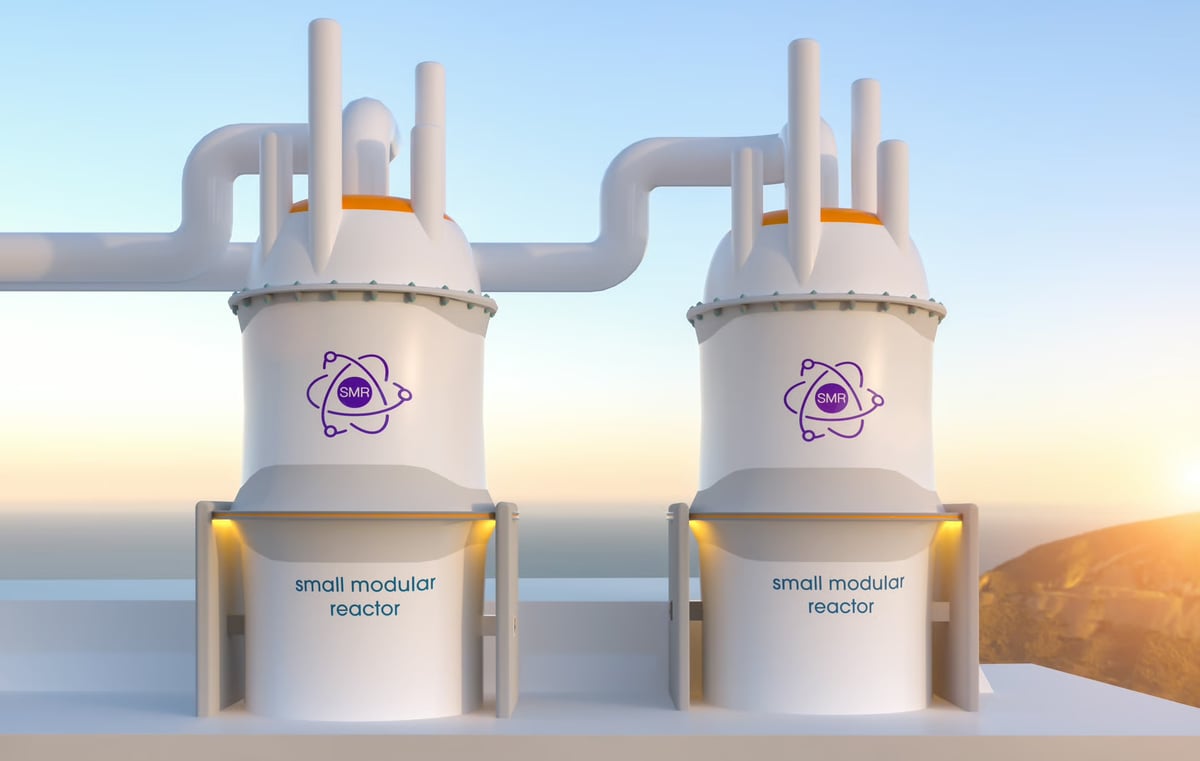
NuScale Stock Rallies From Lows: Can Small Modular Reactors Reach $20?
NuScale Power ($SMRK) has become one of Wall Street's most polarizing energy stocks after a dramatic collapse from its October 2025 peak of $57 to $12.85—a devastating 77% decline. Yet despite this crater, analysts and industry observers believe the company's stock could recover to $20 or higher by year-end, suggesting substantial upside from current levels. This projection hinges on NuScale's unique competitive position as the only U.S. company with an NRC-licensed small modular reactor (SMR) design, paired with mounting evidence that the global energy market is desperately seeking alternatives to meet surging power demands from artificial intelligence and data centers.
The volatility reflects the classic risk-reward dynamic facing investors in early-stage nuclear technology: transformational upside potential weighed against execution risk, commercialization delays, and the inherent uncertainty of deploying unproven systems at scale. For investors considering whether to buy the dip or stay on the sidelines, understanding NuScale's current trajectory and market opportunity is essential.
Key Details: From Regulatory Victory to Market Downturn
NuScale's journey from October's euphoric highs to current depressed levels reveals the inherent tension between technological achievement and market reality. The company's NRC license approval—a watershed moment for the SMR industry—validated its design and cleared regulatory hurdles that have stalled competitors for years. This approval should theoretically have cemented NuScale's market leadership, yet the stock has moved dramatically in the opposite direction.
What's changed the narrative isn't the underlying technology, but rather the commercial deployment timeline and market expectations. Key developments supporting NuScale's growth thesis include:
- Romania Partnership: NuScale has secured a significant project to develop small modular reactors in Romania, representing one of the first international deployments of its licensed design
- Tennessee Valley Authority (TVA) Agreement: A major U.S. utilities contract suggests institutional confidence in NuScale's technology and its ability to deliver solutions to established energy infrastructure operators
- Zero Commercial Deployments: Despite regulatory approval, NuScale has yet to deploy its technology at commercial scale, meaning all growth projections depend on future execution
The disconnect between NuScale's $3 trillion market opportunity and its current market capitalization reflects both the massive potential addressable market and Wall Street's skepticism about near-term commercialization. The company must now transition from promising startup to proven reactor builder—a shift that typically takes years and billions in capital.
Market Context: The Nuclear Renaissance Powered by AI Demand
NuScale's valuation swings cannot be understood apart from the broader energy market transformation reshaping global power dynamics. The rise of artificial intelligence, hyperscale data centers, and cryptocurrency mining has created an unprecedented surge in electricity demand that threatens to overwhelm existing grid capacity. Traditional renewable sources like solar and wind, while rapidly expanding, have intermittency challenges that make nuclear power increasingly attractive to energy buyers.
This dynamic has triggered what many analysts call a "nuclear renaissance." Established nuclear operators like Constellation Energy ($CEG) have seen their stocks surge as data center operators and tech giants desperate for reliable, emissions-free baseload power have turned to nuclear as the solution. NuScale's competitive advantage lies in its small modular design, which offers several theoretical benefits over traditional large reactors:
- Lower capital requirements per unit: SMRs require smaller upfront investments than gigawatt-scale plants
- Flexibility: Multiple units can be deployed incrementally, matching power demand growth
- Remote locations: Smaller physical footprints allow deployment in locations unsuitable for massive reactors
- Industrial heat applications: SMRs can potentially serve manufacturing and desalination beyond electricity generation
However, NuScale faces formidable competition and structural challenges. Traditional nuclear operators continue dominating the field, and questions persist about whether SMR economics pencil out at the per-unit scale NuScale is targeting. Construction cost inflation, supply chain constraints, and the historically poor track record of nuclear megaprojects in developed economies all weigh on investor confidence.
The $3 trillion market opportunity cited by NuScale represents the total addressable market across decades, not near-term revenue. This distinction matters significantly for valuation: the difference between capturing 0.1% of that market versus 5% over the next decade represents vastly different financial outcomes.
Investor Implications: High Risk, Transformational Upside
For shareholders, the journey from $57 to $12.85 to potential $20 represents the volatile reality of backing pre-commercial energy infrastructure plays. Several dynamics merit consideration:
The Bull Case for Recovery to $20+: If NuScale successfully deploys reactors in Romania on schedule and the TVA project advances, real-world proof-of-concept could trigger re-rating higher. Demonstration that SMRs can be built on time and budget would validate the entire category and potentially open floodgates of customer demand. Major utilities, tech companies, and international governments all have stated interest in SMR technology, and NuScale's licensed design gives it first-mover advantage.
The Bear Case for Continued Weakness: NuScale has never built a commercial reactor. Cost overruns and schedule delays are standard in nuclear construction globally. The company's burn rate and capital requirements may force dilutive financing before achieving profitability. Competitive entrants—both established firms and well-funded startups—continue developing alternative SMR designs. Regulatory uncertainty, particularly regarding waste disposal and decommissioning costs, persists.
Volatility as Feature, Not Bug: The 77% decline from peak underscores that NuScale shares are inherently volatile. This stock is suitable only for investors with high risk tolerance and long time horizons. Position sizing matters more than with established utilities; many analysts suggest treating NuScale as a speculative growth position rather than a core holding.
The analyst consensus that the stock "could" reach $20 by year-end should be interpreted cautiously—this represents a modest 55% recovery from current levels, not a guarantee. Execution timelines in nuclear always slip, and market sentiment can shift rapidly on disappointing updates.
Looking Ahead: Execution Will Determine Value
Ultimately, whether NuScale stock recovers to **$20, soars beyond it, or continues declining depends entirely on real-world deployment progress. The regulatory approval was necessary but insufficient; investors now need to see:
- Concrete construction timelines and capital commitments from the Romania and TVA projects
- Evidence of cost control and construction progress
- New customer contracts demonstrating genuine market demand beyond early adopters
- Clear pathway to profitability and positive cash flow
The $3 trillion nuclear market opportunity is real, and NuScale's licensed design positions it uniquely to capture a portion of it. But the path from approved design to profitable producer is littered with casualties in the energy sector. The next 12 months will prove decisive in determining whether the company's stock represents a value opportunity at $12.85 or a value trap deserving of its depressed valuation. Investors should monitor quarterly updates on project progress, capital spending, and customer pipeline closely before making significant commitments.