
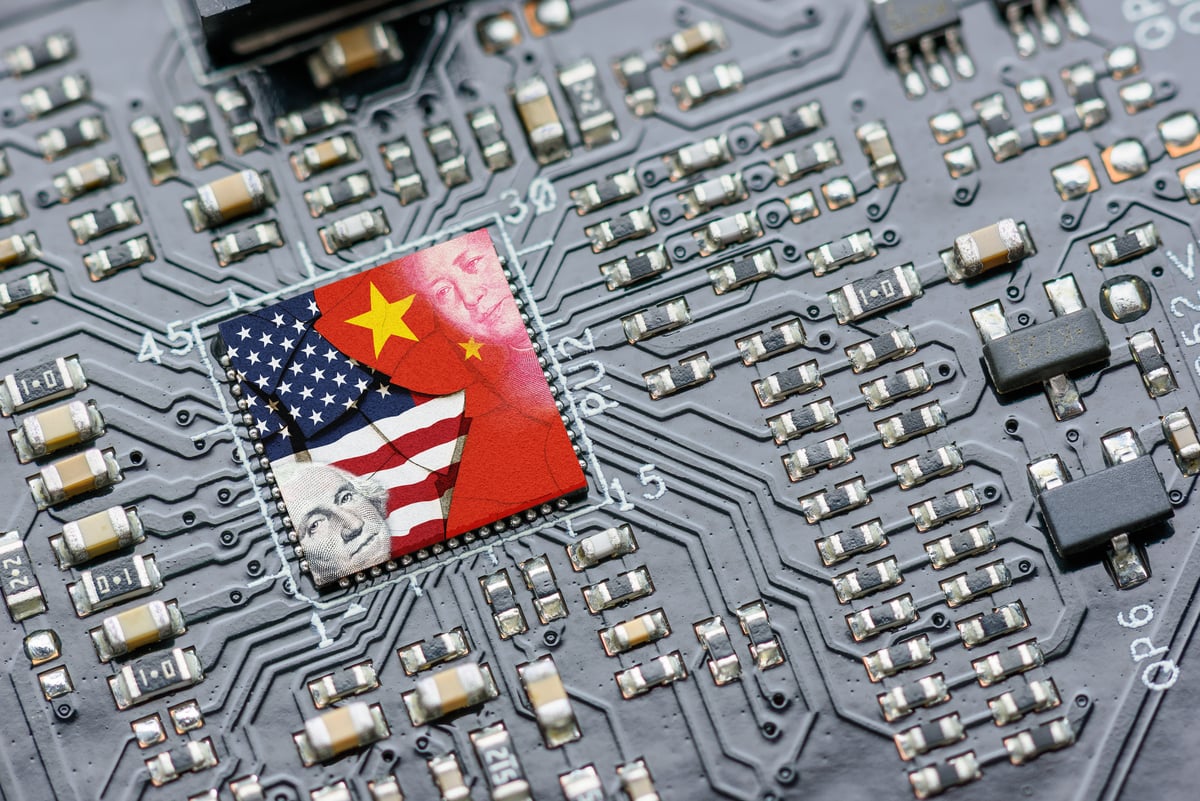
Nvidia Clears Regulatory Hurdle in China, but Questions Remain on Market Access
Nvidia Corporation ($NVDA) has received U.S. government approval to sell its advanced H200 chips to China, marking a significant development after a year-long export ban that had restricted the company's access to one of the world's most important semiconductor markets. However, despite obtaining regulatory clearance from Washington, the GPU giant still faces critical uncertainty about whether Chinese customers will actually be permitted to purchase and import the approved products—a distinction that highlights the complex geopolitical tensions surrounding semiconductor trade between the United States and China.
The approval represents a potential thaw in the restrictions imposed under the Biden administration's sweeping export controls on advanced artificial intelligence and computing chips. Yet Nvidia has made clear that regulatory approval in the U.S. does not guarantee market entry, as China's own import mechanisms and approval processes remain opaque and subject to political considerations. This approval-without-clarity dynamic underscores the precarious position many U.S. technology companies occupy as they navigate competing interests between maximizing global revenue and complying with national security frameworks.
Nvidia's Current Financial Position and China's Revenue Contribution
Despite the regulatory headwinds in China, Nvidia continues to demonstrate extraordinary financial momentum. The company reported a 73% revenue surge in its most recent quarter, driven primarily by insatiable demand for its data center chips in North America and Europe, where customers are racing to build artificial intelligence infrastructure.
China's current contribution to Nvidia's business, while meaningful, remains secondary to the company's dominant position in Western markets:
- China represented 13% of Nvidia's fiscal 2025 revenue, translating to a meaningful but non-critical portion of total sales
- Industry analysts estimate the Chinese AI market could be worth approximately $50 billion annually at maturity
- The company's overall growth trajectory appears sustainable without immediate China sales resumption
- U.S. and international markets (excluding China) continue to drive the bulk of revenue expansion
The H200 chip in question represents Nvidia's latest-generation offering for AI inference and data center applications. While less cutting-edge than the company's most advanced H100 and B100 chips, the H200 was explicitly designed to comply with export control parameters, suggesting the company anticipated eventual regulatory approval for this product tier.
Market Context: Geopolitics, Competition, and Semiconductor Trade Wars
Nvidia's China situation exists within a broader framework of U.S.-China technological competition that has dramatically reshaped the global semiconductor industry over the past two years. The export controls, first announced in October 2022 and tightened throughout 2023 and 2024, were explicitly designed to prevent advanced AI chips from enhancing China's military and surveillance capabilities.
Key market context factors:
- The Biden administration imposed restrictions targeting chips with specific computing capabilities, effectively creating a bifurcated global semiconductor market
- Chinese competitors like Huawei and Alibaba have accelerated domestic chip development efforts in response, though they remain years behind Nvidia's technology
- Advanced Micro Devices (AMD) and Intel Corporation ($INTC) have faced similar export restrictions, though AMD has received some approvals for lower-tier products
- European semiconductor companies have also encountered restrictions, reshaping the geopolitical supply chain
The approval of H200 sales could represent a subtle shift in U.S. policy—moving toward a more calibrated approach that restricts the most advanced chips while permitting slightly older generations. This middle-ground approach might be sustainable politically, allowing U.S. companies to maintain some market presence in China without compromising national security.
Investor Implications: Upside Potential Tempered by Uncertainty
For Nvidia shareholders, the H200 approval offers several possible interpretations:
Optimistic scenario: The approval could herald a gradual relaxation of export controls, potentially opening a $50 billion market that would materially boost long-term revenue growth. China's AI infrastructure buildout remains in early innings, suggesting substantial market share gains are possible for Nvidia if political conditions permit.
Conservative scenario: The approval may prove symbolic rather than commercially meaningful if Chinese regulators block imports or if the U.S. government reverses course with a new administration. The company's stock has already priced in extraordinary growth assumptions, so incremental China revenue might not move the needle significantly.
Near-term reality: Nvidia's current 73% quarterly revenue growth demonstrates the company doesn't depend on China sales to maintain momentum. The U.S. and allied nations' AI infrastructure spending remains robust, providing a growth foundation independent of China market access.
For investors seeking exposure to Nvidia's core AI momentum, the China situation represents optionality rather than a dependency. The company's valuation reflects its dominance in serving Western data centers, cloud providers, and enterprise AI adoption—all markets where Nvidia faces limited competition from Advanced Micro Devices (AMD) or other rivals.
The broader semiconductor sector may view this development more favorably, as it suggests the extreme export restrictions of 2023-2024 might not persist indefinitely. This could benefit semiconductor equipment manufacturers, materials companies, and other chip designers with China exposure.
Looking Forward: A Measured Step in a Volatile Landscape
Nvidia's H200 approval represents a measured step toward potentially normalizing U.S.-China semiconductor trade, though significant uncertainty persists about actual implementation. The company has wisely positioned itself to benefit from either scenario: if China reopens to Nvidia products, the company possesses the world's most advanced chip technology to capture share; if restrictions tighten further, Nvidia has already built an overwhelming lead in Western markets that will sustain growth for years.
For investors monitoring geopolitical risk and semiconductor supply chain dynamics, this development merits attention as a potential inflection point. However, the absence of actual Chinese customer orders and the persistent regulatory ambiguity counsel patience. Nvidia's fundamental growth story remains intact regardless of China outcomes, making this development interesting context rather than game-changing news. The real significance will only become apparent when—or if—Nvidia announces actual sales to Chinese customers, signaling that both governments have genuinely committed to a less restrictive trade posture.