
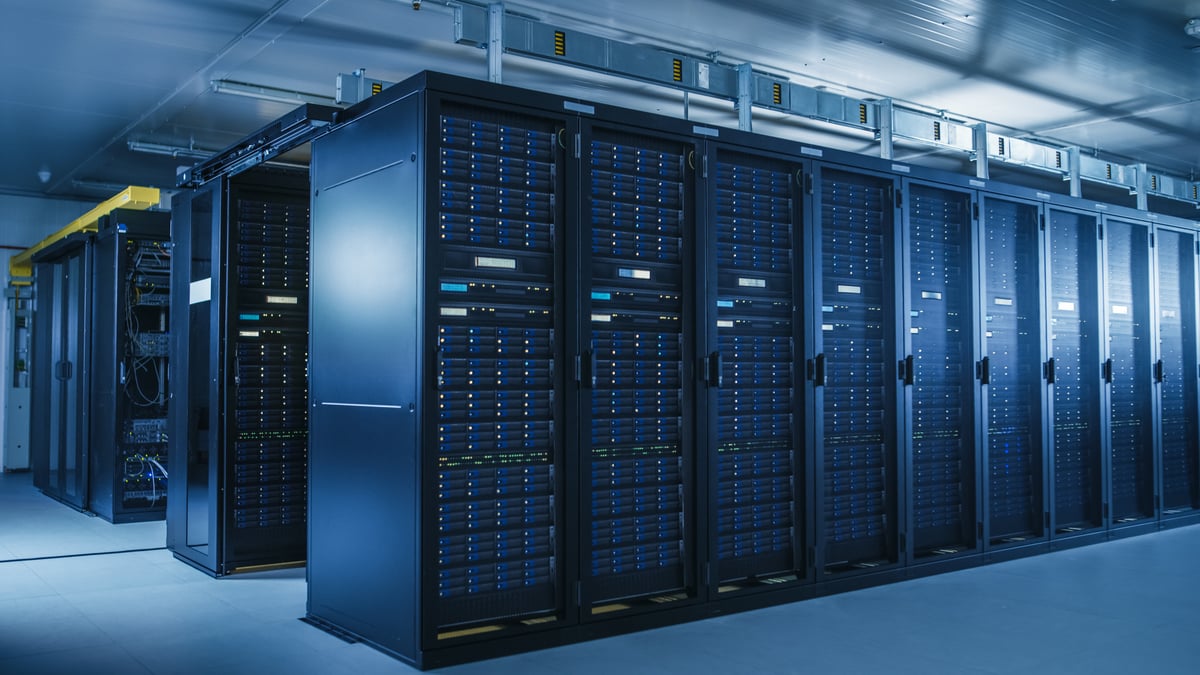
Hyperscalers' $700B Data Center Boom Creates Windfall for Infrastructure Suppliers
Major technology companies are unleashing a historic wave of capital spending on data center infrastructure, committing $700 billion in capital expenditures this year to support artificial intelligence and cloud services expansion. This generational investment cycle is creating substantial opportunities for specialized infrastructure providers—particularly Quanta Services ($PWR), Vertiv ($VRT), and Eaton ($ETN)—whose power generation, cooling, and electrical solutions are essential to building out the computational backbone of the AI era.
The scale of this spending underscores how critical physical infrastructure has become in the technology industry's transformation. As hyperscalers including Amazon, Google, Meta, and Microsoft race to build out AI capabilities and expand cloud computing capacity, they face an unprecedented challenge: the data centers that power these services require massive investments in cooling systems, power distribution, and backup generation to maintain reliability and efficiency. The three infrastructure companies positioned at the center of this demand cycle are poised to capture significant market share and revenue growth as the capital expenditure wave accelerates through 2024 and beyond.
The Scale of Hyperscaler Investment
The $700 billion annual commitment represents an extraordinary level of spending intensity by technology companies. To contextualize this figure: it dwarfs the total capital expenditure budgets of traditional heavy infrastructure sectors and reflects the urgency with which hyperscalers view data center expansion. The spending is driven by several converging factors:
- AI infrastructure demands: Training and deploying large language models and generative AI systems requires unprecedented computational power, necessitating new data center builds and retrofits of existing facilities
- Cloud service growth: Continued expansion of cloud computing services across enterprise customers drives baseline capacity requirements
- Redundancy and resilience: Geographic diversification and fault tolerance requirements mean hyperscalers cannot simply maximize utilization of existing facilities—they must build excess capacity
- Power and cooling bottlenecks: Modern data centers consume massive amounts of electricity and generate intense heat, requiring sophisticated infrastructure solutions
These capital expenditures are not evenly distributed across infrastructure providers. Instead, they flow disproportionately to companies with specialized expertise in the critical systems that make modern data centers function: power management, thermal solutions, and electrical distribution infrastructure.
The Three Winners: Specialized Exposure to Data Center Growth
Quanta Services ($PWR) represents one of the largest beneficiaries of hyperscaler infrastructure spending. As a leading provider of infrastructure solutions for the power and communications industries, Quanta has positioned itself as a preferred partner for data center construction and upgrade projects. The company's comprehensive service offerings—spanning site preparation, power infrastructure installation, and ongoing maintenance—make it essential to hyperscaler expansion plans.
Vertiv ($VRT) specializes precisely in the thermal and power infrastructure that modern data centers cannot function without. The company manufactures cooling systems, power distribution units, and monitoring solutions designed specifically for data center environments. As data centers become increasingly power-dense due to AI workloads, Vertiv's solutions address one of the most critical bottleneck: dissipating the heat generated by thousands of processors running simultaneously.
Eaton ($ETN) brings complementary electrical and power management capabilities to the infrastructure ecosystem. The company's products for power distribution, uninterruptible power supplies, and energy management are foundational to data center operations. Eaton's established relationships with major technology companies and its broad portfolio of solutions position it to capture a significant share of the infrastructure spending wave.
Together, these three companies form a natural ecosystem of suppliers addressing the full spectrum of data center infrastructure requirements. Rather than competing directly, they often work in tandem on hyperscaler projects, with each company providing specialized solutions within their domain of expertise.
Market Context and Industry Dynamics
The data center infrastructure market exists within a broader context of technological transformation and competitive pressure among hyperscalers. Several market dynamics amplify the significance of the current spending cycle:
Competitive acceleration: The emergence of advanced AI models and their commercial applications has created a winner-take-most dynamic in cloud computing. Companies that cannot rapidly scale AI infrastructure risk losing market share to faster-moving competitors, creating urgency around capital spending decisions.
Supply chain constraints: Data center construction and infrastructure installation have become bottlenecks themselves. Hyperscalers are competing for limited construction capacity, engineering expertise, and manufacturing output from infrastructure suppliers—giving providers like Quanta, Vertiv, and Eaton substantial pricing power.
Energy and efficiency considerations: Data centers consume enormous amounts of electricity. Regulators, investors, and customers increasingly scrutinize the environmental impact of cloud computing infrastructure. This creates demand for advanced cooling and power optimization solutions that help hyperscalers reduce energy consumption—a sweet spot for Vertiv's thermal management expertise.
Real estate constraints: The physical footprint required for data centers remains significant, and prime locations near fiber optic infrastructure and power sources have become scarce. This geographic constraint means that every available site must maximize computational density, driving demand for more sophisticated power and cooling solutions.
Investor Implications and Market Opportunity
For investors, the infrastructure supply opportunity represents a structural tailwind that extends across multiple market cycles. Unlike single-product cyclical businesses, these companies benefit from sustained demand driven by fundamental shifts in how computation and data storage are organized.
The investment thesis breaks down into several components:
- Revenue growth visibility: Hyperscalers have publicly signaled elevated capital spending plans extending multiple years into the future, providing unusual clarity about demand trends for infrastructure suppliers
- Margin expansion potential: As these companies scale operations to meet demand, fixed costs are absorbed across larger revenue bases, potentially expanding profitability
- Market concentration benefits: The handful of infrastructure providers with the scale and expertise to serve hyperscalers operates with limited direct competition, supporting pricing discipline
- Secular tailwinds: The long-term growth of AI, cloud computing, and data-intensive applications suggests sustained infrastructure demand extending beyond the current cycle
However, investors should remain attentive to execution risks. Quanta, Vertiv, and Eaton must all successfully scale operations without sacrificing quality or project delivery timelines. Supply chain disruptions in critical components—power equipment, electronics, manufacturing capacity—could constrain their ability to fully capitalize on the opportunity.
Additionally, as capital intensity in the data center sector increases, potential regulatory scrutiny around environmental impact, electricity usage, and land use could introduce new constraints or requirements that favor certain infrastructure solutions over others.
The $700 billion spending commitment by hyperscalers represents a defining investment opportunity for the specialized infrastructure providers positioned to serve the industry. As artificial intelligence continues reshaping the technology landscape, the unglamorous but essential business of moving power, cooling systems, and managing electrical distribution will prove as critical as the computing hardware and software innovations capturing headlines. For investors seeking exposure to the AI infrastructure boom, the three companies positioned at the center of hyperscaler expansion plans warrant serious consideration.