
Ford Shifts Strategy with Aggressive Push into Mass-Market Electric Vehicles
Ford Motor Company is making a decisive strategic pivot that could reshape its competitive position in the electric vehicle market. The automotive giant is redirecting its focus away from premium EVs to concentrate on a $5 billion investment in affordable electric vehicles built on its new Universal EV Platform. This fundamental shift in product strategy reflects Ford's recognition that the future of electrification lies not in luxury segments, but in democratizing EV technology for mainstream consumers—a market where Chinese competitors are already establishing dominance.
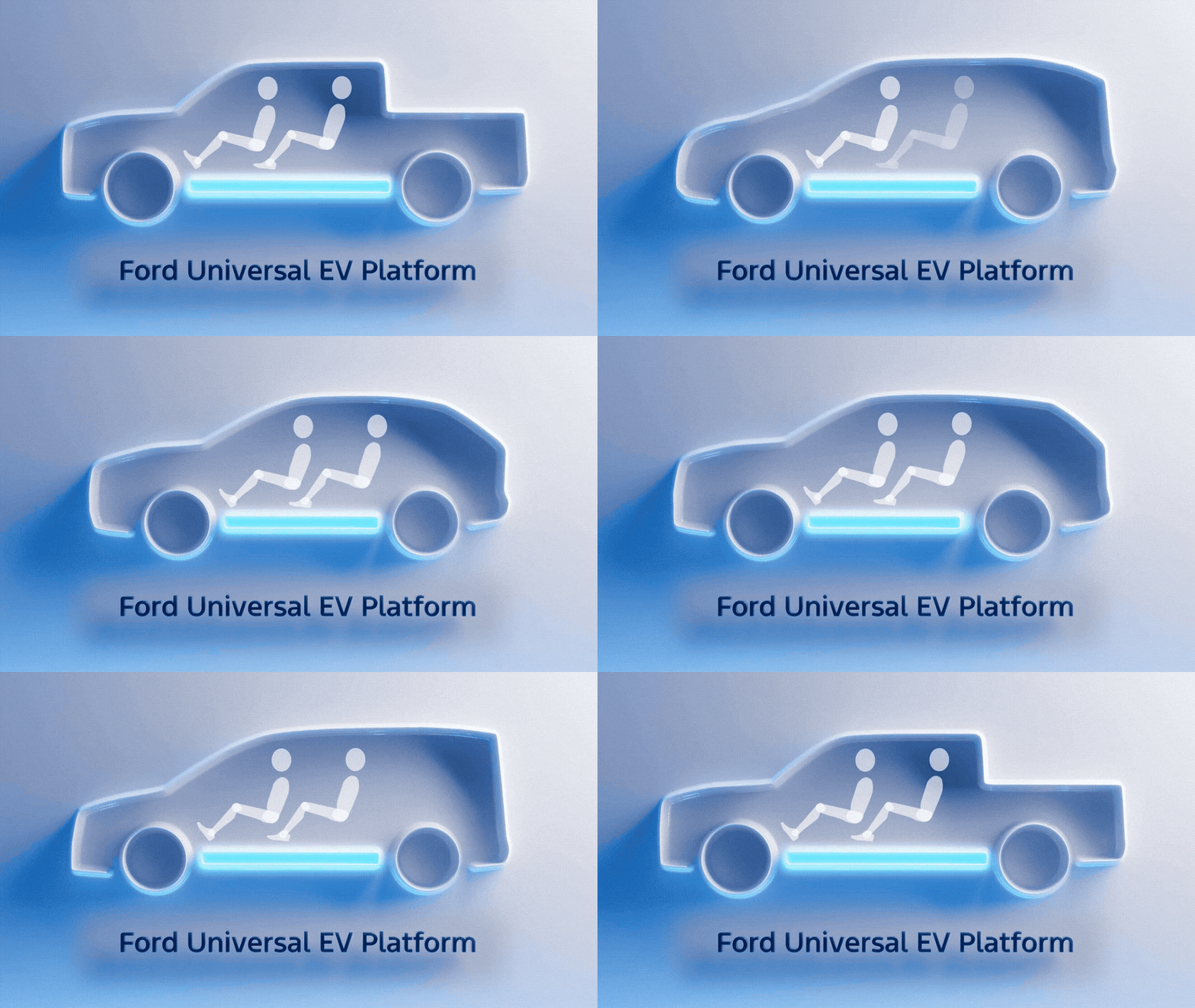
The centerpiece of Ford's transformation is an ambitious product roadmap that begins with the launch of a $30,000 electric pickup truck next year, marking a significant entry point for price-conscious buyers. Following this flagship vehicle, Ford plans to introduce crossovers and sedans built on the same platform by the end of the decade. This phased approach suggests the company is not simply reacting to market pressures but executing a carefully calibrated strategy to establish manufacturing capabilities and consumer demand at multiple price points simultaneously.
The Universal EV Platform: Manufacturing Revolution
At the core of Ford's transformation is the Universal EV Platform, which represents far more than incremental product development. This platform embodies a fundamental redesign of both the company's engineering architecture and manufacturing processes. By consolidating vehicle design onto a single flexible platform, Ford can dramatically reduce production complexity, lower per-unit manufacturing costs, and accelerate time-to-market for new models—critical advantages in a rapidly evolving competitive landscape.
The platform's flexibility allows Ford to produce vehicles across multiple segments—pickups, crossovers, and sedans—using substantially shared components and manufacturing infrastructure. This approach mirrors the playbook successfully deployed by Chinese EV manufacturers like BYD and NIO, which have leveraged platform standardization to achieve cost efficiencies that Western automakers historically struggled to match. The $5 billion commitment signals Ford's serious investment in competing on cost structure, not simply on brand heritage or technology differentiation.
The timing of this investment carries particular significance. As EV adoption accelerates globally and regulatory pressures intensify—with multiple jurisdictions implementing increasingly stringent emissions standards—Ford is hedging against potential future EV regulation changes by establishing manufacturing scale in the affordable segment where regulatory compliance translates directly into mass-market demand.
Market Context: Facing the Chinese EV Challenge
Ford's strategic reorientation must be understood within the context of seismic shifts in the global automotive industry. Chinese EV manufacturers have achieved extraordinary market penetration by focusing precisely on the affordable segment that Ford is now prioritizing. Companies like BYD, which surpassed Tesla ($TSLA) in EV deliveries during 2023, have demonstrated that battery technology, manufacturing efficiency, and distribution networks can combine to create formidable competitive advantages at lower price points.
The traditional American and European automakers initially pursued premium EV strategies—positioning electric vehicles as aspirational, technology-forward products commanding premium pricing. However, this approach ceded the high-volume, highest-growth segments to Chinese competitors who recognized that EV market expansion would ultimately be driven by affordability, not exclusivity. Ford's pivot acknowledges this market reality and positions the company to compete directly in segments where volume opportunities are exponentially larger than in premium categories.
Key market dynamics supporting Ford's strategy:
- Global EV adoption: Affordable EVs represent the fastest-growing segment of the electric vehicle market
- Battery cost reduction: Continuing improvements in battery manufacturing have made sub-$30,000 price points technically feasible
- Regulatory momentum: Multiple major markets are implementing stricter emissions standards requiring manufacturers to shift production toward electrification
- Consumer demand shift: Mass-market buyers increasingly view EVs as practical alternatives rather than luxury purchases
- Chinese competition intensity: BYD, NIO, and emerging competitors are establishing distribution networks across developed markets
Investor Implications and Path to Profitability
For Ford shareholders, this strategic reorientation carries both opportunities and risks that merit serious consideration. The opportunity is substantial: the affordable EV segment represents exponentially larger addressable markets than premium segments, and Ford's manufacturing heritage and distribution network could translate into significant competitive advantages against newer entrants lacking automotive production expertise.
However, the path to profitability in mass-market EVs is more challenging than in premium segments. Margins compress dramatically at lower price points, requiring extraordinary manufacturing efficiency and supply chain optimization. The $5 billion investment must generate sufficient manufacturing scale and operational efficiency to achieve acceptable returns on capital—a feat that has proven elusive for many traditional automakers transitioning to EV production.
The universal platform approach also reduces Ford's product differentiation flexibility, potentially constraining premium pricing strategies. Success will depend on execution across multiple dimensions:
- Manufacturing cost reduction: Achieving manufacturing cost structures competitive with Chinese producers
- Supply chain security: Securing stable, affordable access to battery cells and critical minerals
- Quality and reliability: Establishing EV product quality that supports brand reputation and resale values
- Distribution and service: Building service infrastructure to support affordable EV ownership
- Capital efficiency: Ensuring the $5 billion investment delivers adequate return on invested capital
The competitive landscape also matters. General Motors ($GM) and Volkswagen ($VOLKSWAGEN) are pursuing similar mass-market EV strategies, creating a crowded field where only the most efficient producers will achieve acceptable profitability. Ford's historical cost structure advantages relative to pure EV startups could prove decisive, but disadvantages relative to Chinese manufacturers with lower labor costs remain significant.
Forward-Looking Assessment
Ford Motor Company's $5 billion commitment to affordable electric vehicles through the Universal EV Platform represents a decisive strategic choice with far-reaching implications for the automotive industry and Ford's long-term competitive position. By shifting focus from premium EVs to mass-market vehicles, Ford is acknowledging market realities that Chinese competitors identified earlier and are capitalizing upon more aggressively.
The success of this strategy will determine whether traditional automakers can compete effectively in the high-volume EV segments that will define the industry's future profitability. The $30,000 electric pickup truck launching next year will serve as a critical test case—both for Ford's manufacturing capabilities and for American consumer appetite for affordable electric vehicles. In an industry where competitive advantages are increasingly determined by cost structure and manufacturing efficiency rather than brand heritage alone, Ford's execution on this platform commitment will likely determine its relevance in the automotive industry for decades to come. Investors should monitor upcoming quarterly results for evidence of platform efficiency gains and market reception of affordable EV products as concrete indicators of strategy execution.