
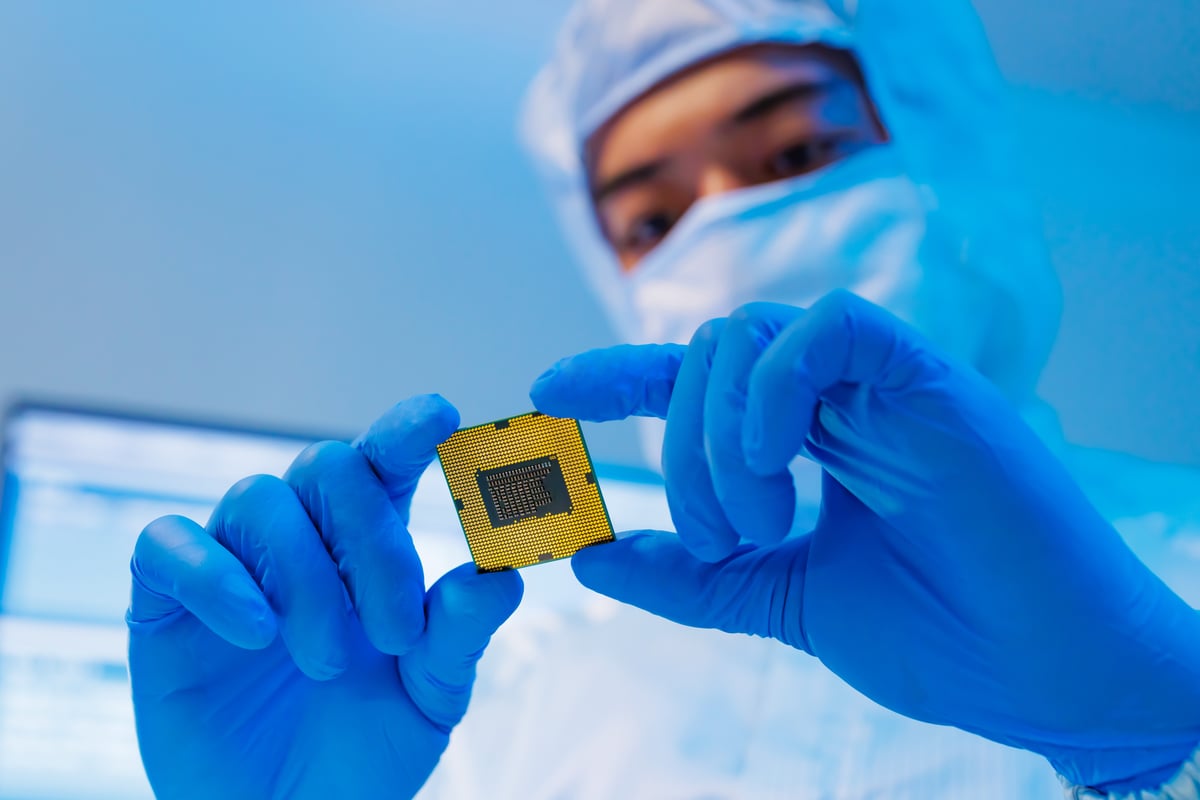
Taiwan's Chip Giant Positioned to Dominate AI Era
Taiwan Semiconductor Manufacturing Company ($TSM) stands as the primary beneficiary of the artificial intelligence revolution, according to market analysis, given its unique position as the world's leading independent chip fabricator serving virtually all major computing companies driving the AI buildout. As Nvidia ($NVDA), AMD ($AMD), and Broadcom ($AVGO) race to meet explosive demand for AI-capable processors, TSMC remains the critical intermediary—the only company capable of manufacturing cutting-edge chips at the scale required by these industry giants. With the global AI infrastructure spending expected to reach $7 trillion cumulatively by 2030 and AI-specific chip revenue projected to grow at approximately 60% compound annual growth rate (CAGR) through 2029, TSMC is positioned to capture a disproportionate share of value creation across the next decade.
The Semiconductor Supply Chain Bottleneck
TSMC's dominance stems from its irreplaceable role in global semiconductor manufacturing. As the world's largest dedicated foundry—a company that manufactures chips designed by other companies rather than designing its own—TSMC operates with near-monopolistic advantages that few industries can match:
- Process technology leadership: The company maintains the most advanced chip fabrication capabilities on Earth, enabling production of the 3-nanometer and smaller chips essential for modern AI accelerators
- Unmatched capacity: TSMC commands approximately 54% of the global foundry market, dwarfing competitors like Samsung and Intel's foundry division
- Neutrality advantage: Unlike Samsung or Intel, which design and manufacture their own chips, TSMC's independence allows it to serve all competitors equally, making it an indispensable partner rather than a threatening rival
- Manufacturing expertise: Years of process optimization and quality control create switching costs that make transitioning to competitors economically irrational for TSMC's customers
This structural positioning has transformed TSMC into what might be termed the "tollbooth" of the AI revolution. Every major AI chip manufacturer must pass through its fabs, or face severe competitive disadvantages. Nvidia's dominance in AI accelerators depends entirely on TSMC's ability to manufacture its chips. AMD's efforts to compete in the data center market rest on the same foundation. Broadcom, which supplies networking infrastructure for AI data centers, faces identical dependencies.
Market Context: The $7 Trillion AI Opportunity
The financial opportunity driving TSMC's positioning is historically significant. Industry forecasts project $7 trillion in cumulative AI-related spending through 2030, representing an investment cycle unprecedented in modern technology history. This spending encompasses:
- AI-capable chip manufacturing and design (where TSMC extracts maximum value)
- Data center infrastructure buildout by hyperscalers like Microsoft, Google, and Amazon
- Software and services layers built atop AI foundation models
- Edge computing and distributed AI deployment
The AI chip segment specifically is expected to generate compound annual growth of approximately 60% through 2029, far outpacing traditional semiconductor industry growth rates of 5-10%. This explosive growth reflects the economic value of AI capabilities and the willingness of technology companies to spend aggressively on competitive advantages.
Competitors in related sectors face constraints that TSMC avoids. Intel ($INTC) struggles with its own manufacturing operations while attempting to build a foundry business. Samsung must balance foundry operations against its own chip design ambitions. Chinese competitors like SMIC lack the advanced process technology necessary for cutting-edge AI chips. TSMC faces no such conflicts or technological limitations.
Valuation and Investment Thesis
Despite its commanding market position, TSMC trades at 25x forward earnings—a premium valuation that requires justification. The investment case rests on several factors:
Revenue growth visibility: With AI chip demand expected to grow at 60% CAGR through 2029, TSMC can sustain double-digit revenue growth for the remainder of the decade, well above historical semiconductor industry averages.
Margin expansion potential: As TSMC utilizes advanced fabs at high capacity utilization rates, manufacturing margins should expand. The company currently operates at near-full capacity, with customers accepting extended lead times—a pricing power indicator.
Competitive moat deepening: The more advanced TSMC's process technology becomes, the wider the gap widens between TSMC and second-tier competitors. This dynamic makes TSMC more valuable, not less, as the AI cycle progresses.
Geopolitical premium: As policymakers worldwide recognize semiconductor manufacturing as critical infrastructure, governments provide incentives for TSMC expansion. The U.S. government funded TSMC fab construction in Arizona, reducing the company's capital requirements while enhancing its geopolitical importance.
The 25x forward earnings valuation reflects market recognition of these dynamics, yet remains justified by growth prospects. If TSMC achieves 60% AI chip revenue CAGR through 2029, earnings growth will far exceed historical rates, potentially expanding the valuation multiple rather than compressing it.
Looking Forward: The AI Buildout Intensifies
The next five to seven years will determine whether TSMC successfully captures the full value of the AI revolution. Risks exist—process technology delays could weaken competitive advantages, geopolitical tensions could disrupt operations or markets, and customer concentration (with Nvidia and other large customers representing significant revenue portions) creates dependency risks in both directions.
However, the structural fundamentals remain compelling. TSMC operates in an industry where supply constraints, not demand, represent the limiting factor. The company controls the bottleneck resource—advanced semiconductor manufacturing capacity—at precisely the moment when global demand for that resource is experiencing unprecedented growth. With $7 trillion in cumulative AI spending projected through 2030 and AI chip growth expected to sustain 60% CAGR, TSMC is positioned to deliver returns aligned with or exceeding its premium valuation. For investors seeking exposure to the AI transformation, TSMC represents the most direct and defensible way to participate in the coming decade's technology buildout.